LY2109761 from Selleck dual TGFR-I/II inhibition suppresses triple-negative breast cancer progression
Copy code to add this image to your page
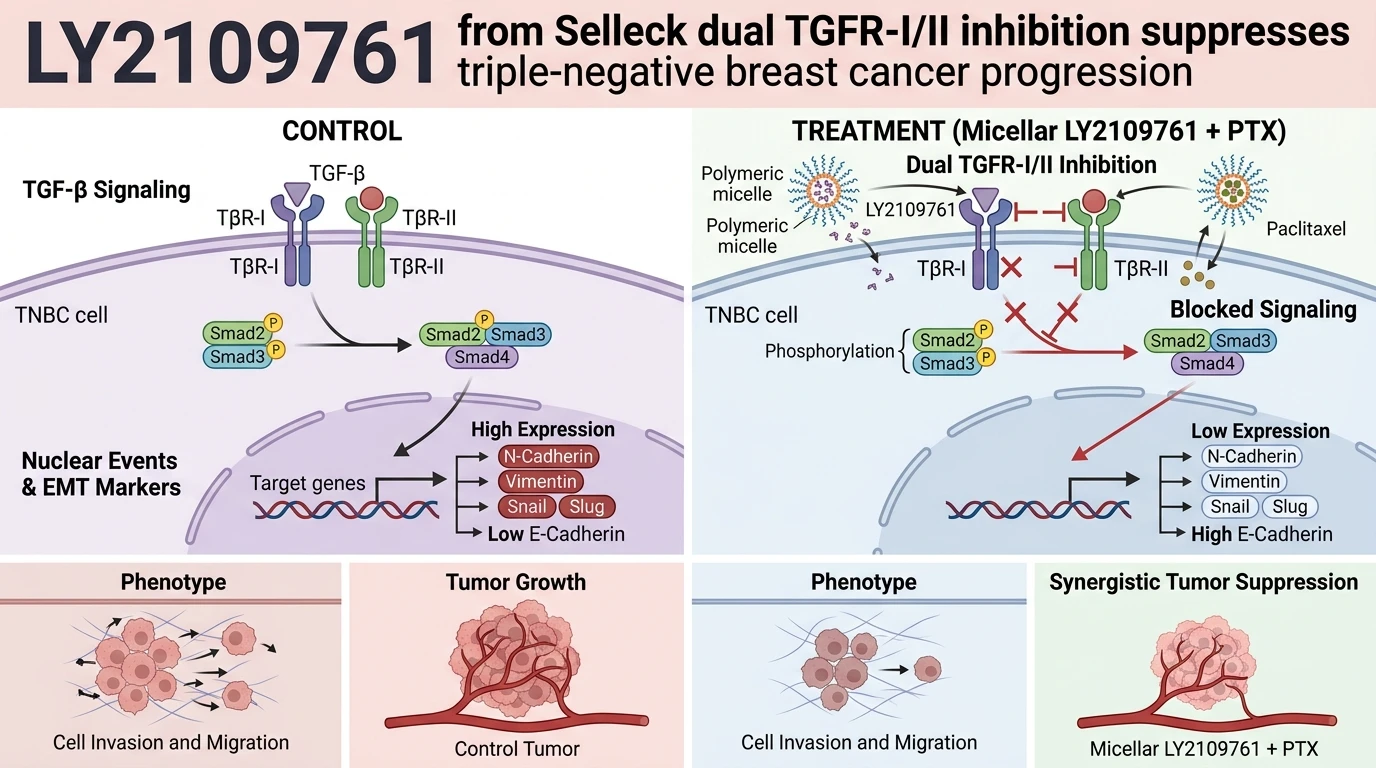
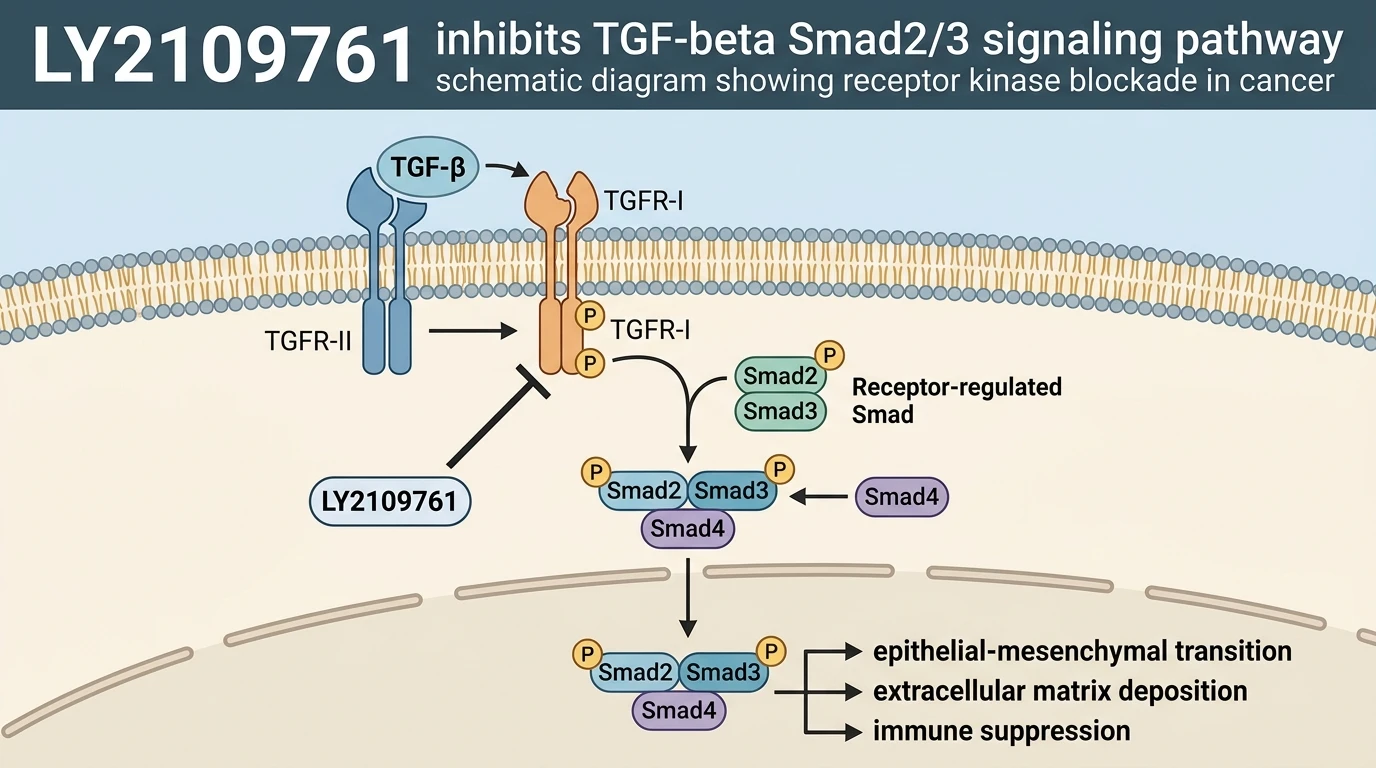
Transforming growth factor-beta (TGF-beta) signaling plays a complex, context-dependent role in cellular homeostasis and oncogenesis. In advanced malignancies, particularly triple-negative breast cancer (TNBC), canonical TGF-beta signaling transitions from a tumor-suppressive axis into a primary driver of aggressive disease phenotypes. Ligand binding induces the assembly of a heterotetrameric receptor complex on the plasma membrane. This complex consists of two TGF-beta receptor type II (TGFR-II) subunits and two TGF-beta receptor type I (TGFR-I) subunits. Upon ligand engagement, TGFR-II transphosphorylates TGFR-I within its glycine-serine-rich (GS) domain, activating the intracellular kinase domain of TGFR-I. Activated TGFR-I subsequently binds and phosphorylates C-terminal serine residues on receptor-regulated Smad proteins, specifically Smad2 (at Ser465/467) and Smad3 (at Ser423/425). Phosphorylated Smad2 and Smad3 dissociate from the receptor complex and associate with the common mediator Smad4. This heteromeric Smad complex translocates into the cell nucleus, binding specific DNA motifs and recruiting transcriptional co-activators or co-repressors. These nuclear events drive epithelial-mesenchymal transition (EMT), expand cancer stem cell populations, induce extracellular matrix remodeling, and enforce an immunosuppressive microenvironment.
Targeting receptor kinase domains provides a direct strategy to arrest this pro-metastatic cascade. LY2109761 is an ATP-competitive, dual-kinase inhibitor engineered to target the intracellular catalytic domains of both TGFR-I and TGFR-II. By occupying the ATP-binding pockets of both receptor subunits, the compound blocks autophosphorylation and heteroreceptor transphosphorylation events necessary for signal propagation. Utilizing high-purity LY2109761 from Selleck allows researchers to interrogate receptor cross-talk and establish the precise kinetics of canonical pathway suppression. Blockade of TGFR-I and TGFR-II kinase activity prevents downstream Smad2/3 phosphorylation, halting assembly of the functional Smad2/3-Smad4 complex. Consequently, nuclear transcription of EMT master regulators—including Snail, Slug, and Zeb1—is repressed, leading to the preservation of epithelial architecture and reduction of metastatic propensity.
Despite clear mechanistic rationale, clinical translation of hydrophobic small molecules like LY2109761 faces hurdles regarding systemic solubility and delivery efficiency. Unformulated hydrophobic drugs often exhibit erratic pharmacokinetics and limited tumor accumulation. Polymeric nanocarrier platforms offer a viable method to mitigate these biophysical barriers. Encapsulation of the inhibitor into amphiphilic poly(2-oxazoline) (POx) polymeric micelles yields a nanomedicine formulation designated LY-POx. This delivery strategy enhances aqueous solubility, prolongs systemic circulation time, and maintains steady target engagement at tumor sites.
In vitro evaluation confirmed the functional activity of LY-POx in cell culture systems. In TGF-beta-stimulated NIH-3T3 fibroblasts, treatment with LY-POx resulted in concentration-dependent suppression of Smad2/3 phosphorylation. Translating these findings in vivo involved testing immunocompetent murine TNBC models, including 4T1, T11-Apobec, and T11-UV carcinomas. LY-POx monotherapy demonstrated subtype-dependent antitumor activity, reflecting variable baseline signaling dependencies across distinct genetic backgrounds. To counter resistance mechanisms, combination regimens pairing LY-POx with micellar paclitaxel (PTX-POx) were investigated. Cytotoxic chemotherapy often induces stress-mediated TGF-beta release, driving residual cells toward EMT and chemoresistance. Co-administration of LY-POx with PTX-POx suppressed primary tumor growth and reduced pulmonary metastases across tested TNBC subtypes, establishing the utility of dual TGFR-I/II inhibition alongside micellar chemotherapy delivery.
Pharmacological Synthesis and Polymeric Nanocarrier Evaluation
Copy code to add this image to your page
LY2109761 functions as a competitive dual inhibitor of TGFR-I and TGFR-II kinase activities. By preventing ligand-induced receptor autophosphorylation and subsequent phosphorylation of downstream Smad2 and Smad3 proteins, the molecule blocks nuclear translocation of the Smad2/3-Smad4 transcriptional complex. In triple-negative breast cancer models, this pathway blockade represses epithelial-mesenchymal transition transcriptional networks, curtails cancer stem cell self-renewal, and relieves microenvironmental immunosuppression.
Polymeric Micellar Encapsulation Restores Aqueous Solubilization and Kinase Blockade
Hydrophobic small molecules targeting membrane-bound kinase domains frequently suffer from low aqueous solubility. Encapsulating LY2109761 from Selleck into poly(2-oxazoline) (POx) polymeric micelles successfully circumvented precipitation issues in aqueous media. Under tested in vitro assay conditions utilizing NIH-3T3 fibroblasts, exogenous TGF-beta exposure elicited rapid C-terminal phosphorylation of Smad2 and Smad3. Treatment with LY-POx potently suppressed this phosphorylation event. Kinase inhibition occurred within minutes of administration. Western blot analysis confirmed complete attenuation of phospho-Smad2/3 signals at low nanomolar concentrations. The delivery vehicle retained high drug loading efficiency without compromising the intrinsic catalytic inhibition profile of the active agent.
Subtype-Dependent Monotherapy Efficacy in Syngeneic Murine Mammary Carcinoma Models
Translating dual TGFR-I/II blockade into complex biological systems revealed significant variation across distinct tumor backgrounds. In immunocompetent mouse models of triple-negative breast cancer—specifically 4T1, T11-Apobec, and T11-UV—systemic monotherapy with LY-POx yielded divergent primary tumor responses. Tumor volume measurements indicated modest growth retardation in 4T1 syngeneic grafts. Conversely, T11-Apobec tumors exhibited marked sensitivity to single-agent administration. Phenotypic evaluation showed reduced mesenchymal marker expression within responsive cohorts. These empirical observations highlight that baseline TGF-beta signaling dependencies dictate single-agent sensitivity within heterogeneous TNBC microenvironments.
Chemo-Immunotherapeutic Synergy with Micellar Paclitaxel Attenuates Primary and Metastatic Burden
Chemotherapy-induced stress often triggers compensatory cytokine release within the tumor microenvironment. Combining LY2109761 from Selleck in its POx micellar formulation (LY-POx) with micellar paclitaxel (PTX-POx) altered disease progression dynamics in vivo. The dual-combination regimen produced robust, consistent inhibition of primary tumor burden across all tested TNBC syngeneic models. Primary tumor volume declined significantly compared to monotherapy arms. Spontaneous lung metastasis was markedly suppressed. Mechanistic analyses confirmed that blocking canonical TGF-beta/Smad signaling impeded taxane-induced epithelial-mesenchymal transition. Simultaneously, target engagement alleviated local microenvironmental immunosuppression, facilitating cytotoxic T-lymphocyte infiltration into the primary lesion.