Troglitazone (CS-045) targeting PPAR-γ regulates metabolic pathways and cutaneous inflammatory cascades
Copy code to add this image to your page
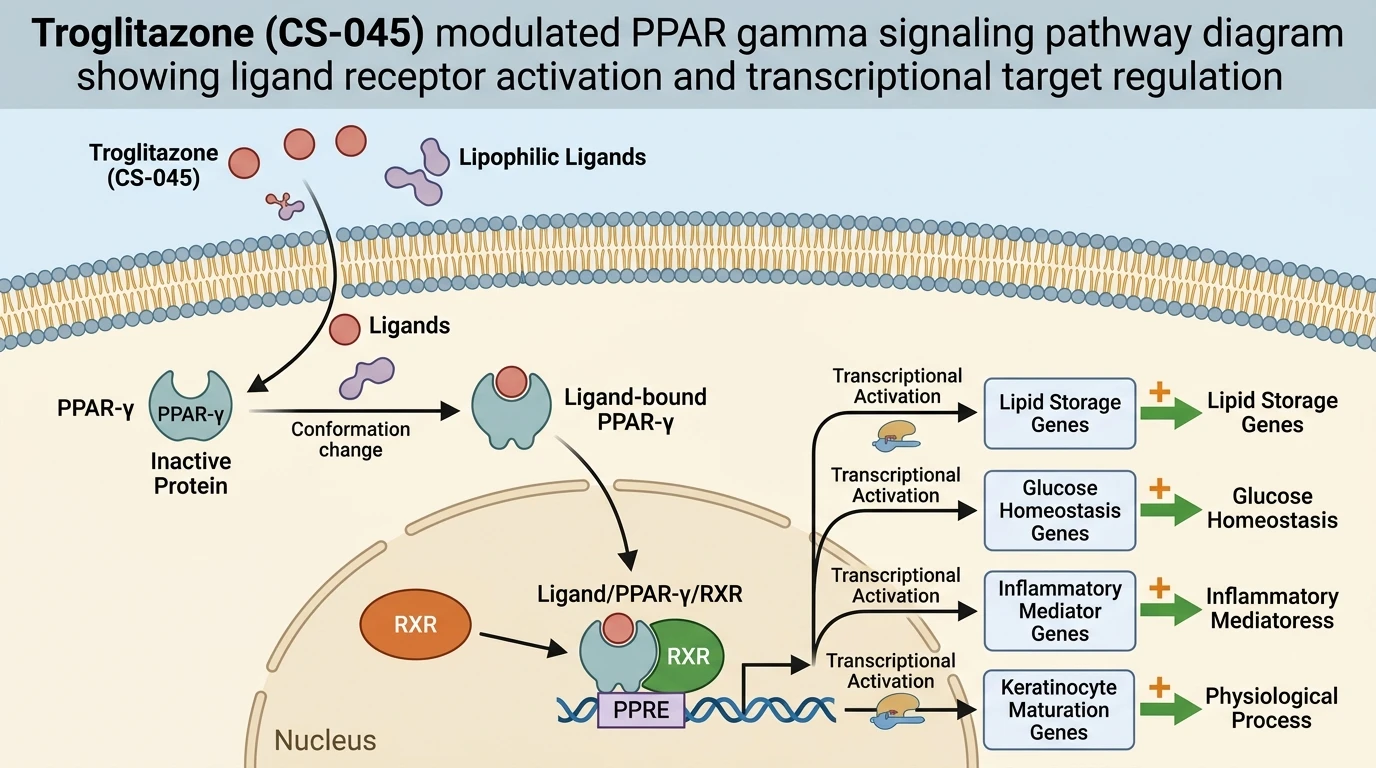
Troglitazone (CS-045) is a synthetic thiazolidinedione class ligand that functions as a high-affinity agonist for peroxisome proliferator-activated receptor gamma (PPAR-γ). PPAR-γ belongs to the nuclear receptor superfamily of ligand-activated transcription factors. Under baseline cellular conditions, unliganded PPAR-γ remains bound to corepressor complexes containing nuclear receptor corepressor (NCoR) and silencing mediator for retinoid and thyroid receptors (SMRT). These corepressors maintain chromatin in a condensed, transcriptionally inactive state through histone deacetylase activity. Binding of CS045 to the C-terminal ligand-binding domain (LBD) of PPAR-γ induces a conformational shift in helix 12. This conformational change triggers corepressor dissociation and facilitates the recruitment of transcriptional coactivators, including steroid receptor coactivator-1 (SRC-1) and peroxisome proliferator-activated receptor gamma coactivator-1 alpha (PGC-1α).
Following coactivator assembly, liganded PPAR-γ obligatorily heterodimerizes with the retinoid X receptor alpha (RXR-α). The resulting heterodimer translocates to the nucleus and binds to canonical peroxisome proliferator response elements (PPREs) located within promoter regions of target genes. PPREs consist of direct repeats of the hexameric nucleotide consensus sequence AGGTCA separated by a single nucleotide spacer. Genomic binding at PPRE sites drives differential gene expression patterns involved in glucose transport, lipid sequestration, cellular differentiation, and anti-inflammatory cascades.
In adipocytes and skeletal muscle tissues, target engagement by Troglitazone (CS-045) enhances insulin sensitivity and rewires metabolic flux. Transcriptional upregulation of fatty acid translocase (FAT/CD36) and lipoprotein lipase (LPL) promotes systemic free fatty acid uptake into adipose depots. This action lowers circulating plasma free fatty acids and triglycerides. Concurrently, upregulation of glucose transporter 4 (GLUT4) increases peripheral glucose disposal without stimulating pancreatic insulin secretion. In lipid metabolism pathways, PPAR-γ activation enhances ATP-binding cassette transporter A1 (ABCA1) transcription. This shift facilitates reverse cholesterol transport and raises circulating high-density lipoprotein (HDL) levels while decreasing low-density lipoprotein (LDL) concentrations in preclinical animal models.
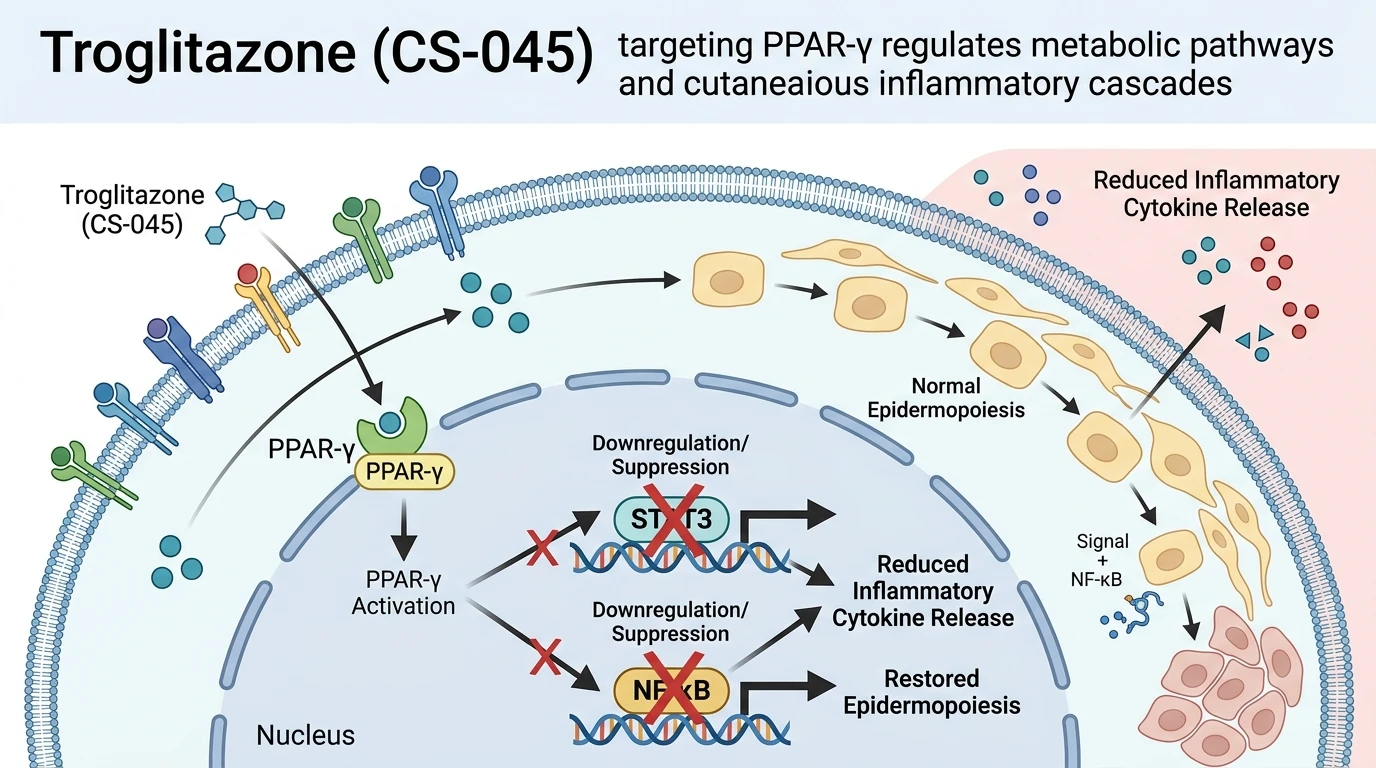
Beyond systemic metabolic control, PPAR-γ signaling plays a fundamental regulatory role in epidermal biology and cutaneous inflammation. In human epidermal keratinocytes, activation of PPAR-γ by CS045 attenuates hyperproliferative signal transduction cascades. Downstream of ligand binding, PPAR-γ engages in direct transcriptional transrepression. Liganded PPAR-γ sequesters nuclear factor kappa B (NF-κB) p65/p50 heterodimers and activator protein 1 (AP-1) transcription factors. This interaction prevents these transcription factors from binding to promoter regions of pro-inflammatory genes. Consequently, transcription of key cytokines including interleukin-1 beta (IL-1β), interleukin-6 (IL-6), and tumor necrosis factor-alpha (TNF-α) decreases significantly.
In psoriatic epidermal models, aberrant signal transducer and activator of transcription 3 (STAT3) signaling drives rapid keratinocyte proliferation and incomplete differentiation. Exposure to Troglitazone (CS-045) suppresses STAT3 tyrosine phosphorylation in cultured human keratinocytes. This signal inhibition downregulates cyclin D1 expression, enforcing G1 phase cell cycle arrest. Simultaneously, PPAR-γ activation restores keratinocyte differentiation markers, including keratin 1, keratin 10, and involucrin. Cellular turnover rates normalize under these experimental conditions. Furthermore, reduced secretion of vascular endothelial growth factor (VEGF) from keratinocytes restricts cutaneous angiogenesis within inflammatory skin microenvironments.
Experimental observations indicate that PPAR-γ agonists alter the metabolic status of activated T lymphocytes within psoriatic plaques. Inhibiting glycolytic flux in infiltrating effector T cells reduces interleukin-17A (IL-17A) and interleukin-22 (IL-22) production. This dual action on keratinocytes and immune cell subsets highlights a coupled mechanism where lipid metabolic reprogramming directly modulates inflammatory disease severity. Primary preclinical evaluations confirm that PPAR-γ targeting attenuates epidermal thickness and scaling in xenograft models of psoriasis. These biochemical metrics demonstrate that troglitazone and related glitazones exert targeted pharmacological control over metabolic dysregulation and hyperproliferative skin disorders.
Pharmacological Modulation of Metabolic and Epidermal Homeostasis
Copy code to add this image to your page
Troglitazone (CS-045) functions as a selective PPAR-γ agonist, driving heterodimerization with RXR and binding to PPRE promoter elements. This activation promotes lipid clearance, reduces serum triglycerides and LDL, and elevates HDL levels. Simultaneously, PPAR-γ engagement transrepresses NF-κB inflammatory signaling, downregulating TNF-α and IL-6 production. In cutaneous tissue, this dual transcriptional control suppresses keratinocyte hyperproliferation and fosters cell differentiation, addressing both metabolic lipid abnormalities and psoriatic lesion severity.
PPAR-γ Activation Directs Transcriptional Reprogramming of Lipid Metabolism
Troglitazone functions as a synthetic agonist selective for PPAR-γ. Upon binding to the nuclear receptor, CS045 stabilizes the active conformation of the ligand-binding domain. This structural transition promotes RXR heterodimerization. The resulting complex binds regulatory PPRE sequences across diverse metabolic genes. Transcription of lipoprotein lipase and fatty acid translocase increases rapidly. Concurrently, hepatic triglyceride secretion declines under tested assay conditions. Circulating low-density lipoprotein levels drop markedly. Plasma high-density lipoprotein concentrations show sustained elevation. These metabolic alterations mitigate systemic lipid dysregulation. Free fatty acid clearance accelerates in peripheral tissue beds.
Transrepression of Inflammatory Cascades Suppresses Psoriatic Plaque Pathogenesis
Beyond metabolic governance, target engagement drives pronounced anti-inflammatory signaling cascades. Ligand-bound PPAR-γ blocks NF-κB transactivation via direct physical co-repressor stabilization. Cytokine expression decreased significantly in treated keratinocyte lines. Interleukin-6 and TNF-α levels dropped steadily during prolonged incubation. Downstream STAT3 activation ceased within hours of exposure. This transcriptional arrest suppresses epidermal hyperproliferation in psoriatic lesion models. Microvascular remodeling also showed marked attenuation. Furthermore, cellular apoptosis increased among dysregulated epidermal populations. These observed pharmacological actions establish a mechanistic link between lipid modulation and cutaneous lesion resolution.