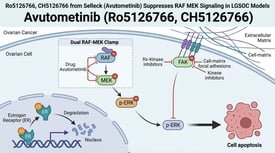
Raf Inhibitors
The Raf (Rapidly Accelerated Fibrosarcoma) family of serine/threonine kinases, comprising A-Raf, B-Raf, and C-Raf (Raf-1), serves as a crucial intermediary in the canonical Ras-Raf-MEK-ERK signaling pathway. Among these, B-Raf is the most significant driver of human oncogenesis, with the V600E mutation occurring in approximately 50% of cutaneous melanomas and at lower frequencies in colorectal, thyroid, and lung cancers. This mutation results in a constitutively active monomeric kinase that bypasses the need for upstream Ras activation, leading to uncontrolled cellular proliferation and survival. The development of Raf inhibitors has been a landmark achievement in molecularly targeted therapy, transitioning melanoma from a largely untreatable disease to one with manageable therapeutic options. The first generation of B-Raf-selective inhibitors, including vemurafenib and dabrafenib, are Type I inhibitors that specifically target the active conformation of the V600E mutant kinase. While these drugs show remarkable initial responses, their use as monotherapy is limited by the rapid emergence of resistance and a unique phenomenon known as paradoxical ERK activation.
In cells with wild-type B-Raf and upstream Ras mutations, these inhibitors can actually induce the dimerization and activation of C-Raf, thereby stimulating the MAPK pathway and leading to the development of secondary cutaneous squamous cell carcinomas. To mitigate this, the current standard of care involves combining B-Raf inhibitors with MEK inhibitors, such as dabrafenib plus trametinib or encorafenib plus binimetinib. This vertical inhibition more effectively suppresses the pathway and significantly delays the development of resistance. Current research progress is focused on the development of paradox-breaking or next-generation Raf inhibitors. These include Type II inhibitors, such as belvarafenib and tovorafenib, which bind to the inactive DFG-out conformation and are designed to inhibit both monomers and dimers of Raf without inducing paradoxical activation. These agents hold promise for treating patients with non-V600 B-Raf mutations, Raf fusions, or those who have failed first-generation therapies.
Additionally, pan-Raf inhibitors are being investigated for their ability to target all three Raf isoforms, which may be necessary in Ras-mutant cancers where C-Raf plays a dominant role. Despite these advancements, resistance remains the primary hurdle. Mechanisms such as the expression of truncated B-Raf variants, amplification of B-Raf, or mutations in upstream Ras or downstream MEK can restore ERK signaling. Furthermore, the activation of parallel pathways like the PI3K/AKT axis often provides a survival escape route for tumor cells. Future strategies are increasingly looking toward triple-combination therapies and intermittent dosing schedules to prevent the selection of resistant clones. The evolution of Raf inhibitors exemplifies the iterative nature of drug development, where clinical challenges directly inform the design of more sophisticated, mechanistically diverse small molecules that can address the complexities of kinase signaling and tumor heterogeneity.