Ro5126766, CH5126766 from Selleck (Avutometinib) Suppresses RAF MEK Signaling in LGSOC Models
Copy code to add this image to your page
Low-grade serous ovarian carcinoma (LGSOC) represents a distinct clinical entity characterized by frequent alterations in the RAS/MAPK cascade and persistent sensitivity to estrogen signaling. Standard cytoreductive surgery and platinum-based chemotherapy frequently fail to prevent disease recurrence, leading to therapy-resistant relapse. While endocrine interventions such as aromatase inhibitors are routinely administered in refractory settings, adaptive resistance mechanisms rapidly emerge. A prominent driver of resistance involves reciprocal crosstalk between MAPK pathway signaling, focal adhesion kinase (FAK) activation, and estrogen receptor (ER) expression. Monotherapy targeting individual nodes often triggers compensatory feedback loops, limiting durable clinical benefit.
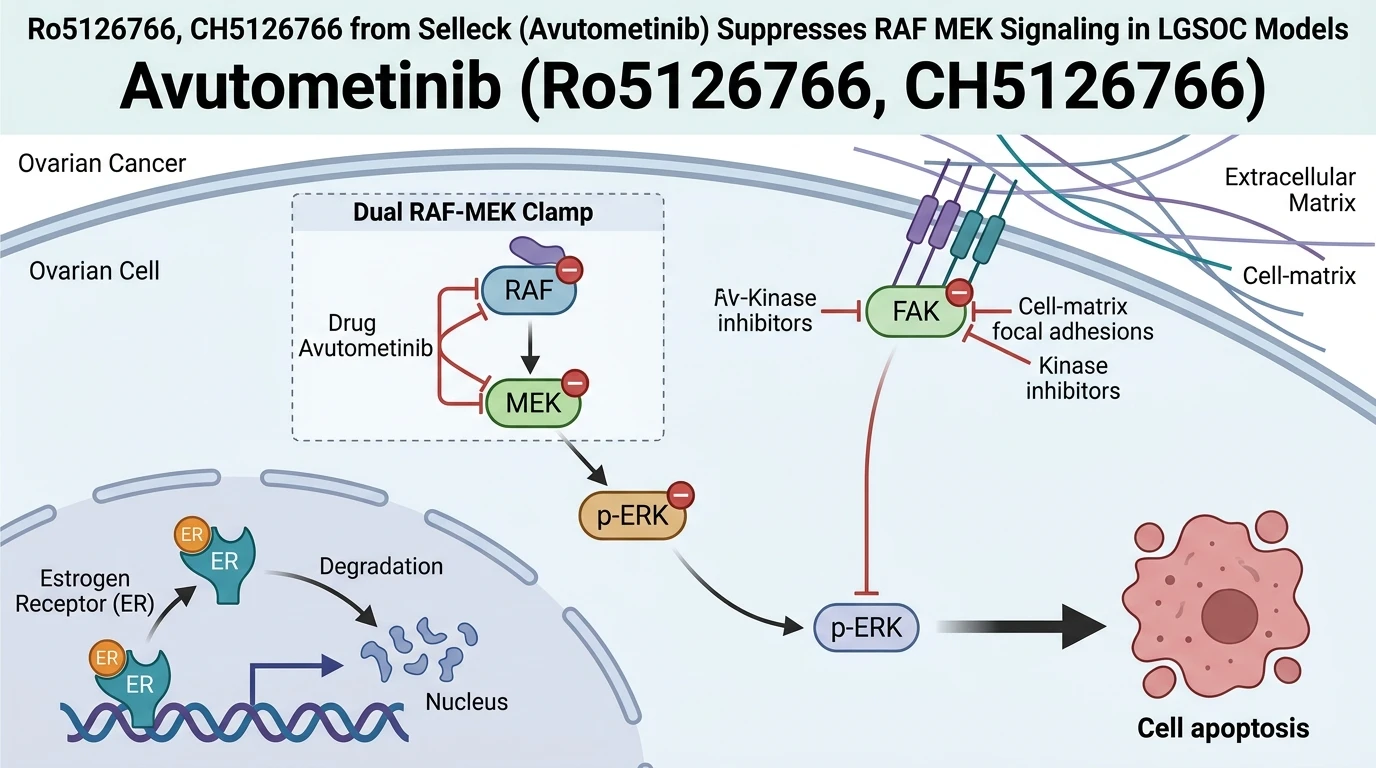
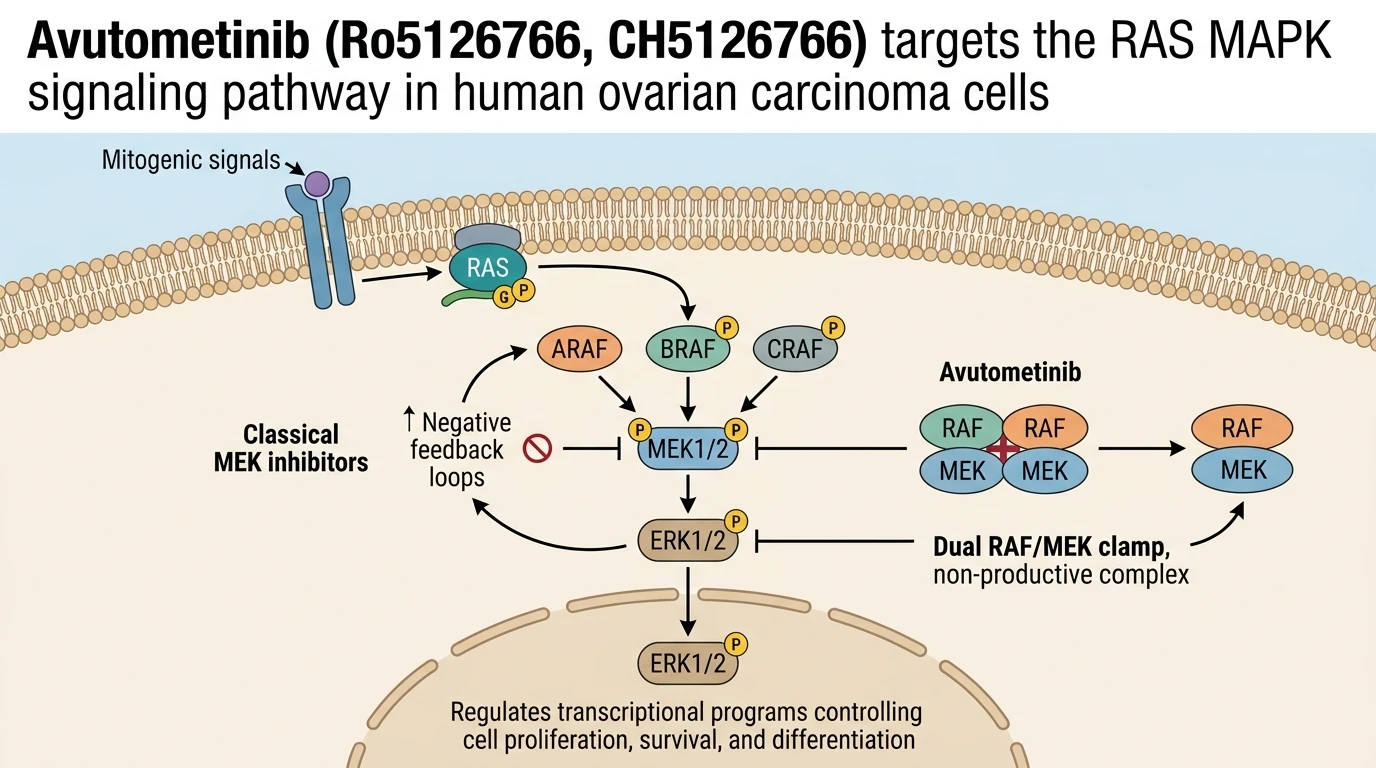
To circumvent these adaptive mechanisms, recent preclinical investigations evaluated a novel combination regimen targeting multiple signaling nodes simultaneously. Central to this approach is Avutometinib (Ro5126766, CH5126766), a unique dual RAF/MEK clamp. Unlike conventional ATP-competitive or allosteric MEK inhibitors that trigger hyperphosphorylation of RAF and MEK, Ro5126766, CH5126766 from Selleck binds MEK and traps it in a stable complex with RAF. This dual-action clamping mechanism prevents MEK phosphorylation by RAF while inhibiting MEK kinase activity, effectively shutting down downstream p-ERK signaling without inducing compensatory upstream pathway reactivation.
In a chemotherapy- and anastrozole-resistant LGSOC patient-derived xenograft (PDX) model, investigators interrogated the therapeutic efficacy of pairing the dual RAF/MEK clamp avutometinib with the FAK inhibitor VS-4718 (defactinib) and the selective estrogen receptor degrader fulvestrant. Integrin-mediated signaling through FAK represents a well-documented bypass node that promotes cell survival and invasion during MEK blockade. Furthermore, ER signaling provides parallel survival cues that sustain tumor proliferation under therapeutic stress. Pharmacological evaluation in this PDX model demonstrated that single-agent fulvestrant or dual avutometinib/defactinib therapies achieved modest pathway suppression, whereas the triple combination produced pronounced tumor growth inhibition and sustained regression.
Ex vivo Western blot analyses of tumor tissue harvested from treated PDX models revealed robust pharmacodynamic suppression. The triple combination significantly attenuated phosphorylated MEK (p-MEK) and phosphorylated ERK (p-ERK) levels compared to monotherapies or double combinations. Concurrently, fulvestrant exposure successfully degraded ER protein levels, validating multi-target engageability within the tumor microenvironment. Survival analyses confirmed that mice receiving the triple regimen experienced significantly prolonged overall survival compared to control groups. Importantly, this survival advantage occurred without inducing significant body weight loss, indicating manageable systemic tolerability within the tested animal cohort.
Therapeutic Evaluation and Pharmacological Characterization
Copy code to add this image to your page
Avutometinib acts as a dual RAF/MEK inhibitor that traps RAF and MEK in an inactive complex, preventing feedback-induced phosphorylation of MEK. When combined with the FAK inhibitor defactinib and the estrogen receptor degrader fulvestrant, this strategy simultaneously dismantles RAS/MAPK signaling, integrin-mediated FAK signaling, and estrogen receptor pathways in low-grade serous ovarian carcinoma (LGSOC). Ex vivo western blot analyses confirm substantial reductions in p-MEK, p-ERK, and ER expression. Within chemo- and anastrozole-resistant LGSOC xenografts, this triple combination induces significant tumor regression and extends survival without systemic toxicity.
Triple Blockade Suppresses Phosphorylated MEK and ERK Effector Levels
Biochemical evaluation of tumor lysates established pronounced pathway suppression under combination treatment. Phosphorylated MEK (p-MEK) levels dropped sharply following administration of the dual RAF/MEK clamp. Downstream p-ERK signals remained persistently suppressed; conventional single-agent MEK inhibitors typically fail to sustain this degree of inactivation due to loss of negative feedback. Concurrently, Western blot assays confirmed total ER protein reduction in fulvestrant-treated cohorts. The simultaneous downregulation of both p-ERK and ER demonstrates efficient target engagement within the PDX tissue.
FAK and Estrogen Receptor Co-Inhibition Prevents Adaptive Resistance
Focal adhesion kinase signaling functions as a critical parallel survival cascade in LGSOC. Blockade of MEK alone frequently drives focal adhesion assembly and autophosphorylation of FAK at Tyr397. Utilizing Ro5126766, CH5126766 from Selleck alongside defactinib directly abrogates this bypass mechanism—dismantling cellular adhesion signaling while keeping MAPK flux constrained. Adding fulvestrant neutralizes concurrent estrogen receptor activity. Consequently, tumor cells lose multiple signaling redundancies required for adaptive survival under drug pressure.
Sustained In Vivo Tumor Regression Without Inducing Body Weight Loss
In vivo tumor volume monitoring revealed marked differences across treatment arms. Monotherapy with fulvestrant yielded minimal tumor growth inhibition in this anastrozole-resistant model. Dual treatment with avutometinib and defactinib delayed disease progression, yet tumor regrowths eventually occurred. In contrast, the triple combination regimen induced durable tumor regression over extended dosing schedules. Murine body weight remained stable throughout the evaluation period; toxicity markers showed no significant deviation from baseline parameters.