ML141 (CID-2950007) ML141 Rho GTPase Inhibition Suppresses GAL3-Induced Neuronal Autophagy
Copy code to add this image to your page
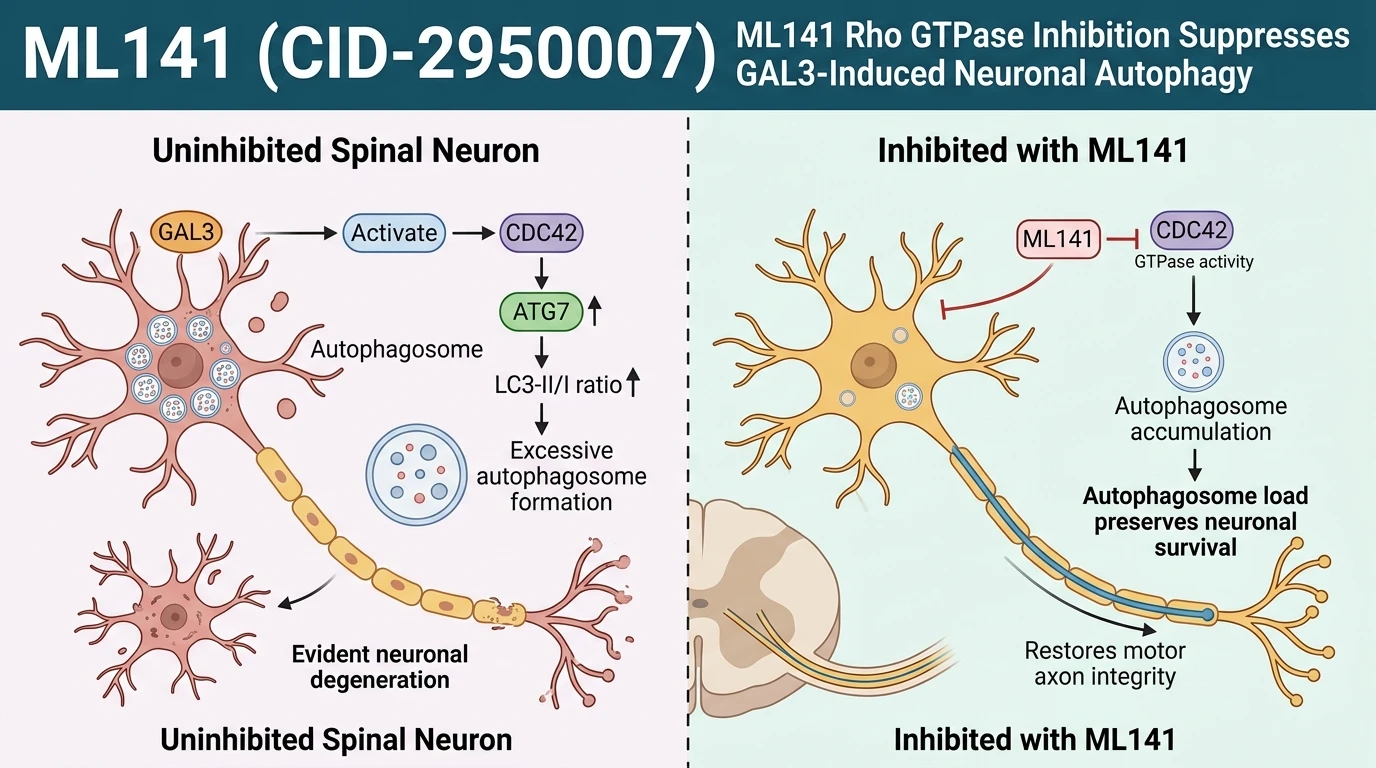
Spinal cord injury (SCI) triggers secondary pathological cascades that exacerbate primary tissue damage. Among these mechanisms, excessive neuronal autophagy contributes directly to persistent functional deficits. Cell Division Cycle 42 (CDC42), a small GTPase belonging to the Rho family, acts as a regulator of actin cytoskeleton dynamics and intracellular membrane trafficking. Recent evidence identifies Galectin-3 (GAL3), a carbohydrate-binding protein, as an upstream binding partner that physically interacts with CDC42 during neuroinflammatory stress. In adult rat models of SCI, GAL3 upregulation correlates with enhanced GTP binding on CDC42. This interaction accelerates autophagic flux within injured spinal neurons, aggravating motor impairment.
Pharmacological targeting of CDC42 offers a strategy to dissect this degenerative mechanism. ML141 (CID-2950007) is a non-competitive, selective small-molecule inhibitor of CDC42 that exhibits high specificity over closely related Rho GTPases like Rac1, RhoA, and RhoG. Mechanistically, ML141 binds to an allosteric pocket on CDC42, locking the protein in an inactive, GDP-bound conformation. By preventing guanine nucleotide exchange factor (GEF) mediated activation, ML141 halts downstream signaling cascades without non-specifically perturbing other intracellular GTPase networks. In experimental SCI protocols, small-molecule engagement by ML141 suppresses GAL3-induced GTP loading on CDC42. This inhibition attenuates aberrantly elevated neuronal autophagy in peri-lesional spinal cord tissue.
At the molecular level, execution of neuronal autophagy involves a core set of autophagy-related proteins. Autophagy Related 7 (ATG7) functions as an E1-like activating enzyme essential for autophagosome biogenesis. Upon activation, ATG7 facilitates the conjugation of Microtubule-associated protein 1 Light Chain 3 (LC3-I) to phosphatidylethanolamine, forming lipidated LC3-II. Consequently, an elevated LC3-II to LC3-I ratio serves as an established metric of active autophagosome accumulation. Sequestosome-1 (P62/SQSTM1) serves as a selective autophagy receptor that undergoes degradation during complete autophagic turnover. Following SCI, elevated GAL3 levels induce marked upregulation of ATG7 expression and increase the conversion ratio of LC3-I to LC3-II. Concurrently, P62 dynamics become dysregulated, reflecting pathologically accelerated flux in acutely damaged tissues.
Administration of ML141 effectively reverses these autophagic marker alterations within animal models. Treatment with ML141 leads to a dose-dependent reduction in spinal ATG7 expression levels. Furthermore, ML141 normalizes the LC3-II/I ratio back toward baseline control values in injured spinal cord tissue. Changes in P62 accumulation confirm that CDC42 inhibition normalizes protein turnover rates rather than inducing non-specific lysosomal blockade. Through these biochemical modifications, ML141 halts pathologically hyperactive autophagy in spinal neurons.
The functional consequence of CDC42 inhibition translates directly into physiological outcomes. In rodent models subjected to contusive spinal cord injury, daily administration of ML141 yields measurable improvements in hindlimb motor performance as scored by standard locomotor rating scales. Histological evaluation demonstrates enhanced preservation of ventral horn motor neurons and decreased lesion cavity volumes in ML141-treated subjects compared to vehicle controls. These observations substantiate that GAL3-mediated activation of CDC42 constitutes a destructive pathway in SCI pathology. Research data retrieved from the National Center for Biotechnology Information database support the broader role of small GTPase signaling in central nervous system trauma.
Understanding the specific pharmacology of ML141 Rho GTPase modulation clarifies how CDC42 functions within acute neural injury microenvironments. While CDC42 plays physiological roles in axonal pathfinding and synaptic plasticity during development, its acute hyperactivation following trauma drives auto-destructive catabolic activity. The selective activity profile of ML141 (CID-2950007) provides a molecular tool to isolate CDC42 signaling from parallel Rho pathways. By disrupting the GAL3/CDC42 complex, ML141 establishes a pharmacological target for mitigating secondary cell death in spinal cord trauma.
Pharmacological Evaluation of CDC42 Inhibition in Traumatic Injury
Copy code to add this image to your page
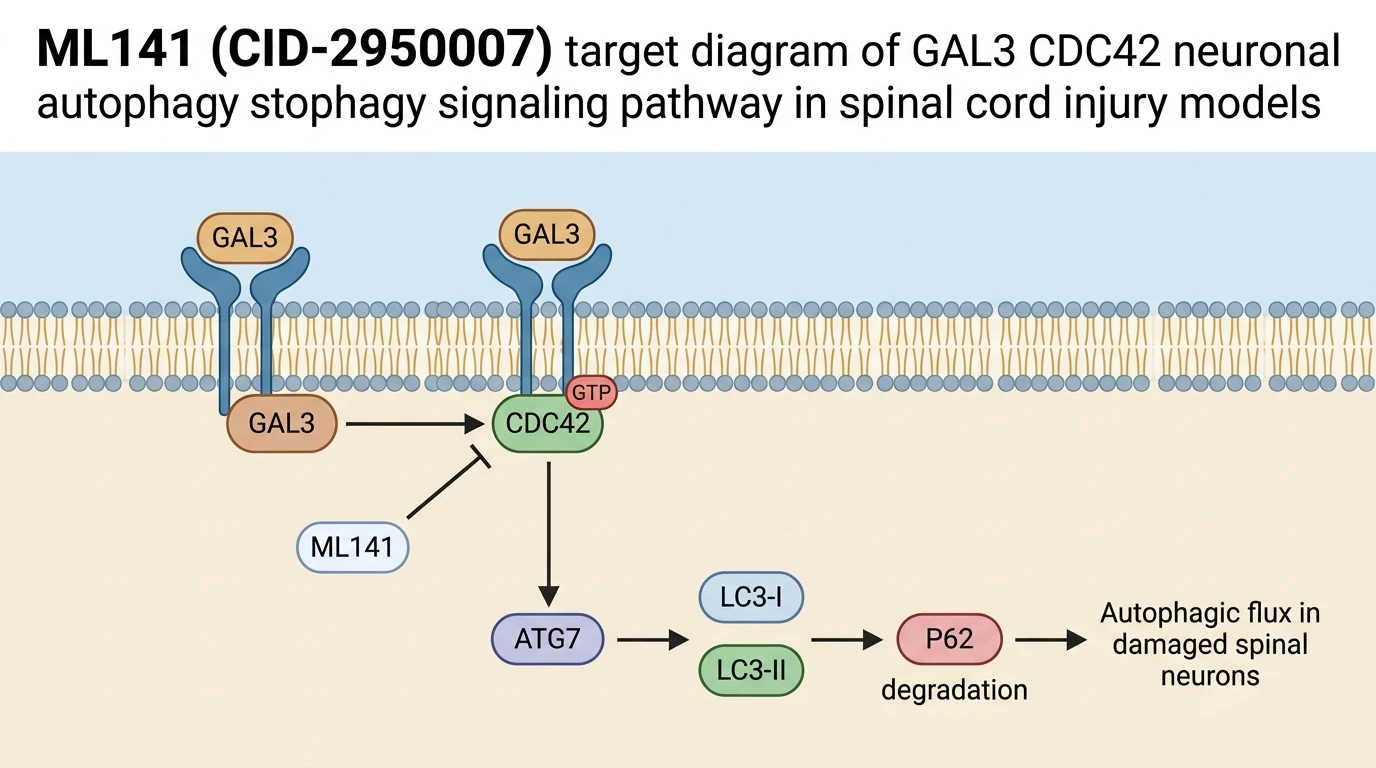
ML141 (CID-2950007) is a selective inhibitor of Cell Division Cycle 42 (CDC42). In spinal cord injury models, Galectin-3 (GAL3) binds directly to CDC42, triggering its activation and driving excessive neuronal autophagy. This autophagic surge exacerbates motor dysfunction. ML141 blocks CDC42 activation, suppressing GAL3-induced autophagic signaling. Pharmacological inhibition reduces ATG7 expression, normalizes LC3-II/LC3-I conversion ratios, and restores P62 dynamics. Consequently, ML141 reduces secondary neuronal loss and improves functional motor recovery in preclinical spinal trauma models.
Inhibition of CDC42 GTPase Suppresses GAL3-Induced Autophagic Flux
Biochemical evaluation in adult Sprague-Dawley rats demonstrates that traumatic spinal cord injury triggers rapid upregulation of Galectin-3 (GAL3) in peri-lesional tissues. GAL3 physically associates with active GTP-bound CDC42. This interaction drives autophagosome formation in ventral horn motor neurons. To evaluate target engagement, investigators administered ML141 at micromolar concentrations directly following contusion injury. ML141 selectively bound CDC42 without affecting Rac1 or RhoA expression. In treated tissue homogenates, Western blot analysis revealed a marked drop in ATG7 protein levels. Additionally, the LC3-II to LC3-I conversion ratio decreased significantly compared to vehicle-treated injured controls. Measurements of P62 protein levels confirmed the restoration of normal autophagic turnover. These biochemical parameters indicate that the ML141 Rho inhibitor directly disrupts GAL3-dependent signaling cascades. Consequently, hyperactive neuronal autophagy was contained within physiological boundaries.
Functional Motor Recovery and Neuronal Survival Following Selective Inhibition
Functional assessment of injured rats revealed significant locomotor gains following pharmacological CDC42 blockade. Animals receiving ML141 (CID-2950007) exhibited higher Basso, Beattie, and Bresnahan scores over a four-week post-injury monitoring period. Electrophysiological testing demonstrated improved motor-evoked potential amplitudes in the hindlimb musculature of treated subjects. Histological quantification confirmed a higher survival rate of alpha motor neurons in the spinal cord anterior horn. Furthermore, tissue spared at the injury epicenter was significantly greater in treated groups. Under these experimental conditions, blocking GAL3-mediated CDC42 activation preserved functional neural circuits. The ML141 Rho inhibitor thus demonstrates concrete neuroprotective activity in preclinical trauma models. These findings clarify the mechanistic viability of targeting GAL3/CDC42 interactions to mitigate secondary degeneration.