AOA (Aminooxyacetic acid) hemihydrochloride inhibits cystathionine-β-synthase to suppress colon cancer bioenergetics
Copy code to add this image to your page
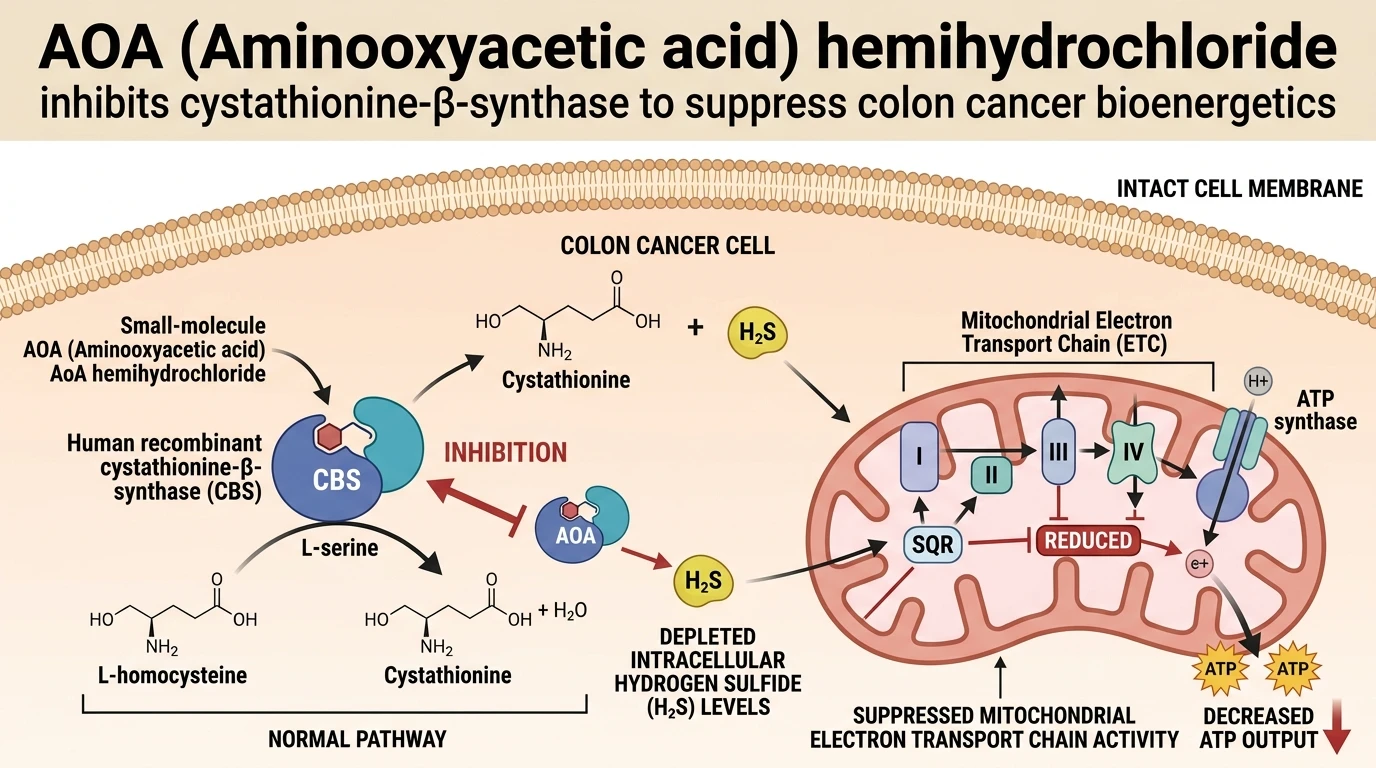
Targeting metabolic adaptations in solid tumors requires precise enzymatic intervention. Cystathionine-β-synthase (CBS) catalyzes the condensation of L-homocysteine and L-serine to generate cystathionine, yielding endogenous hydrogen sulfide (H2S) as a gasotransmitter byproduct. In human colorectal malignancies, upregulation of CBS sustains cell survival by stimulating mitochondrial bioenergetics and preserving electron transport chain integrity. Standard antineoplastic compounds target tubulin assembly or DNA replication; conversely, CBS targeting starves malignant cells of metabolic fuel. AOA (Aminooxyacetic acid) hemihydrochloride functions as a classical reference inhibitor of CBS activity.
At the enzymatic level, the active moiety Aminooxyacetic acid engages the pyridoxal-5'-phosphate (PLP) cofactor within the catalytic pocket of CBS. Direct biochemical assays using purified human recombinant CBS demonstrate that this compound achieves effective inhibition with an IC50 of approximately 3 µM. The inhibitor forms a stable oxime adduct with the enzyme-bound PLP cofactor. This covalent interaction impedes transsulfuration reactions without non-specifically scavenging free H2S molecules in solution. Consequently, enzymatic substrate conversion ceases rapidly under standard test conditions.
In cellular contexts, CBS-derived H2S operates as an autocrine driver of oxidative phosphorylation and glycolysis. Exposure of human HCT116 colon adenocarcinoma cells to AOA (Aminooxyacetic acid) hemihydrochloride results in a dose-dependent reduction of cellular H2S synthesis. Mitochondrial oxygen consumption rates fall markedly within hours of treatment. Metabolic profiling reveals compromised electron flow through Complex II (succinate dehydrogenase) and Complex IV (cytochrome c oxidase). Sub-millimolar concentrations disrupt mitochondrial membrane potential without inducing immediate plasma membrane rupture. Lactate dehydrogenase (LDH) release assays confirm that cell death occurs primarily via biochemical starvation rather than necrotic lysis.
In vitro antiproliferative evaluations reflect these metabolic alterations. In HCT116 culture models, treatment yields concentration-dependent suppression of cellular growth with an IC50 value of approximately 300 µM. Colorimetric MTT assays document diminished mitochondrial dehydrogenase activity, verifying cellular bioenergetic decline. Importantly, control non-malignant epithelial lines maintain viability across equivalent dose ranges, reflecting a lower basal reliance on CBS-driven transsulfuration pathways. This differential sensitivity validates CBS as an active metabolic vulnerability in colorectal carcinoma cells.
Biochemical characterization differentiates CBS inhibition from non-specific gas scavenging. Rather than reacting directly with synthesized H2S, the small molecule selectively suppresses catalytic synthesis at the enzyme source. This distinction preserves experimental specificity when probing gasotransmitter biology. In cell culture assays, exogenous administration of sodium hydrosulfide (NaHS) restores mitochondrial bioenergetics despite continuous enzyme blockade. This chemical rescue validates that bioenergetic suppression stems directly from target-specific H2S depletion rather than off-target cytotoxicity.
Beyond primary bioenergetics, CBS blockade alters cellular redox balance and antioxidant reserves. Depletion of downstream transsulfuration products reduces glutathione biosynthesis capacity, elevating intracellular reactive oxygen species. Elevated oxidative strain further compromises mitochondrial function and impairs nuclear DNA repair pathways. However, these downstream effects remain constrained by cellular context, basal expression levels, and nutrient availability in the microenvironment. Systematic titration of the inhibitor provides a clear quantitative framework for dissecting CBS-mediated signaling nodes in colorectal tumor models.
Enzymatic Inhibition and Biological Evaluation in Colon Cancer
Copy code to add this image to your page
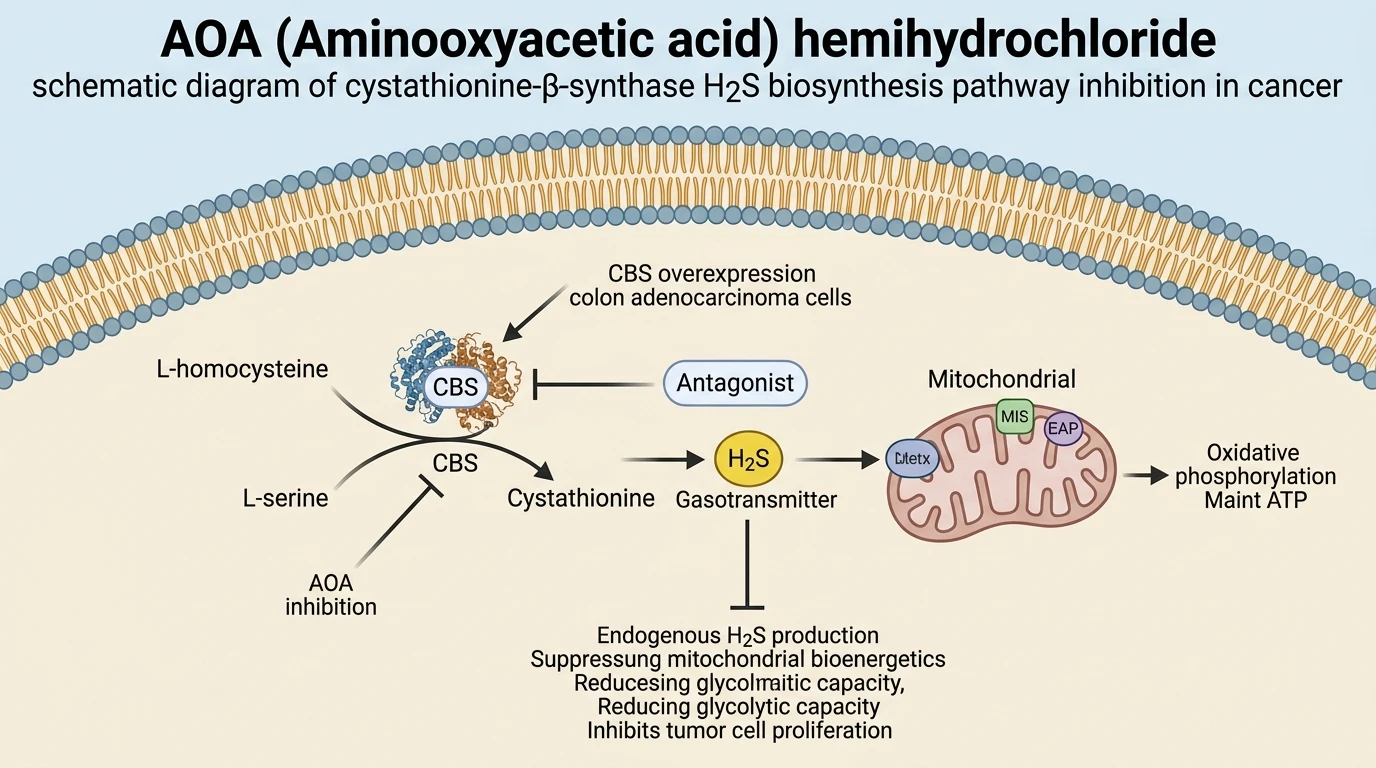
AOA (Aminooxyacetic acid) hemihydrochloride acts as a competitive reference inhibitor of cystathionine-β-synthase (CBS) by targeting its pyridoxal-5'-phosphate cofactor. Direct enzymatic assays demonstrate recombinant human CBS inhibition with an IC50 of ~3 µM. In HCT116 colon adenocarcinoma models, treatment reduces intracellular hydrogen sulfide synthesis, suppresses mitochondrial respiration, and inhibits cell proliferation (IC50 ~300 µM). Membrane toxicity remains absent as evidenced by low LDH release, confirming target-specific metabolic starvation.
Direct Recombinant CBS Inhibition and Gasotransmitter Depletion
Biochemical evaluation establishes that Aminooxyacetic acid suppresses human recombinant CBS activity with an IC50 of approximately 3 µM under standard in vitro buffer conditions. The compound targets the active-site pyridoxal-5'-phosphate cofactor. This binding prevents the transsulfuration of L-homocysteine into cystathionine. Importantly, kinetic measurements confirm that H2S synthesis drops rapidly upon inhibitor administration. Scavenging assays confirm that the compound does not neutralize pre-existing gasotransmitter molecules directly. Target engagement remains selective for PLP-dependent enzymes involved in transsulfuration. These cell-free biochemical parameters establish a defined baseline for mechanistic studies in complex tissue models.
Attentuation of HCT116 Proliferation and Mitochondrial Bioenergetics
Cellular assays in HCT116 colon adenocarcinoma cultures demonstrate dose-dependent growth suppression. Exposure to Aminooxyacetic acid yields an IC50 value of approximately 300 µM in 72-hour proliferation assays. Colorimetric MTT measurements document significant reductions in mitochondrial bioenergetics and cellular metabolic activity. Contrastingly, lactate dehydrogenase release remains negligible across effective concentration ranges; this finding confirms that plasma membrane integrity is maintained. The observed cytostatic effect correlates with impaired mitochondrial electron transport. These cellular observations validate CBS activity as a critical driver of metabolic fitness in colon tumor models.