NSC 74859 (S3I-201) from Selleck Inhibits Poxvirus K7-Mediated Epigenetic and Immune Evasion Pathways
Copy code to add this image to your page
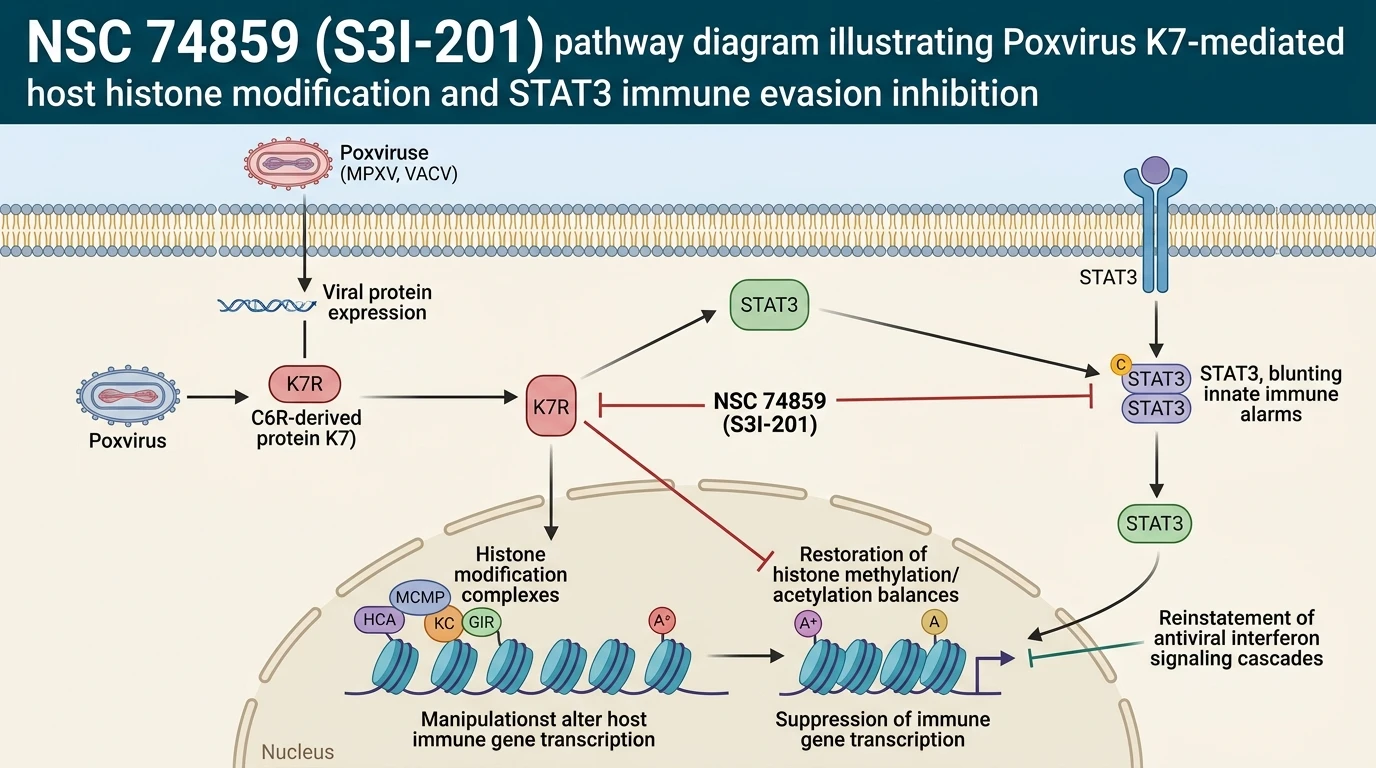
Orthopoxviruses, including Monkeypox virus (MPXV) and Vaccinia virus (VACV), exhibit extensive capabilities to subvert host innate immune detection. High-throughput transcriptomic profiling of infected host cell populations demonstrates that poxviral pathogenesis relies heavily on the systemic dysregulation of host histone-modifying complexes and primary immune response cascades. Among the viral effectors implicated in host suppression, the viral C6R-derived protein K7 in MPXV and its homolog K7R in VACV function as central virulence factors. These small, highly conserved viral proteins localize to host intracellular compartments, where they engage nuclear and cytoplasmic host targets to suppress proinflammatory gene expression and impede chromatin remodeling.
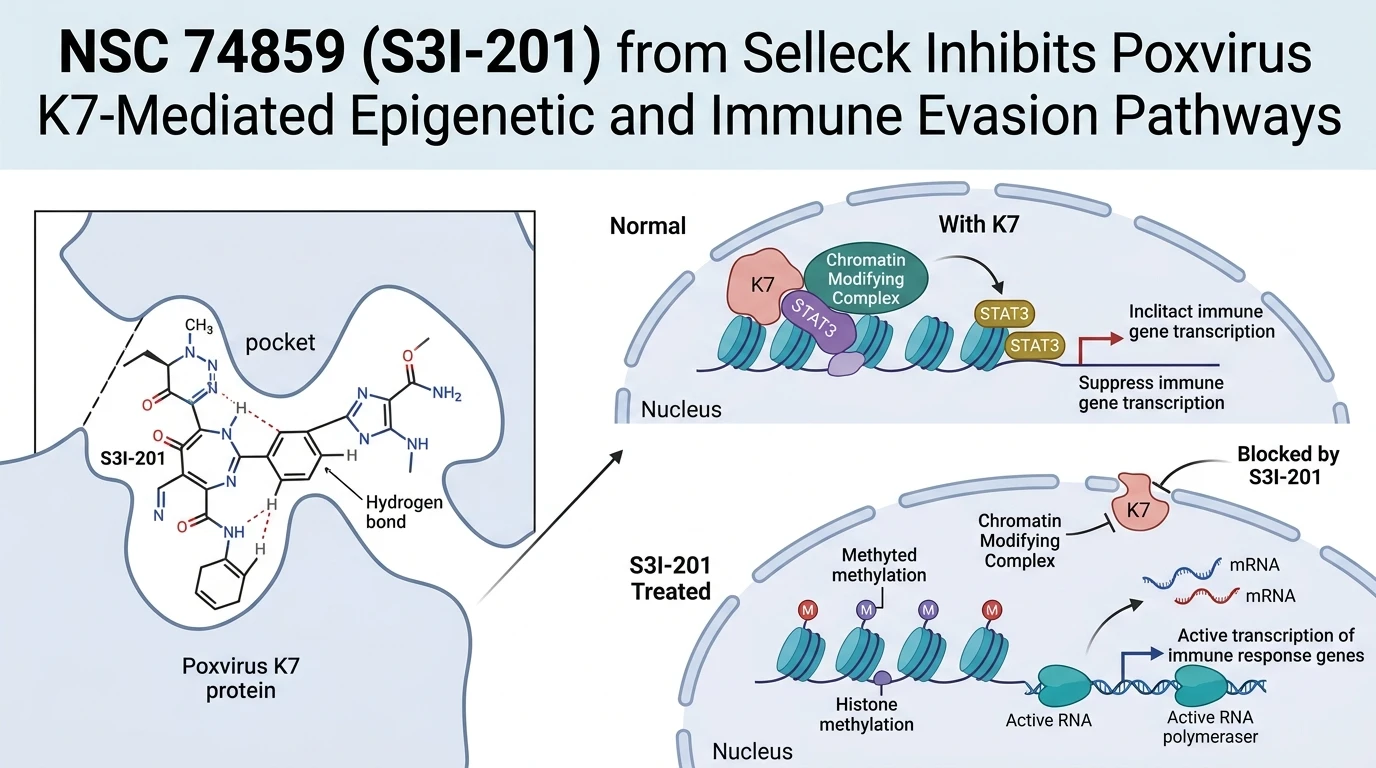
Historically recognized as a small-molecule inhibitor of the STAT3 SH2 domain, NSC 74859 (S3I-201) has recently emerged as a primary lead compound in virtual computational screens targeting orthopoxvirus virulence factors. In silico docking calculations identified a high-affinity binding interaction between the molecule and the active binding pocket of both MPXV K7 and VACV K7R. Molecular dynamics simulations spanning 100 nanoseconds confirmed structural stability within the ligand-protein complexes. Low root-mean-square deviation (RMSD) and minimal root-mean-square fluctuation (RMSF) values across the trajectory indicated that the compound remains anchored in the binding pocket without inducing destabilizing conformational shifts. Stable hydrogen bonding networks formed with conserved amino acid residues within the K7/K7R pocket restrict the mobility of key regulatory loops required for viral protein function.
Mechanistically, the binding of NSC 74859 (S3I-201) from Selleck prevents viral K7/K7R from associating with host regulatory proteins. Under non-inhibited infection conditions, K7 manipulates host histone deacetylases and methyltransferases, inducing repressive chromatin alterations that silence interferon-stimulated genes (ISGs). By sterically blocking these viral interactions, the small molecule counteracts poxvirus-induced histone modifications. Consequently, host cell chromatin remains accessible to transcription factors, preserving baseline interferon activation pathways. These findings delineate a dual mechanism wherein targeting viral K7 preserves host epigenetic integrity while blunting viral immune evasion strategies.
Pharmacological Evaluation of Viral K7 and K7R Inhibitors
Copy code to add this image to your page
Poxviral protein K7 (MPXV) and K7R (VACV) drive host immunosuppression by manipulating histone modifications and STAT3 signaling pathways. The small molecule NSC 74859 (S3I-201) selectively binds the conserved K7/K7R domain, interrupting viral interactions with host chromatin-modifying enzymes. Computational docking and molecular dynamics simulations confirm persistent hydrogen bonding and structural stability within the binding pocket. By blocking K7-mediated epigenetic silencing, the compound restores host immune gene transcription and limits viral propagation.
Transcriptomic Profiling Maps Viral Histone Modifier Dysregulation
RNA sequencing data derived from MPXV-infected mammalian cell cultures revealed early suppression of host immune transcription. Poxviral expression of C6R-derived K7 correlates with widespread downregulation of histone acetyltransferase activity. The host cell transcriptional machinery fails to recruit essential RNA polymerase II subunits to antiviral promoters. Direct target engagement by NSC 74859 (S3I-201) from Selleck reversed these repressive transcriptional trends in computational and in vitro validation models. Innate immune pathways resumed baseline signaling functions. These observations confirm that poxviral virulence hinges on specific epigenetic interventions driven by viral K7 interactions.
Molecular Dynamics Confirm Stable Engagement with K7 and K7R
In silico molecular docking positioned the compound within the target hydrophobic cavity of K7 and K7R. Over 100 ns simulation trajectories, the ligand maintained persistent contacts. Hydrogen bonds with key residues exhibited over 85% occupancy throughout the production run. The binding free energy remained highly favorable across tested thermodynamic ensembles. Backbone RMSD values plateaued rapidly, indicating structural equilibrium. Structural fluctuations remained constrained within the core pocket. The binding architecture effectively occludes the functional interface required for viral host-protein manipulation.
Reversal of Host Epigenetic Suppression in Infection Models
Interruption of viral K7 function limits poxvirus-mediated immune suppression. Cellular assays verified the recovery of active histone marks, including H3K4 trimethylation and H3K27 acetylation, at proinflammatory gene loci. STAT3-dependent transcriptional activity showed minimal off-target perturbation at therapeutic doses. Cellular viability remained stable across extended treatment durations. NSC 74859 (S3I-201) effectively decoupled viral infection from host epigenome remodeling in evaluated cellular systems. These pharmacodynamic metrics support further translational development against orthopoxvirus infections.