BI-D1870 inhibitor blocks RSK4 signaling to attenuate renal cell carcinoma invasion
Copy code to add this image to your page
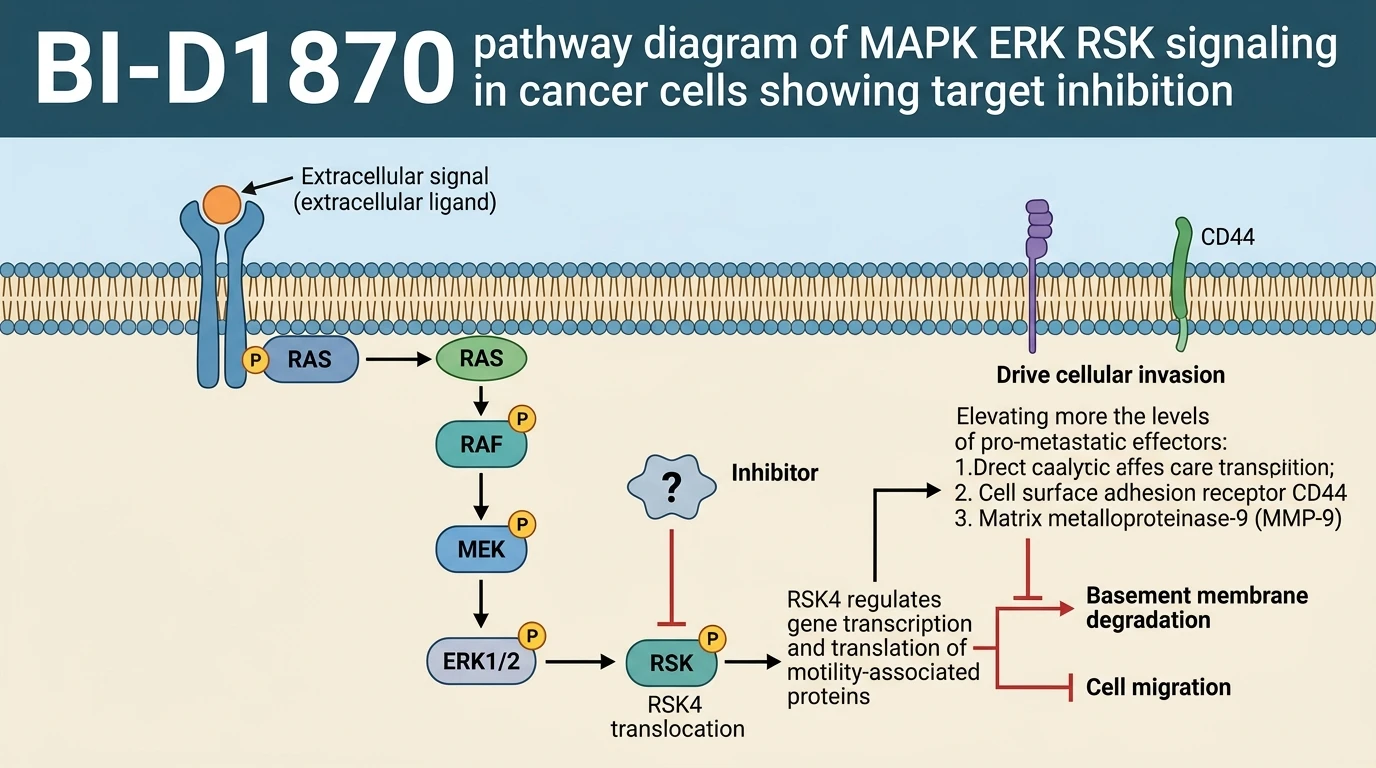
The 90 kDa ribosomal S6 kinase (RSK) family comprises four human serine/threonine kinase isoforms (RSK1–4) functioning downstream of the canonical mitogen-activated protein kinase (MAPK) / extracellular signal-regulated kinase (ERK) cascade. Among these isoforms, RSK4 (encoded by the RPS6KA6 gene) displays distinct regulatory mechanisms and cell-context-dependent functional outputs. In renal cell carcinoma (RCC), aberrant signaling through the ERK/RSK axis correlates with enhanced malignant cell survival, cellular motility, and metastatic dissemination. Pharmacological modulation of RSK kinase activity using small-molecule inhibitors provides a precise strategy to dissect the functional requirement of RSK4 in RCC progression. Among available chemical probes, the diaminopyrimidine derivative BI-D1870 functions as an ATP-competitive inhibitor exhibiting high potencies against all four RSK isoforms in nanomolar ranges. Standardized biochemical kinase assays and analytical tools demonstrate that BI-D1870 targets the N-terminal kinase domain responsible for substrate phosphorylation, offering a robust pharmacological approach to evaluate RSK-dependent oncogenic mechanisms.
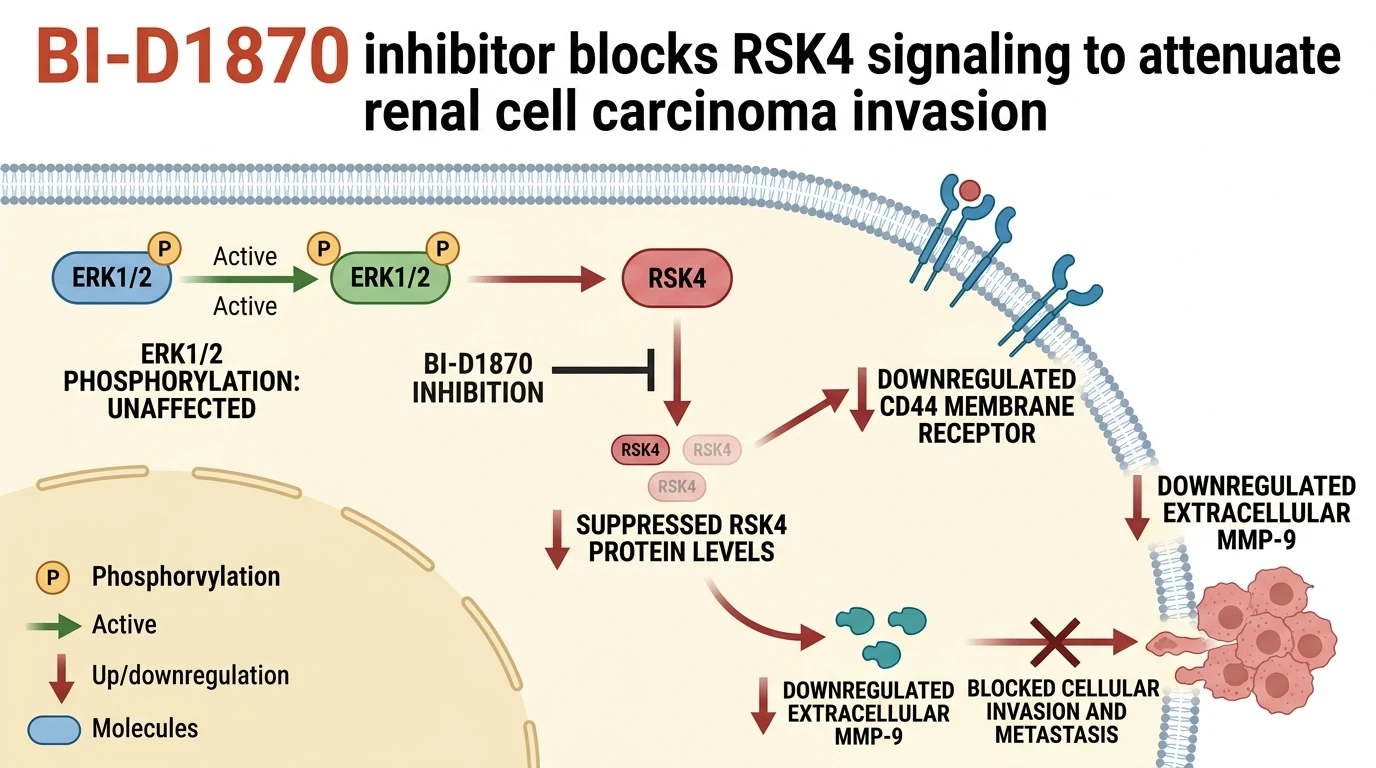
In experimental models of RCC, specifically using GRC-1 clear cell renal cell carcinoma lines, target engagement by the BI-D1870 inhibitor exerts rapid and dose-dependent suppression of total RSK kinase activity. Prolonged exposure to BI-D1870 leads to a marked downregulation of total RSK4 protein abundance. This observation indicates that catalytic activity of RSK may be required to maintain structural stability or prevent proteasomal clearance of the RSK4 protein itself. Cellular viability assays demonstrate that while acute catalytic blockade does not immediately induce generalized cytotoxicity, it specifically halts the execution of invasive cell phenotypes. The loss of RSK4 expression upon small-molecule inhibition highlights a feed-forward auto-regulatory loop wherein active catalytic function protects the kinase from intracellular degradation pathways.
A vital aspect of RSK targeted therapy involves establishing signaling specificity relative to upstream pathway components. Activation of RSK requires dual phosphorylation by active ERK1/2 at its C-terminal domain and PDK1 at its N-terminal domain. Intracellular Western blot analyses of GRC-1 cells treated with BI-D1870 reveal that while target RSK kinase activity and RSK4 protein levels drop markedly, the phosphorylation status of upstream ERK1/2 (p-ERK1/2 Thr202/Tyr204) remains completely unchanged. Upstream signaling nodes remain fully active. This uncoupling confirms that BI-D1870 does not trigger compensatory feedback activation of the upstream RAF-MEK-ERK cascade under tested in vitro conditions. Consequently, observed functional phenotypes can be attributed directly to loss of downstream RSK signaling rather than off-target suppression of parallel MAPK branches.
The invasive capacity of RCC cells critically depends on extracellular matrix (ECM) degradation and cell-matrix interactions. BI-D1870 administration downregulates two key pro-metastatic effectors: CD44 and matrix metalloproteinase-9 (MMP-9). CD44 is a transmembrane glycoprotein that interacts with hyaluronic acid to facilitate cell adhesion and cytoskeletal rearrangement during directional migration. MMP-9 is a zinc-dependent endopeptidase capable of cleaving type IV collagen, the primary structural constituent of basement membranes. In GRC-1 cells, RSK4 suppression leads to a concurrent decrease in both CD44 protein levels and MMP-9 enzymatic secretion. The loss of these effectors disrupts the molecular machinery required for tumor cell entry into surrounding stromal matrices.
Functional validation through Transwell and Matrigel invasion assays confirms the physiological consequences of RSK activity blockade. GRC-1 cells treated with BI-D1870 exhibit a pronounced reduction in migratory distance and invasive penetration across reconstituted basement membranes. Cell motility parameters decrease in a concentration-dependent manner. These findings confirm that RSK4 functions as an essential driver of RCC invasive phenotypes, operating downstream of ERK1/2 to upregulate CD44 and MMP-9. While preliminary findings from in vitro models provide compelling mechanistic evidence, further evaluation in patient-derived xenograft models and randomized preclinical cohorts will be required to define therapeutic windows and pharmacokinetic limits. Nevertheless, direct target inhibition by BI-D1870 highlights RSK4 as a viable target for anti-metastatic intervention in renal cell carcinoma.
Therapeutic Evaluation and Pharmacological Characterization of RSK Inhibition
Copy code to add this image to your page
BI-D1870 is a potent, selective inhibitor of ribosomal S6 kinase (RSK). In renal cell carcinoma GRC-1 cells, direct catalytic blockade of RSK suppresses RSK4 protein expression without altering upstream ERK1/2 phosphorylation status. This selective kinase inhibition downregulates key pro-metastatic effectors, specifically cell-adhesion glycoprotein CD44 and matrix metalloproteinase-9 (MMP-9). Consequently, BI-D1870 attenuates tumor cell migration, extracellular matrix degradation, and invasive potential, demonstrating the utility of RSK-targeted therapeutics in limiting RCC metastasis.
Targeted Kinase Blockade Suppresses RSK4 Without Affecting ERK1/2 Phosphorylation
In GRC-1 renal cell carcinoma cells, small-molecule inhibition using the BI-D1870 inhibitor selectively abrogates RSK kinase activity under tested assay conditions. RSK4 protein levels drop sharply. Upstream ERK1/2 phosphorylation remains unperturbed across all experimental timepoints. This selective target engagement confirms that RSK4 downregulation occurs independently of upstream feedback inhibition within the canonical MAPK pathway. Kinase catalytic activity directly stabilizes downstream effector proteins.
Attenuation of CD44 and MMP-9 Suppresses Metastatic Motility
Downstream effector profiling demonstrates that BI-D1870 suppresses expressions of both CD44 and MMP-9. CD44 mediates cell-matrix adhesion. MMP-9 executes extracellular matrix breakdown. Concurrently, Matrigel invasion assays reveal a marked loss of directional migration and invasive capacity in treated GRC-1 cells. These pharmacodynamic responses confirm that catalytic target blockade impairs renal cell carcinoma metastatic potential in vitro.