Irinotecan Hydrochloride Nanoparticles Targeting Topoisomerase I for High-Grade Glioma Therapy
Copy code to add this image to your page
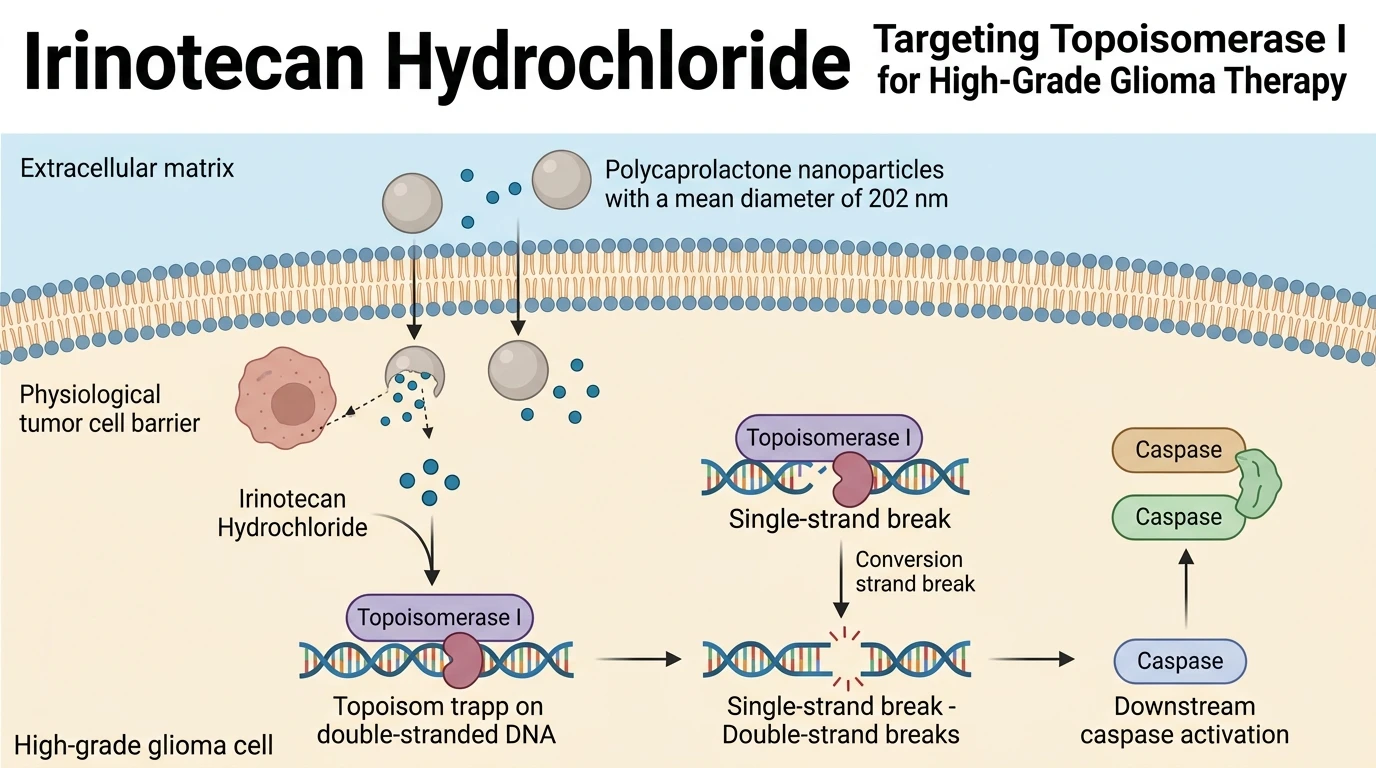
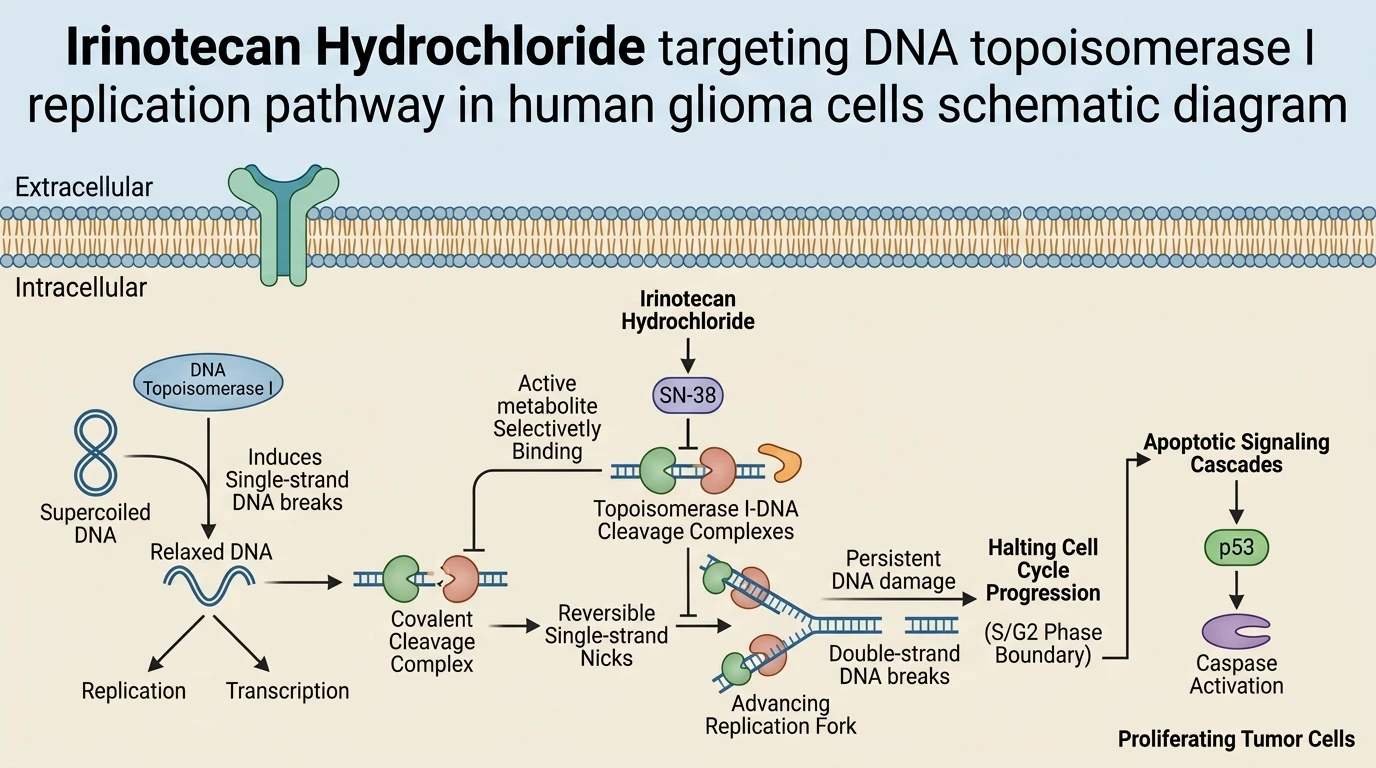
High-grade glioma (HGG) remains one of the most recalcitrant malignancies of the central nervous system. Treatment efficacy is severely constrained by the blood-brain barrier (BBB) and rapid systemic drug clearance. Irinotecan Hydrochloride serves as a potent prodrug of SN-38, a topoisomerase I inhibitor that halts DNA replication by stabilizing transient single-strand DNA-protein complexes. However, unformulated Irinotecan Hydrochloride exhibits poor aqueous stability at physiological pH, rapid lactone ring hydrolysis to an inactive carboxylate form, and limited parenchymal accumulation within brain tumors. Nanoformulation strategies offer a direct methodology to bypass these pharmacokinetic bottlenecks.
To address these limitations, polymer-based carrier platforms have been engineered to encapsulate water-soluble antineoplastic agents. Polycaprolactone (PCL) is a biocompatible, biodegradable hydrophobic polyester recognized for its structural integrity and slow degradation kinetics. Encapsulating a hydrophilic salt like Irinotecan Hydrochloride trihydrate into hydrophobic polymer matrices presents substantial technical challenges. Standard single-emulsion techniques typically result in low encapsulation efficiency due to rapid drug diffusion into the continuous aqueous phase. Modified water-in-oil-in-water (W/O/W) double emulsion techniques overcome phase partitioning limits by inducing polymer amorphization and controlling osmotic gradients across inner and outer aqueous interfaces.
Optimizing formulation parameters requires precise electrolyte balancing. Incorporating sodium chloride into both internal and external aqueous phases suppresses the osmotic pressure differential, preventing premature drug leakage during droplet hardening. Amorphization of the PCL matrix decreases polymer crystallinity, facilitating uniform drug dispersion within the core. Nanoparticles generated through this double emulsion process yielded a spherical morphology with an optimal mean hydrodynamic diameter of 202.1 nm. This specific size range is well suited for passive accumulation via enhanced permeability and retention kinetics in compromised tumor vasculature.
The optimized formulation achieved a high encapsulation efficiency of 65.0%. Physical characterization revealed that the encapsulated drug remained trapped in an amorphous state, preventing re-crystallization during storage. Dynamic dissolution testing demonstrated zero-order release kinetics, with 40.4% of total encapsulated drug liberated over 16 days. Mathematical modeling confirmed a non-Fickian anomalous diffusion mechanism, indicating that drug release occurs through a synergistic combination of polymer matrix relaxation and core dissolution.
Biological evaluation using primary human HGG cell models demonstrated pronounced pharmacodynamic advantages. In vitro MTT viability assays showed that PCL-encapsulated Irinotecan Hydrochloride sustained antiproliferative activity over an 11-day evaluation period. Unformulated drug controls exhibited rapid initial cytotoxicity followed by loss of potency due to chemical degradation. In contrast, the continuous zero-order release from PCL nanoparticles maintained constant intracellular drug exposure, achieving sustained target engagement with topoisomerase I complexes. These empirical findings establish that polymer amorphization combined with osmotic modulation yields a stable nanocarrier capable of extending therapeutic duration in primary human brain tumor models.
Nanoparticle Synthesis Kinetics and Prolonged Glioma Cytotoxicity
Copy code to add this image to your page
Irinotecan Hydrochloride inhibits DNA topoisomerase I by stabilizing enzyme-DNA covalent cleavage complexes during replication. Encapsulation into amorphous polycaprolactone nanoparticles via a double emulsion technique produces 202.1 nm particles with 65.0% encapsulation efficiency. The formulation provides sustained zero-order drug release (40.4% over 16 days) driven by non-Fickian anomalous diffusion. This steady release pattern overcomes rapid systemic elimination and maintains continuous topoisomerase I inhibition, yielding superior long-term cytotoxicity against primary human high-grade glioma cells compared to unformulated drug controls.
Saline Addition and Polymer Amorphization Yield High Encapsulation
Formulating hydrophilic molecules within hydrophobic PCL shells requires strict control over interface thermodynamics. The addition of NaCl to both aqueous phases during W/O/W double emulsion minimized osmotic gradients. This osmotic stabilization reduced drug migration into the external continuous phase. Concurrently, polymer amorphization disrupted crystalline domains within the PCL matrix. Nanoparticles synthesized under these parameters displayed a mean hydrodynamic diameter of 202.1 nm. The formulation achieved a 65.0% encapsulation efficiency. Particles maintained uniform spherical morphology without evidence of aggregation. These structural features enabled stable suspension behavior under physiological tonicity.
Zero-Order Non-Fickian Diffusion Extends In Vitro Cytotoxicity
In vitro dissolution profiles revealed controlled zero-order release of Irinotecan Hydrochloride. Over a 16-day period, 40.4% of total drug content was liberated from the PCL core. Kinetic fitting confirmed a non-Fickian anomalous diffusion mechanism—a regime characterized by simultaneous polymer relaxation and solute diffusion. Cytotoxicity against primary human high-grade glioma cells was monitored across 11 days using MTT viability assays. Unformulated Irinotecan Hydrochloride demonstrated transient growth inhibition followed by loss of potency. Conversely, the optimized nanoparticle formulation maintained steady cytotoxicity throughout the 11-day period. Persistent intracellular target engagement with topoisomerase I drove sustained cell death in proliferating glioma populations.