Nirogacestat (PF-03084014) inhibitor suppresses γ-secretase and Notch Wnt signaling in colorectal cancer
Copy code to add this image to your page
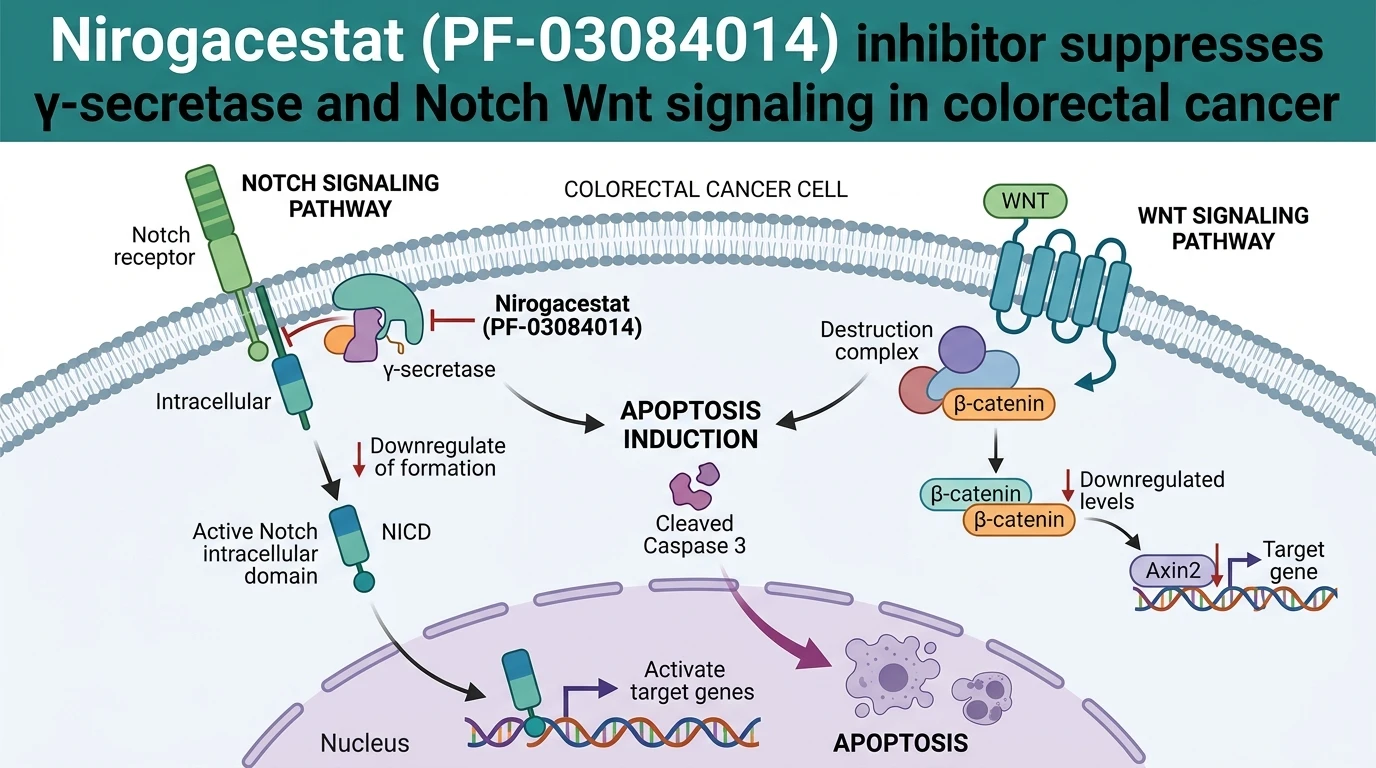
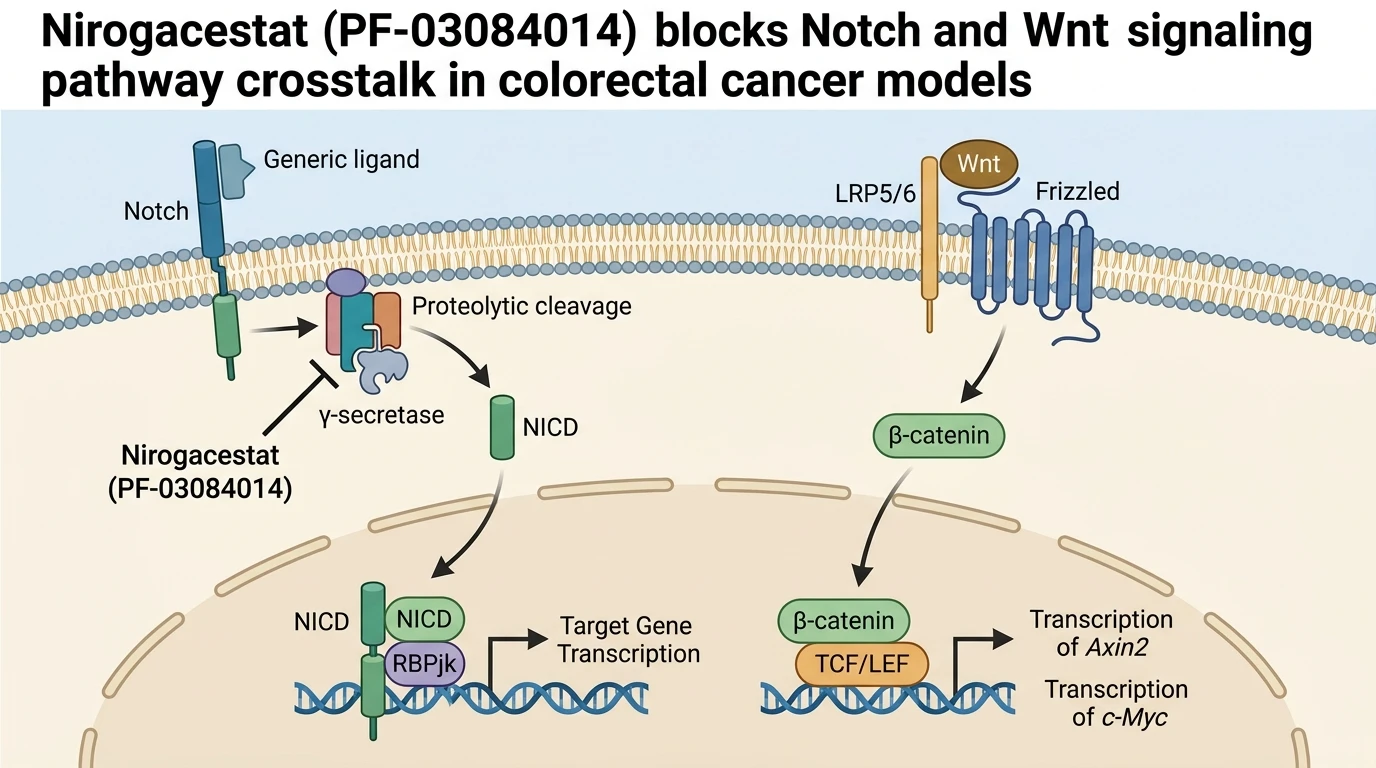
Targeted inhibition of membrane-bound protease complexes represents a precise pharmacological strategy in oncology. The intramembrane aspartyl protease γ-secretase executes the final cleavage step required for Notch receptor activation. Following ligand engagement, γ-secretase cleavage liberates the Notch intracellular domain (NICD), which translocates to the nucleus to assemble a transcriptional complex with RBPjk. In intestinal tissues, this pathway intersects with canonical Wnt signaling, where β-catenin accumulation drives stem cell maintenance and oncogenic transformation. Nirogacestat (PF-03084014) was designed as a potent, reversible γ-secretase inhibitor to disrupt this signaling interface. In preclinical patient-derived colorectal cancer (CRC) explant models, targeting this catalytic complex revealed distinct response phenotypes dependent on baseline pathway activity.
Evaluation across sixteen patient-derived CRC explants established a heterogeneous response profile to γ-secretase inhibition. A distinct subgroup comprising explants CRC001, CRC021, and CRC040 demonstrated significant tumor growth inhibition following treatment. Molecular characterization of these responsive tumors revealed co-occurring elevations in baseline Notch and canonical Wnt activity prior to therapeutic intervention. High initial levels of cleaved Notch1 coincided with nuclear active β-catenin and elevated baseline expression of the Wnt target gene Axin2. Administration of the PF-03084014 inhibitor induced marked pharmacodynamic changes specifically within this sensitive subset. Treatment rapidly reduced cleaved Notch1 concentrations, confirming target engagement within the tumor tissue. Concurrently, levels of active non-phosphorylated β-catenin and Axin2 transcript fell, demonstrating functional crosstalk suppression between Notch processing and canonical Wnt output.
Pharmacodynamic analysis further linked this signaling inhibition to programmed cell death in responsive explants. Exposure to Nirogacestat (PF-03084014) elevated cleaved caspase-3 and cleaved poly(ADP-ribose) polymerase (PARP) markers. Apoptotic induction occurred alongside marked dephosphorylation of the NF-κB subunit p65 at Ser536, pointing to multi-pathway signaling normalization in sensitive tissues. To confirm that observed antitumor actions stemmed specifically from Notch suppression rather than uncharacterized off-target proteolysis, investigators utilized genetic silencing models. Knockdown of RBPjk in HCT116 colorectal xenografts phenocopies the growth inhibition and biomarker modulation seen with small-molecule γ-secretase blockade. These experimental findings indicate that tumor responsiveness to γ-secretase inhibition requires co-existing activation of both Notch and Wnt cascades, providing a concrete mechanistic rationale for biomarker-driven patient selection in colorectal carcinoma.
Pharmacological Evaluation and Pathway Crosstalk Dynamics in Preclinical CRC
Copy code to add this image to your page
Nirogacestat (PF-03084014) is a selective γ-secretase inhibitor that blocks Notch receptor cleavage, attenuating nuclear NICD accumulation. In susceptible patient-derived colorectal cancer models characterized by baseline Notch and canonical Wnt activation, treatment decreases active β-catenin and Axin2 expression. Downstream pharmacodynamic effects include p65 dephosphorylation and apoptotic cascade initiation marked by caspase-3 and PARP cleavage.
Baseline Dual Pathway Elevation Predicts Explant Sensitivity
Screening across sixteen patient-derived CRC explants identified three highly responsive models: CRC001, CRC021, and CRC040. Tumor volume regression occurred exclusively in models presenting elevated baseline levels of both cleaved Notch1 and active β-catenin. Non-responsive explants lacked this dual activation signature. Primary pathway status governed drug susceptibility. Administration of the PF-03084014 inhibitor suppressed tumor progression in a dose-dependent manner within sensitive explants. Vehicle-treated control tumors grew rapidly. These empirical observations establish that baseline transcriptional co-activation of Notch and Wnt cascades is necessary for therapeutic sensitivity in this setting.
Targeted Inhibition Attenuates Active β-Catenin and Axin2
Dosing with Nirogacestat (PF-03084014) disrupted downstream signaling nodes across multiple pathways in sensitive explant tissues. Intracellular cleaved Notch1 levels declined rapidly upon compound administration. Downstream Wnt effector expression decreased in parallel; active β-catenin protein and Axin2 mRNA concentrations were markedly diminished. Phosphorylation of p65 at Ser536 was similarly attenuated. Apoptotic execution followed signal suppression. Proteolytic activation of caspase-3 and PARP cleavage increased significantly in treated samples. Cellular viability declined sharply as pathway crosstalk dissolved.
RBPjk Knockdown Confirms Notch Specificity in Xenografts
Genetic validation isolated the precise contribution of Notch pathway signaling in colorectal models. Depletion of RBPjk via short hairpin RNA in HCT116 cell lines reproduced the phenotypic effects of chemical γ-secretase blockade. In vivo testing demonstrated that HCT116 xenografts bearing RBPjk knockdown exhibited restricted tumor proliferation relative to scrambled controls. Dosing the PF-03084014 inhibitor in this knock-down background yielded no additive growth suppression. Target specificity remained intact. These results indicate that drug efficacy relies on functional Notch transcriptional machinery in sensitive cellular contexts.