Topotecan HCl Inhalation Enhances Targeted Topoisomerase I Inhibition in Lung Cancer Models
Copy code to add this image to your page
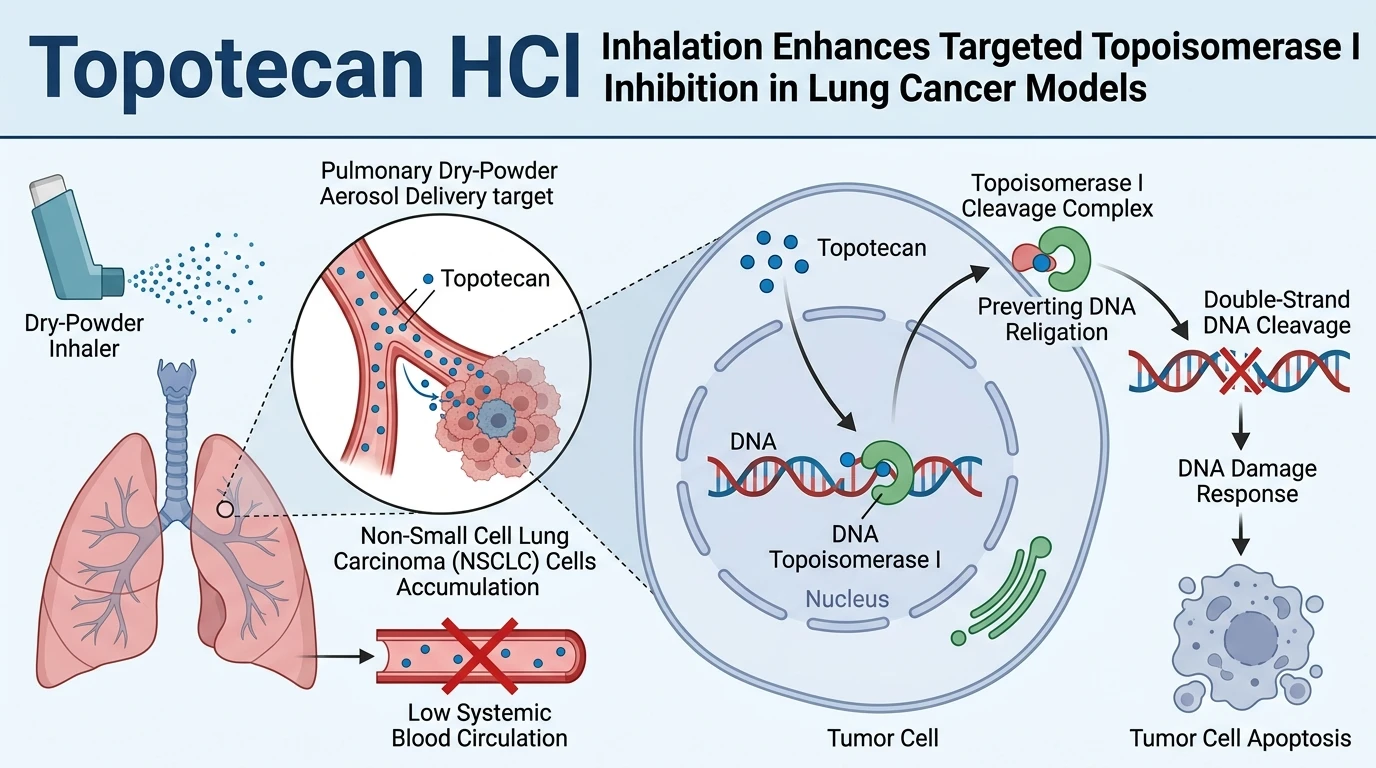
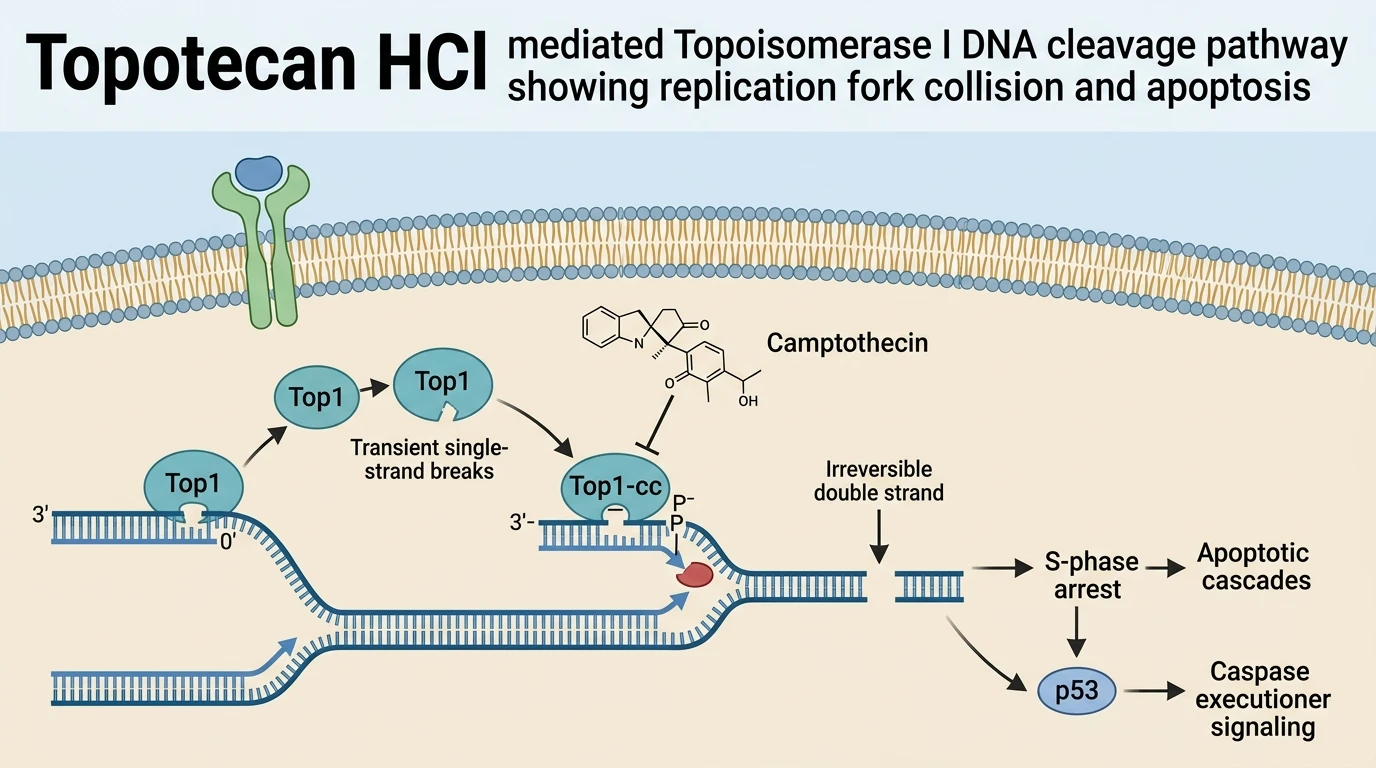
Topoisomerase I (Top1) is an essential monomeric nuclear enzyme that relieves helical torsional strain generated during DNA replication, transcription, and repair. By generating a transient single-strand nick and forming a covalent 3'-phosphotyrosyl cleavage complex (Top1-cc) with the DNA backbone, Top1 permits controlled relaxation of supercoiled DNA prior to executing strand re-ligation. Topotecan HCl, a semi-synthetic water-soluble analog of camptothecin, intercalates into the DNA cleavage site at the Top1-DNA interface. This non-covalent trapping stabilizes the transient covalent intermediate, reversibly inhibiting the re-ligation phase of the catalytic cycle.
When advancing DNA replication forks encounter these persistent Top1-cc lesions during S-phase, the collision converts single-strand nicks into lethal, irreversible double-strand DNA breaks. This structural lesion triggers ataxia telangiectasia and Rad3-related (ATR) kinase activation, downstream phosphorylation of H2AX, S-phase cell cycle arrest, and initiation of apoptosis via executioner caspases. Despite potent intrinsic antineoplastic activity, systemic administration of Topotecan HCl is severely constrained by systemic dose-limiting toxicities. Neutropenia, severe thrombocytopenia, and gastrointestinal mucosal injury often necessitate dose reductions or treatment cessation in clinical settings. Furthermore, rapid systemic clearance and limited tissue penetration restrict localized therapeutic concentration within pulmonary malignancies.
Direct pulmonary delivery via engineered dry-powder inhalation represents an advantageous strategy for non-small cell lung cancer (NSCLC) therapy. Formulating the drug as a microparticle dry powder enables targeted aerosol deposition directly into the deep lung tissue. In an orthotopic rat model of NSCLC, inhalation of dry-powder Topotecan HCl fundamentally altered regional drug disposition relative to systemic intravenous administration. Quantitative pharmacokinetic profiling demonstrated that aerosol inhalation increased lung tissue drug exposure (area under the curve, AUC) by approximately 30-fold. In parallel, local pulmonary half-life was significantly extended due to sustained tissue retention within the bronchial and alveolar epithelium.
Crucially, high regional exposure was achieved alongside a striking suppression of peak systemic blood concentrations (Cmax). Low systemic Cmax mitigates off-target tissue accumulation, particularly within bone marrow reserves. In comparative toxicological analyses, animals treated with systemic intravenous formulations exhibited marked myelosuppression and systemic weight loss. In contrast, rodents receiving inhalable dry-powder Topotecan HCl maintained stable peripheral blood cell counts, preserving bone marrow cellularity throughout treatment cycles.
Therapeutic trials in orthotopic lung tumor models confirmed that enhanced local exposure translates directly into superior antitumor control. In rats bearing aggressive, EGFR-mutant H1975 orthotopic lung tumors, weekly inhalation of dry-powder Topotecan HCl at 1 mg/kg achieved an 80% long-term survival rate. Conversely, animals treated with twice the dose delivered intravenously (2 mg/kg) achieved a survival rate of only 7%. Tumor tissue harvested from inhaled treatment groups displayed pronounced apoptosis and reduced Ki-67 proliferation indexes.
Similarly, in orthotopic lung models using A549 human lung adenocarcinoma cells, dry-powder inhalation reduced total lung tumor burden by 5.2-fold relative to intravenous administration at twice the total dose. Histodynamic evaluation confirmed extensive intraluminal tumor regression without inducing lung parenchymal inflammation or systemic toxicity.
At physiological pH, camptothecin derivatives exist in a dynamic equilibrium between an active closed lactone ring and an inactive open carboxylate form. Systemic intravenous infusion exposes the lactone ring to human serum albumin, which preferentially binds the open carboxylate state and drives hydrolytic inactivation. Direct dry-powder pulmonary aerosolization bypasses systemic plasma hydrolysis. Delivering the compound directly into the pulmonary lumen preserves the active lactone configuration at the target tumor site, optimizing localized target engagement before systemic clearance occurs. These combined findings establish that regional inhalation delivery of topoisomerase I inhibitors provides an effective pharmacological approach for pulmonary malignancies.
Pharmacokinetic Optimization and Regional Efficacy in Orthotopic Tumors
Copy code to add this image to your page
Topotecan HCl acts as a semi-synthetic derivative of camptothecin that selectively targets Topoisomerase I (Top1). By intercalating at the DNA-Top1 cleavage interface, the compound stabilizes the transient covalent Top1-DNA complex, halting DNA re-ligation. Formulated as an inhalable dry powder for pulmonary administration, local tissue deposition achieves high regional concentrations within pulmonary parenchyma. This localized accumulation drives lethal double-strand DNA breaks upon replication fork collision in malignant cells, providing marked local tumor regression while attenuating systemic dose-limiting toxicities such as myelosuppression.
Pulmonary Exposure Dynamics and Systemic Cmax Suppression
Direct aerosol administration alters tissue disposition profiles in orthotopic rat models. Aerosolized dry-powder inhalation yields a 30-fold increase in pulmonary tissue AUC relative to intravenous delivery. Local residence time expands significantly. Topotecan HCl concentration in lung parenchyma remains elevated for extended periods. Conversely, systemic Cmax values decline precipitously. Plasma clearance profiles confirm low systemic bioavailability following targeted inhalation; this systemic reduction minimizes off-target toxicity. Bone marrow cellularity remains undisturbed during localized exposure cycles. High local tissue concentration drives steady-state Top1 cleavage complex entrapment without systemic myelosuppression.
Survival Advantage and Tumor Mass Reduction in NSCLC Models
Inhaled therapy yields marked efficacy advantages in aggressive orthotopic lung cancer models. Weekly inhalation of Topotecan HCl at 1 mg/kg boosted survival to 80% in rats harboring H1975 tumors. In contrast, intravenous administration at 2 mg/kg produced a dismal 7% survival rate. The dosage reduction was accompanied by superior survival outcomes. In additional trials evaluating A549 adenocarcinoma lesions, pulmonary aerosol delivery decreased tumor burden by 5.2-fold compared to double the intravenous dose. Peripheral blood counts showed no myelosuppressive toxicity in aerosol-treated animals. Local pulmonary delivery establishes a wide therapeutic margin in these preclinical models.