Sorafenib Tosylate (BAY 43-9006) Multikinase Inhibition via Sodium Selenite Nanoparticles in Hepatocellular Carcinoma
Copy code to add this image to your page
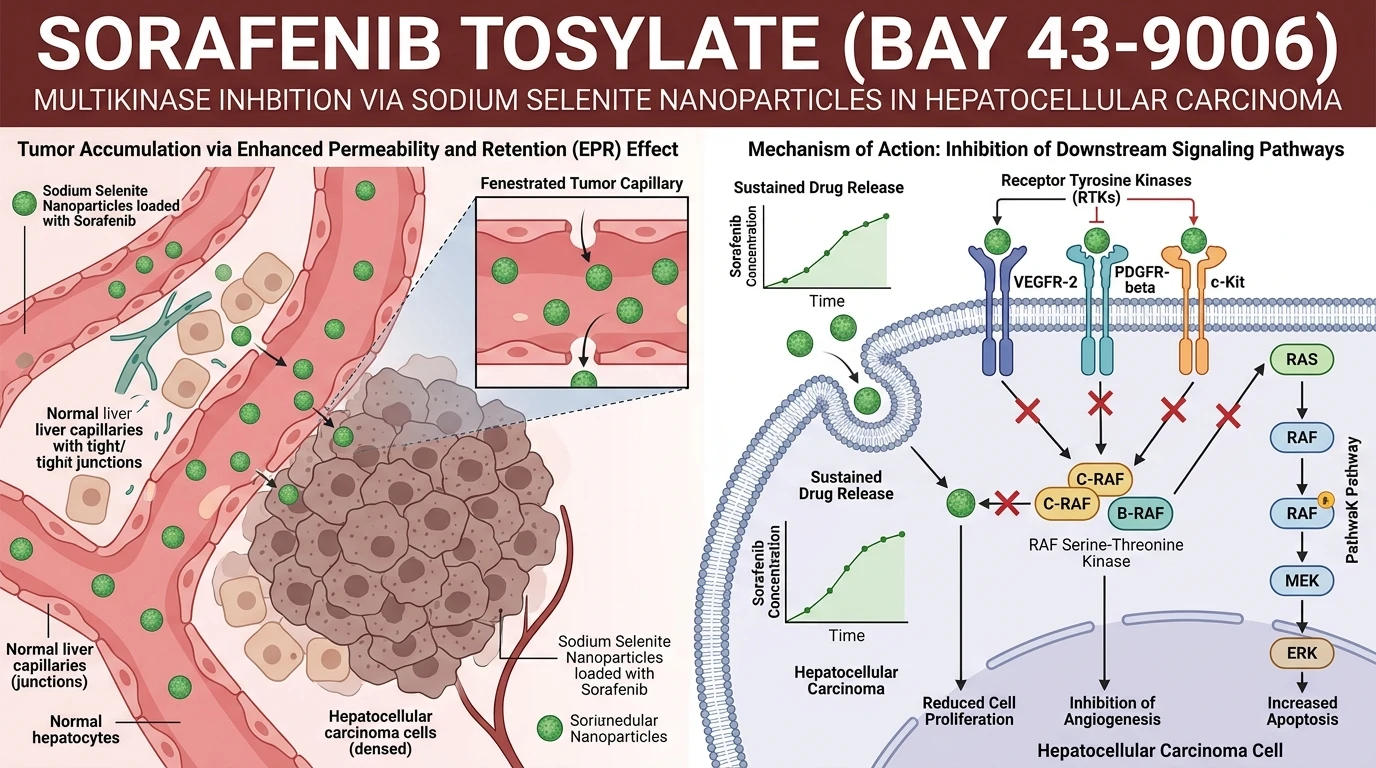
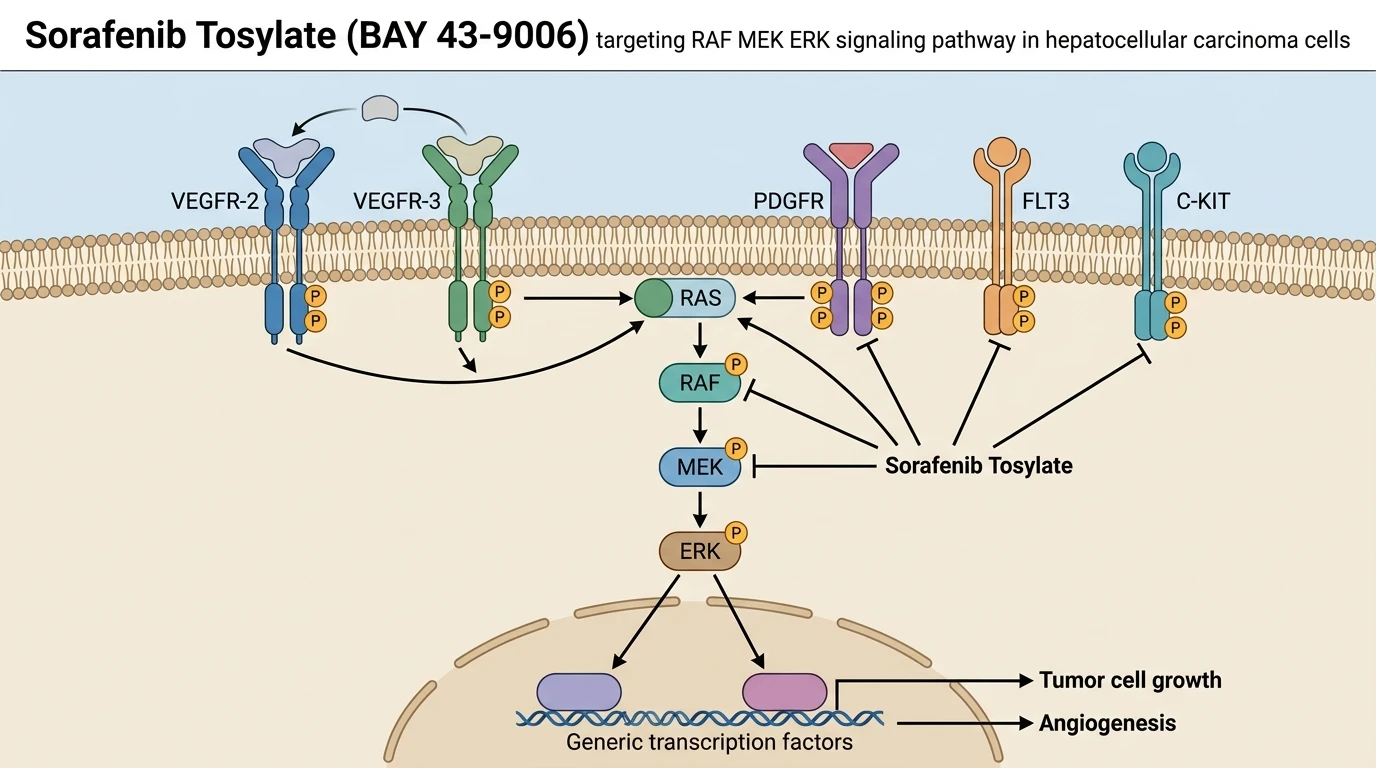
Primary liver malignancies, predominantly hepatocellular carcinoma (HCC), present significant therapeutic challenges owing to systemic toxicity and narrow therapeutic windows associated with conventional small-molecule kinase inhibitors. Sorafenib Tosylate (BAY 43-9006) functions as an oral multikinase inhibitor engineered to suppress tumor cell proliferation and tumor angiogenesis. At the molecular level, Sorafenib Tosylate (BAY 43-9006) targets intracellular RAF serine-threonine kinases—specifically CRAF (Raf-1) and mutant or wild-type BRAF—while concurrently binding cell-surface receptor tyrosine kinases. These receptor targets encompass vascular endothelial growth factor receptors 2 and 3 (VEGFR-2, VEGFR-3), platelet-derived growth factor receptor beta (PDGFR-β), receptor tyrosine kinase FLT3, and stem cell factor receptor C-KIT. Under physiological conditions, activation of these receptor tyrosine kinases triggers downstream signaling cascades that govern vascular endothelial cell migration, vessel formation, and parenchymal tumor growth.
Inhibition of RAF serine-threonine kinase disrupts the canonical RAF/MEK/ERK signaling pathway. Binding of Sorafenib Tosylate (BAY 43-9006) to the ATP-binding pocket of RAF stabilizes an inactive kinase conformation, preventing subsequent phosphorylation of downstream dual-specificity mitogen-activated protein kinase kinases (MEK1/2). Consequently, phosphorylation of extracellular signal-regulated kinases (ERK1/2) is suppressed. Because ERK translocation to the cell nucleus is required for transcription factor activation (such as c-Fos and c-Jun), blockade of this axis arrests cell cycle progression at the G1/S transition. Simultaneously, inhibition of VEGFR-2, VEGFR-3, and PDGFR-β on peritumoral endothelial cells and vascular smooth muscle cells impedes pro-angiogenic signaling cascades. This dual mechanism diminishes microvascular density while increasing apoptosis within malignant hepatic tissues.
Despite demonstrated clinical utility, oral administration of Sorafenib Tosylate (BAY 43-9006) causes off-target systemic toxicities, including hand-foot skin reactions, severe diarrhea, hypertension, and fatigue. These adverse events frequently necessitate dose reductions or treatment interruption, compromising long-term therapeutic efficacy. To address these pharmacokinetic constraints, recent nanoformulation strategies focused on developing an injectable sodium selenite nanoparticle delivery system (SSSNP). Sodium selenite serves both as an inorganic selenium source capable of inducing cellular oxidative stress in tumor cells and as a structural nanocarrier matrix. Among various preparation techniques evaluated, a solvent evaporation methodology using 0.5% w/v tripolyphosphate (TPP) as an ionic crosslinking agent yielded the optimal physical formulation.
Physical characterization of the optimized SSSNP formulation demonstrated robust colloidal properties suitable for parenteral administration. Dynamic light scattering and microscopic analyses revealed smooth, crystal-like particles with hydrodynamic diameters predominantly distributed between 200 and 320 nm. Zeta potential measurements indicated a strongly negative surface charge of -37.5 mV, accompanied by a high electrophoretic mobility of 33.5 mS/cm. These electrostatic parameters provide sufficient interparticle repulsion to prevent aggregation in aqueous dispersion. The polydispersity index (PDI) measured approximately 0.4, indicating moderate dimensional distribution appropriate for polymeric-inorganic hybrid matrices. Particle sizes within the 200–320 nm range leverage the fenestrated microvasculature of hepatic tumors to achieve localized accumulation through the enhanced permeability and retention (EPR) effect. This sustained-release nanoparticle matrix provides a viable parenteral strategy to enhance localized target delivery while mitigating oral toxicity profiles in hepatocellular carcinoma models.
Formulation Optimization and Physical Characterization Analysis
Copy code to add this image to your page
Sorafenib suppresses tumor growth and angiogenesis by targeting RAF serine-threonine kinase alongside receptor tyrosine kinases VEGFR-2, VEGFR-3, PDGFR, FLT3, and C-KIT. Encapsulation into sodium selenite nanoparticles via solvent evaporation utilizing tripolyphosphate crosslinking provides sustained drug release, exploiting the enhanced permeability and retention effect to increase hepatic tumor exposure while reducing systemic toxicity.
Tripolyphosphate Crosslinking Yields Sub-350 Nanometer Colloidal Formulations
Solvent evaporation utilizing 0.5% w/v tripolyphosphate established the optimal formulation matrix for nanocarrier construction. Dynamic light scattering confirmed particle sizes predominantly falling between 200 and 320 nm; this dimension range matches vascular fenestrations typical of liver malignancies. Polydispersity index values remained centered near 0.4. The physical crosslinking density prevented premature drug leaching during phase separation. The incorporation of Sorafenib Tosylate (BAY 43-9006) into injectable sodium selenite nanoparticles stabilized the hybrid organic-inorganic matrix without altering primary crystal morphology.
Electrokinetic Characterization Confirms Long-Term Suspensional Stability
Surface charge analysis yielded a negative zeta potential of -37.5 mV under standard physiological buffer conditions. High electrostatic repulsion retards particle coalescence in aqueous dispersion over prolonged storage intervals. Electrophoretic mobility measured 33.5 mS/cm, confirming dense surface charge distribution across the ionic boundary layer. Microscopy revealed smooth, crystal-like surface features across independently synthesized formulation batches. Structural integrity remained intact upon reconstitution in isotonic media.
Passive Hepatic Accumulation via EPR Microvascular Fenestrations
Targeted delivery relies on the enhanced permeability and retention effect within hypervascular liver tumors. Injectable sodium selenite nanoparticles exploit compromised endothelial junctions to accumulate within parenchymal lesions. Sustained release kinetics attenuate systemic peak drug levels. By providing controlled delivery of Sorafenib Tosylate (BAY 43-9006), the carrier system reduces off-target tissue exposure compared to conventional oral dosing schedules. Observed safety metrics suggest reduced gastrointestinal and dermatologic toxicities in tested models.