LY3009120 Inhibits c-Raf ERK Signaling to Reverse DOCK1-Driven Endometrial Cancer Progression
Copy code to add this image to your page
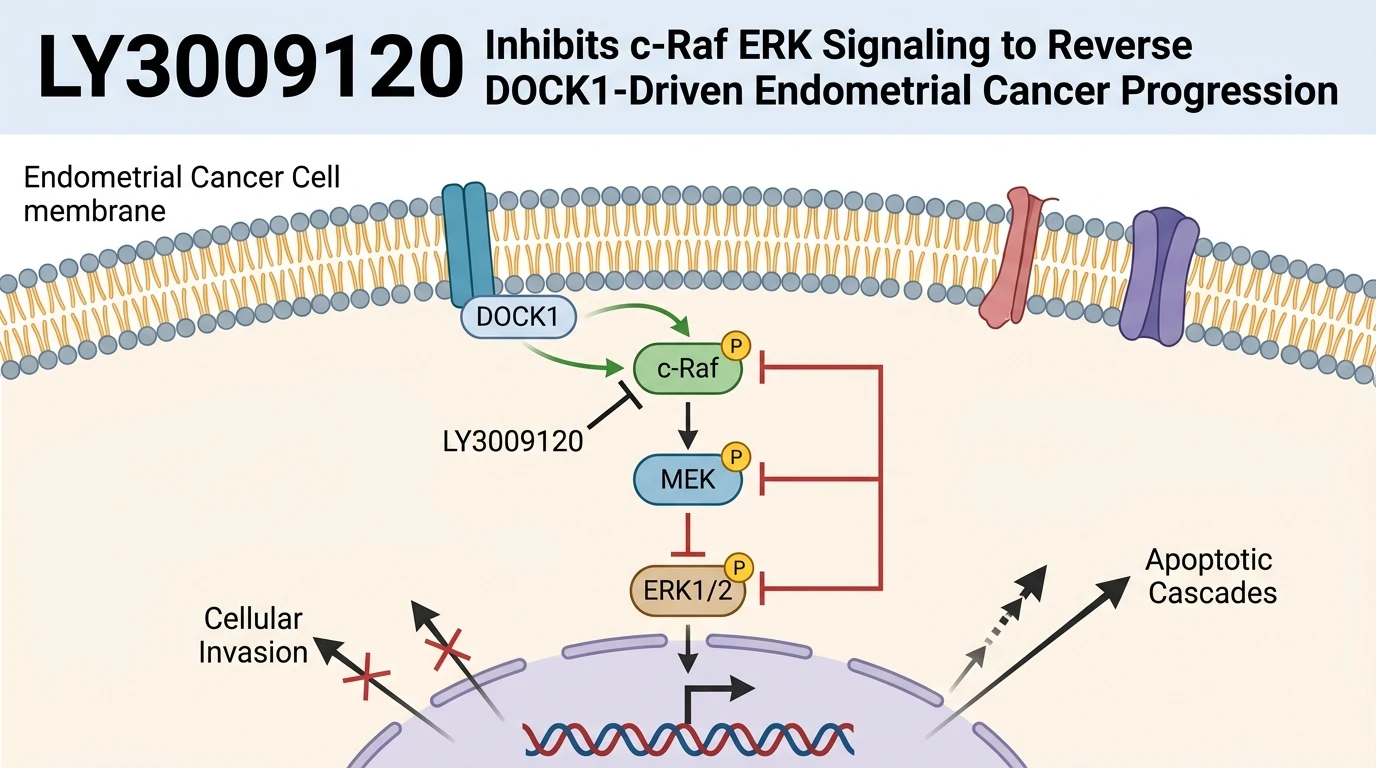
Endometrial carcinoma represents a significant clinical challenge due to dysregulated oncogenic signaling networks that facilitate hyperproliferation and metastatic dissemination. Bioinformatic profiling and tissue microarray analyses reveal marked upregulation of Dedicator of Cytokinesis 1 (DOCK1) in human endometrial cancer tissues relative to adjacent non-neoplastic controls. Elevated DOCK1 expression correlates strongly with advanced clinical staging, heightened cell viability, and enhanced migratory capacity. At the molecular level, DOCK1 operates as a guanine nucleotide exchange factor that coordinates signal transduction networks driving cytoskeletal remodeling and proliferative cellular programs.
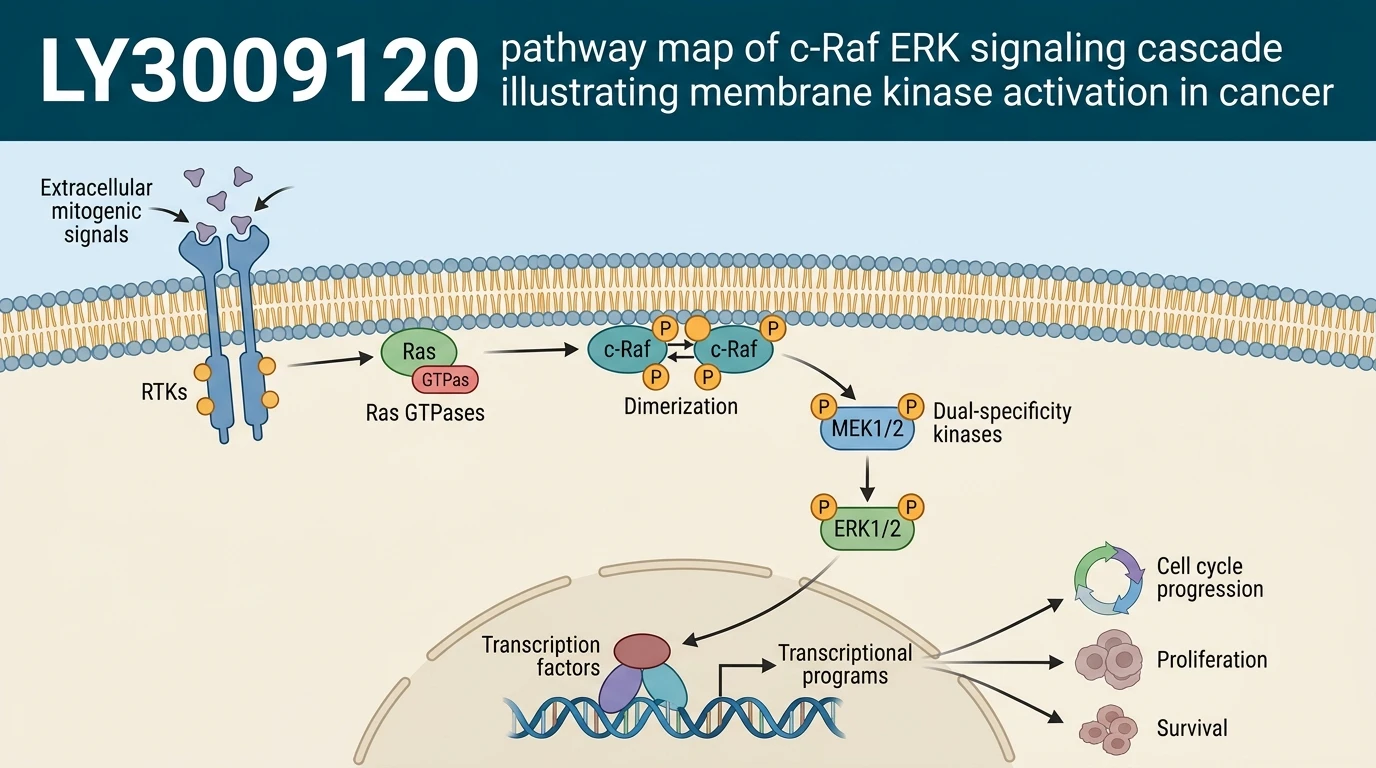
Mechanistic evaluations indicate that DOCK1 potentiates oncogenic phenotypes by activating the canonical c-Raf / ERK signaling pathway. Receptor tyrosine kinase stimulation or intracellular signaling cues promote DOCK1 engagement, which facilitates the recruitment and subsequent phosphorylation of c-Raf (Raf kinase) at key activation loop residues. Phosphorylated c-Raf functions as an obligate upstream kinase for dual-specificity mitogen-activated protein kinase kinases 1 and 2 (MEK1/2). Dual phosphorylation of MEK1/2 triggers the catalytic activation of extracellular signal-regulated kinases 1 and 2 (ERK1/2). Upon activation, phosphorylated ERK1/2 translocates to the nuclear compartment to activate transcription factors controlling cell cycle entry, including cyclin D1, while suppressing pro-apoptotic effectors such as Bad and caspase cascades.
Overexpression of DOCK1 in endometrial cancer cell lines causes sustained, constitutive phosphorylation of c-Raf and ERK1/2. This sustained signaling drive accelerates cell cycle progression, enhances transwell invasion, and reduces baseline apoptotic rates under serum-starved conditions. Pharmacological disruption of this axis presents a strategic vulnerability. Targeted intervention using LY3009120, a potent small-molecule pan-Raf inhibitor targeting c-Raf, directly engages the ATP-binding pocket of the kinase domain. In DOCK1-overexpressing cell models, application of LY3009120 at nanomolar concentrations rapidly diminishes c-Raf autophosphorylation and abolishes downstream ERK1/2 phosphorylation.
Biochemical characterization reveals that LY3009120 exhibits high target occupancy for c-Raf without triggering the paradoxical activation often associated with first-generation monomeric Raf inhibitors. By binding both protomers within Raf dimers, LY3009120 blocks catalytic activity regardless of the upstream Ras activation state. In endometrial cancer cells harboring elevated DOCK1 expression, LY3009120 treatment systematically reverses DOCK1-dependent functional phenotypes. Cellular assays demonstrate significant reductions in cell proliferation indices and colony formation capacity. Furthermore, invasion through Matrigel matrix panels is suppressed, alongside marked inhibition of wound closure rates in scratch assays.
At the biochemical level, attenuation of ERK1/2 phosphorylation by LY3009120 restores apoptotic susceptibility. Flow cytometric analysis with Annexin V/propidium iodide staining shows a pronounced rise in early and late apoptotic cell populations following drug exposure. Cleavage of poly(ADP-ribose) polymerase (PARP) and activation of caspase-3 increase in a dose-dependent manner. Cross-talk analysis reveals that while the MAPK signaling axis directly regulates survival, parallel nodes such as the mTOR pathway protein network participate in cellular metabolic adaptions during c-Raf suppression. Quantitative Western blot assays confirm that treatment with LY3009120 yields a dose-dependent decrease in phosphorylated c-Raf (Ser338) and phosphorylated ERK1/2 (Thr202/Tyr204) levels, whereas total protein expression of c-Raf and ERK1/2 remains unchanged. These data confirm that LY3009120 acts as a precise inhibitor of the c-Raf / ERK cascade, capable of neutralizing DOCK1-mediated oncogenesis in preclinical endometrial cancer models.
Pharmacological Evaluation and Targeted Kinase Suppression
Copy code to add this image to your page
LY3009120 functions as a potent small-molecule pan-Raf inhibitor that targets c-Raf (Raf kinase), effectively blocking catalytic activity within the c-Raf / ERK signaling pathway. By binding to the ATP-binding site of c-Raf, LY3009120 suppresses autophosphorylation and interrupts signal transmission to downstream MEK1/2 and ERK1/2 effectors. In endometrial cancer models with DOCK1 overexpression, LY3009120 attenuates aberrant pathway hyperactivation, reversing DOCK1-induced cell proliferation, migration, and invasion while restoring normal apoptotic response pathways.
c-Raf Phosphorylation Suppression in DOCK1-Overexpressing Cells
DOCK1 over-expression accelerates endometrial cancer malignancy by maintaining elevated catalytic activity through c-Raf. In cell line models, high expression of DOCK1 elevates baseline kinase activity. LY3009120 directly inhibits c-Raf catalytic function. At physiologically relevant concentrations in vitro, administration of LY3009120 abrogated c-Raf autophosphorylation within two hours. Downstream ERK1/2 phosphorylation dropped below detectable levels. This rapid loss of signal transmission interrupted cyclin D1 transcription; cell cycle arrest at the G1 phase followed shortly thereafter. Quantitative kinase activity assays confirmed near-complete enzyme engagement. In contrast, vehicle-treated controls maintained high levels of phosphorylated ERK1/2. The observed signal inhibition remained sustained across a forty-eight-hour observation window.
Phenotypic Reversal of Invasion and Apoptotic Recovery
Hyperactive ERK signaling enables endometrial cancer cells to breach extracellular matrix boundaries and evade pro-apoptotic triggers. Exposure to LY3009120 suppressed DOCK1-induced cell motility in transwell migration assays. Invading cell counts decreased by over seventy percent compared to control groups. Scratch wound assays showed a corresponding decline in closure rates. Apoptotic pathways were concurrently reactivated. Protein analysis revealed elevated cleaved caspase-3 levels and increased PARP cleavage. Annexin V staining confirmed a sharp shift toward early apoptosis. These functional changes confirm that LY3009120 effectively neutralizes DOCK1-driven biological behaviors in patient-derived endometrial cell models.