Valemetostat (DS-3201) Valemetostat EZH1/2 Inhibition Reactivates DUSP5 to Suppress ATL Growth
Copy code to add this image to your page
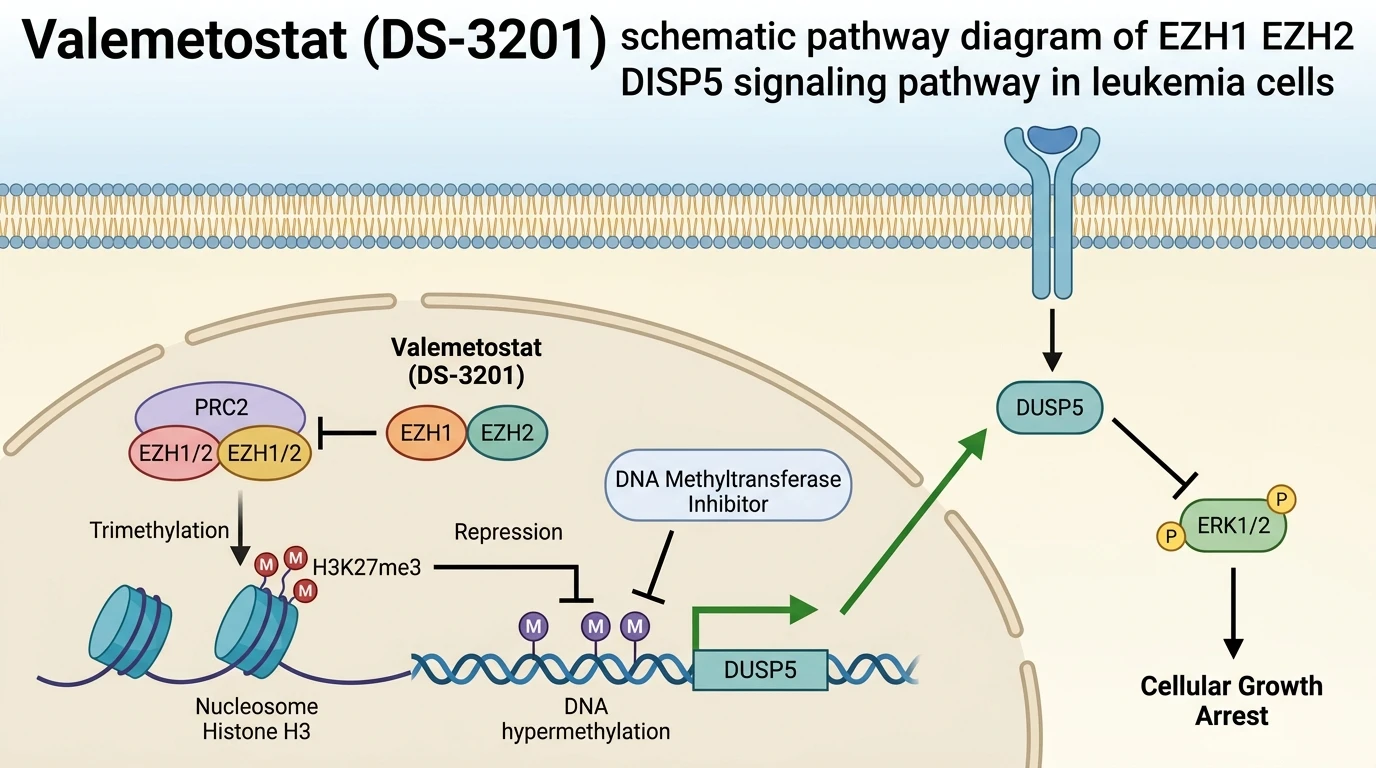
Adult T-cell leukemia/lymphoma (ATL) represents an aggressive peripheral T-cell malignancy driven by human T-cell leukemia virus type 1 (HTLV-1) infection. Epigenetic dysregulation plays a foundational role in maintaining the malignant phenotype and transcriptional silencing of tumor suppressor genes in ATL cells. Repressive chromatin structures are enforced primarily through the enzymatic activity of Polycomb repressive complex 2 (PRC2). Enhancer of Zeste Homolog 1 and 2 (EZH1 and EZH2) function as the catalytic subunits of PRC2, catalyzing trimethylation of histone H3 at lysine 27 (H3K27me3). Concurrent hypermethylation of DNA at CpG islands operates in tandem with H3K27me3 to maintain persistent transcriptional silencing across critical gene loci. Co-targeting these distinct yet interconnected epigenetic layers provides a rational strategy to overcome single-agent therapeutic resistance.
Application of epigenetic modulation mechanisms involving the dual small-molecule inhibitor Valemetostat (DS-3201) achieves potent, balanced target engagement across both EZH1 and EZH2 catalytic domains. EZH1 and EZH2 exhibit distinct yet overlapping functional roles in maintaining H3K27me3 levels. EZH2 predominantly operates in rapidly proliferating cells, whereas EZH1 maintains repressive H3K27me3 marks in non-dividing cellular states or following EZH2 inhibition. Consequently, selective inhibition of EZH2 alone frequently proves inadequate due to functional compensation by EZH1. Dual enzymatic blockade achieved through Valemetostat EZH1/2 suppression eliminates this compensatory survival pathway. When combined with DNA demethylating agents—such as the clinical-stage agent OR21 or decitabine—dual EZH1/2 inhibition produces synergistic growth inhibition in primary ATL cell lines and patient-derived primary cells.
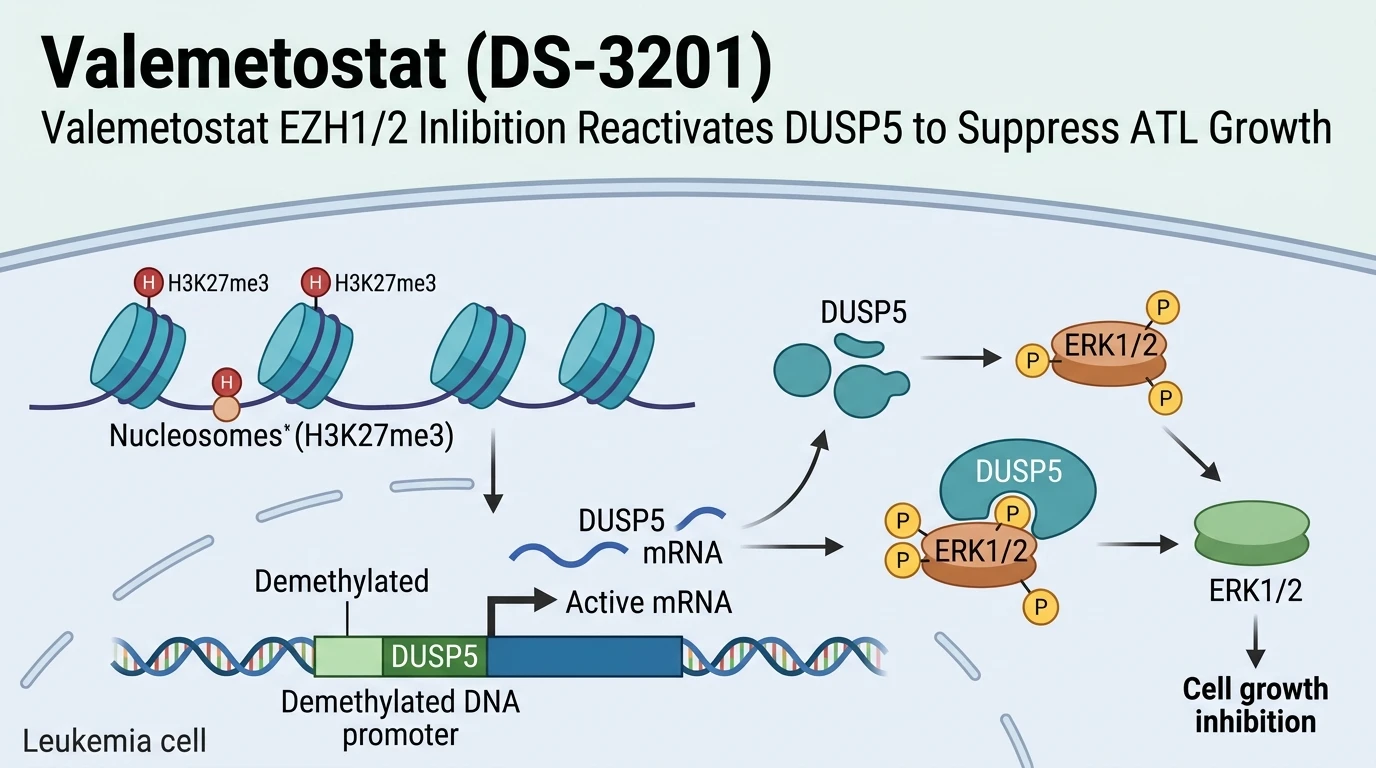
At the molecular level, this concurrent intervention targeting both DNA methyltransferases and H3K27me3 leads to substantial depletion of repressive chromatin marks across genomic targets. Quantitative chromatin immunoprecipitation and bisulfite sequencing analyses confirm simultaneous reduction of promoter H3K27me3 and 5-methylcytosine levels. A primary downstream node reactivated by this combined epigenetic remodeling is dual-specificity phosphatase 5 (DUSP5). In un-treated ATL cells, the DUSP5 gene locus remains densely hypermethylated and enriched with H3K27me3, suppressing its transcription. Combined epigenetic treatment relieves this dual transcriptional repression, restoring functional DUSP5 mRNA and protein expression.
DUSP5 functions as a inducible nuclear phosphatase with strict substrate specificity for activated Extracellular Signal-Regulated Kinases 1 and 2 (ERK1/2). In malignant ATL cells, constitutive activation of the Ras-Raf-MEK-ERK signaling axis sustains rapid cell cycle progression and anti-apoptotic signaling. Restored DUSP5 protein physically binds to phosphorylated ERK1/2 within the nucleus, catalyzing the removal of regulatory phosphate residues. Dephosphorylation inactivates ERK1/2, thereby preventing downstream phosphorylation of nuclear transcription factors, including ELK1 and AP-1 family members. This cascade disrupts oncogenic transcriptional programs and induces rapid arrest of cell cycle dynamics.
In cellular proliferation assays, combined treatment with Valemetostat (DS-3201b) and decitabine or OR21 produced synergistic cell growth inhibition across multiple ATL cell lines. Synergy was quantitatively verified using combination index calculations, demonstrating strong cooperativity at sub-micromolar drug concentrations. Crucially, non-malignant peripheral blood mononuclear cells maintained viable profiles under identical dosing regimens, indicating a favorable therapeutic window in vitro.
In vivo pharmacodynamic efficacy trials utilizing human ATL xenograft murine models corroborated these cellular observations. Co-administration of Valemetostat (DS-3201b) and decitabine achieved pronounced tumor growth inhibition and regression compared to monotherapy arms. Immunoblot analysis of excised xenograft tumor tissues confirmed global loss of H3K27me3, robust re-expression of DUSP5, and marked suppression of ERK1/2 phosphorylation. Systemic safety assessments showed no exacerbation of hematotoxicity or loss of body weight, demonstrating that simultaneous targeting of DNA and histone methylation selectively impairs leukemic cell viability in vivo.
Epigenetic Derepression and Downstream Kinase Suppression Dynamics
Copy code to add this image to your page
Valemetostat (DS-3201) functions as a dual EZH1/2 methyltransferase inhibitor that, when combined with DNA demethylating agents like decitabine or OR21, reverses epigenetic silencing in adult T-cell leukemia/lymphoma. Simultaneous reduction of global H3K27me3 and DNA methylation reactivates transcription of the tumor suppressor gene DUSP5. Elevated DUSP5 dephosphorylates active ERK1/2, suppressing downstream oncogenic ERK signaling. This dual epigenetic intervention drives selective proliferation arrest and apoptosis in ATL cells both in vitro and in murine xenograft models without escalating hematological toxicity.
Valemetostat EZH1/2 Blockade Eradicates Promoter H3K27me3 Marks
Single EZH2 inhibition fails to clear H3K27me3 in non-dividing cells. EZH1 maintains baseline catalytic activity. Simultaneous blockade of EZH1 and EZH2 using Valemetostat EZH1/2 overcomes this functional redundancy in primary leukemic cells. When paired with DNA demethylating agents like decitabine, global promoter hypermethylation drops substantially. Quantitative chromatin profiling reveals a marked loss of repressive marks across target loci within 48 hours of exposure under tested assay conditions. Transcriptional derepression follows directly from this chromatin opening. Epigenetic remodeling remains localized primarily to hypermethylated CpG islands in tested cellular models.
Restored DUSP5 Dephosphorylates ERK1/2 to Arrest Proliferation
Transcriptional reactivation of DUSP5 directly alters downstream signal transduction. DUSP5 acts as a dedicated nuclear phosphatase for ERK1/2. Downstream phosphorylation ceased within hours of drug administration. Unphosphorylated ERK1/2 can no longer translocate to the nucleus or phosphorylate key transcription factors like ELK1 and c-Fos. Cell cycle progression halted rapidly at the G1/S transition in primary patient-derived leukemic cells. Apoptotic markers, including cleaved caspase-3 and PARP, increased concomitantly within 72 hours under in vitro assay conditions. These observations confirm that DUSP5 reactivation serves as the central functional mediator bridging dual epigenetic modulation to cell death.
Combinatorial Therapy Suppresses Murine Xenograft Tumor Growth
In vivo pharmacodynamic models demonstrate robust antitumor efficacy without treatment-limiting systemic toxicity. Murine xenografts bearing human ATL cells were treated with the dual inhibitor combination over a 21-day period. Tumor volume expansion dropped significantly compared to single-agent arms. Ex vivo analysis of excised tumor tissue confirmed sustained reductions in H3K27me3 alongside elevated DUSP5 protein expression. Peripheral blood cell counts and bone marrow cellularity remained stable throughout the study schedule. The selectivity margin remained intact. These preliminary findings establish that dual target suppression selectively impairs malignant proliferation in vivo.