DMH1 TGF-beta/Smad inhibitor Engagement of ALK2 Kinase Pocket
Copy code to add this image to your page
Targeting specific nodes within the bone morphogenetic protein (BMP) and transforming growth factor-beta (TGF-beta) signaling cascades requires exceptional small-molecule selectivity. Among type I receptor serine/threonine kinases, Activin receptor-like kinase 2 (ALK2) plays a primary role in mediating BMP-dependent intracellular responses. However, designing selective inhibitors against ALK2 has historically presented a major drug design challenge due to high sequence conservation across the ATP-binding clefts of closely related family members, such as ALK5, as well as structurally distinct off-target kinases like VEGFR2. The small molecule DMH1 was identified as a potent, ATP-competitive inhibitor designed to evaluate BMP signaling blockade. Dissecting the precise molecular mechanics that govern the selectivity of the DMH1 TGF-beta/Smad inhibitor against ALK2 over ALK5 and VEGFR2 provides critical insights for rational kinase inhibitor refinement.
Conventional rigid docking methodologies frequently fail to explain the binding selectivity of small molecules within highly dynamic kinase domains. Standard docking algorithms treat protein backbones as relatively rigid entities, neglecting entropic penalties, solvent rearrangement, and subtle conformational fluctuations. In comparative studies evaluating DMH1, rigid docking calculations proved insufficient, failing to reproduce empirical binding free energies or account for off-target discrimination. To overcome these computational limitations, free energy perturbation coupled with Hamiltonian replica-exchange molecular dynamics (FEP/H-REMD) simulations were employed. FEP/H-REMD offers rigorous thermodynamic sampling by capturing protein flexibility, explicit solvent dynamics, and atomic-level electrostatic fluctuations. This advanced computational framework accurately reproduced experimental binding free energy values, revealing the precise physical interactions underlying the target selectivity of DMH1.
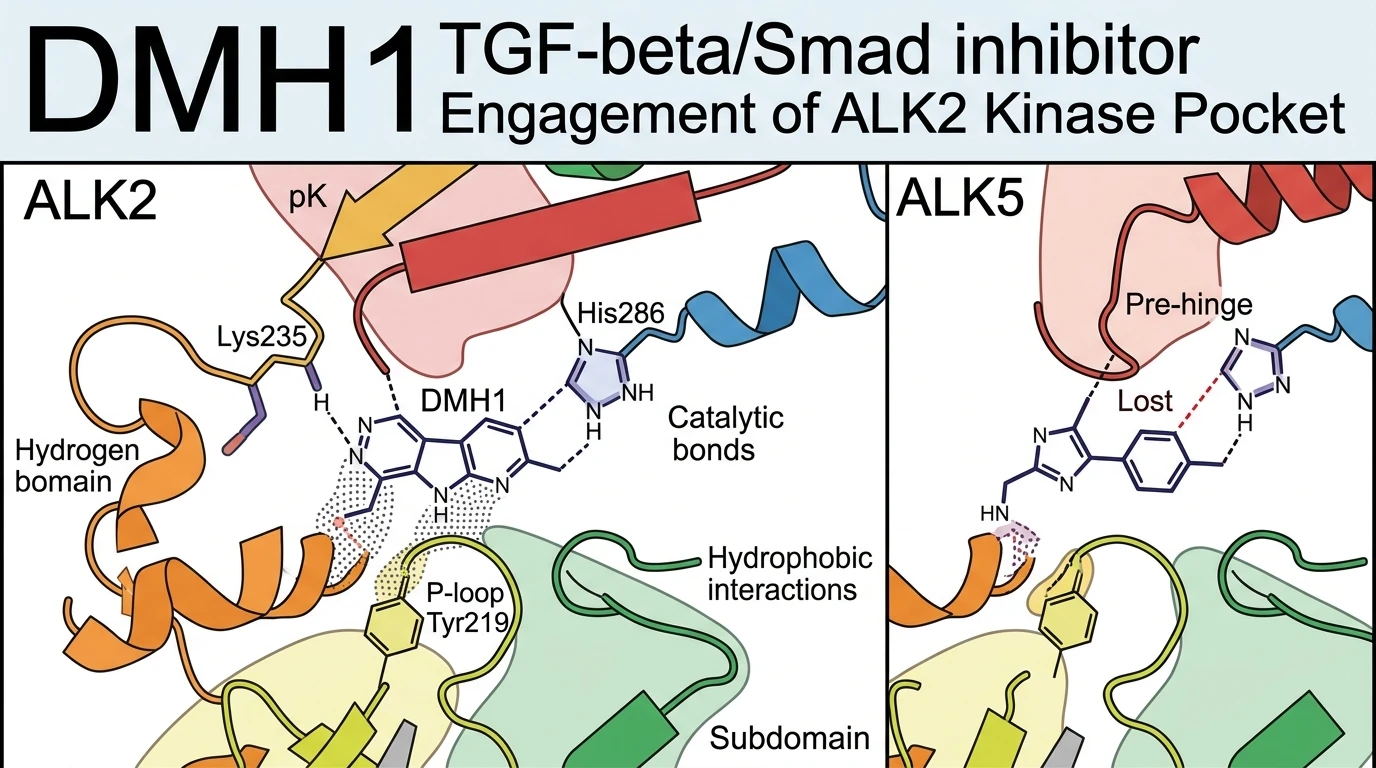
The thermodynamic analysis demonstrates that the selective binding of DMH1 to ALK2 is predominantly driven by favorable electrostatic interactions and tailored hydrophobic contacts. Within the catalytic ATP-binding pocket of ALK2, DMH1 establishes a robust hydrogen-bonding network. A key interaction occurs with the conserved catalytic lysine residue, Lys235, which anchors the inhibitor within the active cleft. Concurrently, DMH1 forms a critical backbone hydrogen bond with His286 situated in the kinase hinge region. These precise electrostatic connections are further reinforced by spatial packing against the P-loop residue Tyr219, which provides complementary hydrophobic interactions that stabilize the inhibitor-receptor complex.
In contrast, the structural basis for the reduced affinity of DMH1 toward ALK5 stems from amino acid sequence divergence localized within the pre-hinge region. Although the core catalytic residues of ALK5 share high homology with ALK2, variations in the pre-hinge region alter the steric and electrostatic environment of the binding cleft. When DMH1 engages ALK5 in molecular dynamics simulations, these pre-hinge sequence differences induce a distinct shift in the inhibitor's binding pose. This conformational reorientation forces DMH1 away from its optimal binding geometry, effectively destabilizing and eliminating the critical hydrogen bonds formed with Lys235 and the hinge region. A similar spatial disruption accounts for its weak interaction with VEGFR2, where divergent pocket geometry prevents favorable electrostatic alignment.
Collectively, these computational and structural findings emphasize that small differences in primary sequence outside the immediate catalytic center can profoundly influence binding orientation and thermodynamic stability. By characterizing the subtle conformational adjustments that drive target engagement, these mechanistic insights clarify how DMH1 achieves high target specificity for ALK2 while sparing closely related TGF-beta and vascular endothelial growth factor receptors under physiological conditions.
Therapeutic Target Selectivity and Structural Thermodynamics
Copy code to add this image to your page
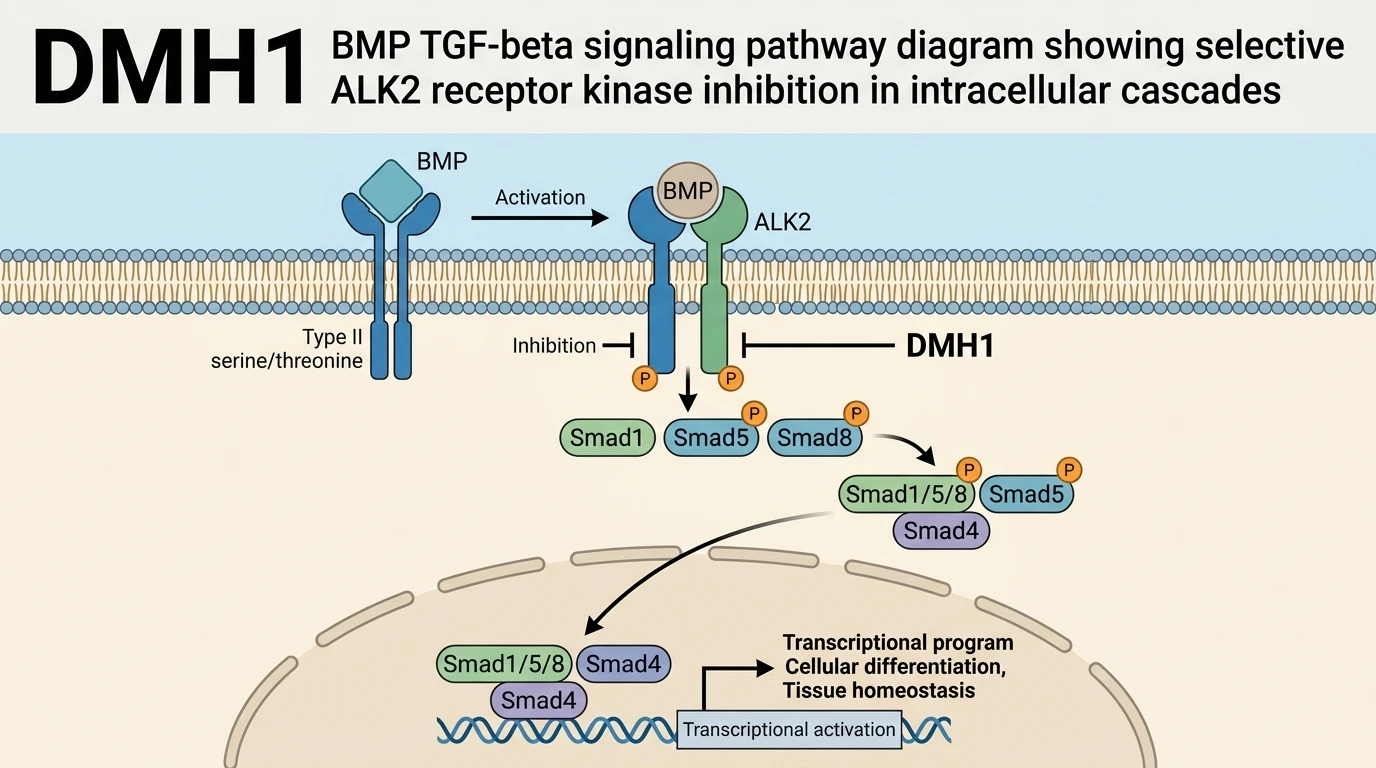
DMH1 acts as a selective, ATP-competitive inhibitor of ALK2 kinase activity. High selectivity over structural paralogs ALK5 and VEGFR2 stems from optimized electrostatic interactions within the catalytic pocket. Specifically, DMH1 forms precise hydrogen bonds with catalytic Lys235 and hinge residue His286, supported by hydrophobic packing against P-loop Tyr219. Divergent amino acid sequences in the pre-hinge region of ALK5 induce steric and electrostatic shifts that displace DMH1 from its active binding orientation, neutralizing its inhibitory potency against non-target kinases.
Electrostatic Anchoring in the ALK2 ATP-Binding Pocket
Free energy calculations delineate clear thermodynamic boundaries for target engagement. While classical rigid docking routines failed to differentiate ALK2 affinity from off-target binding, free energy perturbation coupled with Hamiltonian replica-exchange molecular dynamics simulations yielded free energy profiles matching empirical binding assays. Target selectivity depends heavily on polar contacts. Specifically, the inhibitor forms a persistent hydrogen bond with the catalytic Lys235 residue, stabilizing the active kinase conformation. An additional hydrogen bond engages hinge residue His286. These electrostatic drivers are further enhanced by hydrophobic packing against P-loop Tyr219, establishing a highly favorable energetic state within the catalytic cleft. Under tested in vitro assay conditions, these concerted contacts sustain nanomolar target engagement while preserving selectivity over closely related receptors.
Pre-Hinge Sequence Divergence Alters Binding Conformation in ALK5
Sequence variation governs off-target discrimination across receptor families. Despite structural homology within the kinase domain, ALK5 exhibits distinct sequence variations in its pre-hinge region. These subtle amino acid substitutions alter local pocket dynamics. When evaluated in computational models, the structural shift forces the DMH1 TGF-beta/Smad inhibitor to adjust its binding orientation within the ATP cleft. This conformational rotation disrupts critical electrostatic interactions with the hinge region; consequently, key hydrogen bonds observed in ALK2 are abolished, leading to a marked decrease in calculated binding free energy. Similar structural incompatibilities prevent high-affinity binding to VEGFR2. Within these specific computational and biochemical assay contexts, pre-hinge sequence divergence serves as a structural barrier to non-target kinase inhibition.