A-83-01 and A8301 Inhibition of ALK5 Kinase in Intestinal Stem Cell Cultures
Copy code to add this image to your page
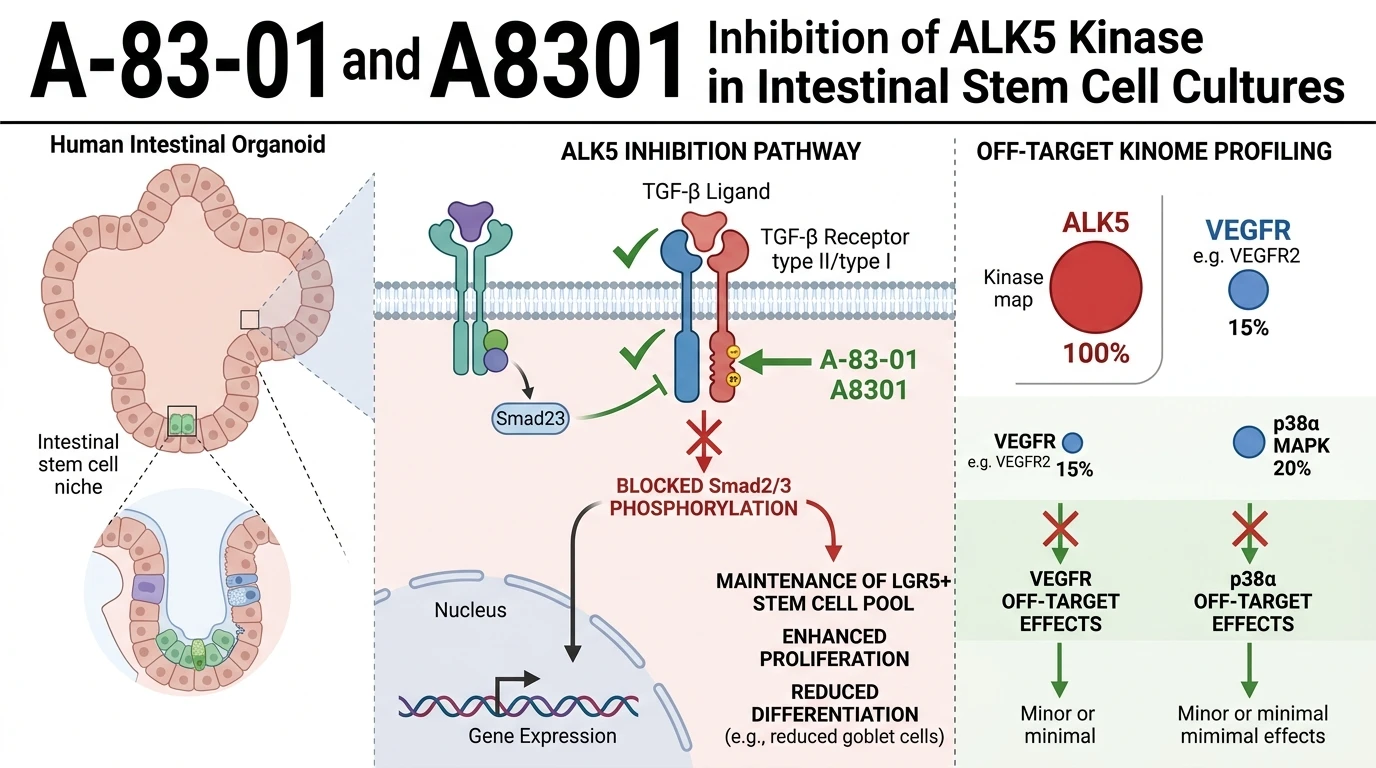
Structural and functional characterization of small-molecule kinase inhibitors has redefined in vitro cell culture, particularly in the expansion of human organoid systems. Among these tools, A-83-01 operates as a potent, ATP-competitive inhibitor of the type I transforming growth factor-beta (TGF-beta) receptor family. Its primary biochemical targets comprise ALK5 (TGFbR1), ALK4 (ActRIB), and ALK7 (ActRIC). Under physiological conditions, canonical TGF-beta ligand binding triggers serine/threonine kinase activation within the receptor complex. The activated ALK5 receptor subsequent phosphorylates the C-terminal serine residues of cytosolic effector proteins Smad2 and Smad3. Once phosphorylated, Smad2/3 form heterotrimeric complexes with Smad4, translocating to the nucleus to drive transcriptional programs associated with terminal epithelial differentiation, cell cycle arrest, and extracellular matrix deposition.
In human colorectal organoid cultures, uninhibited TGF-beta signaling drives Lgr5-positive intestinal stem cells toward irreversible differentiation into enterocytes and goblet cells, resulting in culture depletion over successive passages. By blocking the catalytic ATP-binding domain of ALK5, A-83-01 halts downstream Smad2/3 phosphorylation cascades. This biochemical arrest prevents nuclear accumulation of the Smad complex, effectively silencing the differentiation gene network. Consequently, crypt-base stem cell populations remain in an undifferentiated, self-renewing state, permitting long-term propagation and high-fidelity expansion of primary tissue-derived organoids.
Despite its high potency against ALK5, the utility of A8301 is shaped by its broader kinome interaction profile. Quantitative biochemical profiling demonstrates that the compound exhibits off-target inhibitory activity against several non-receptor tyrosine kinases and serine/threonine kinases. Prominent off-target nodes include vascular endothelial growth factor receptor (VEGFR), receptor-interacting serine/threonine-protein kinase 2 (RIPK2), MAP3K7-binding protein kinase 1 (MINK1), p38 alpha mitogen-activated protein kinase (p38 alpha MAPK), and fibroblast growth factor receptor 1 (FGFR1). At elevated concentrations or during extended incubation periods, off-target suppression of VEGFR and FGFR1 can suppress receptor tyrosine kinase pathways regulating cellular survival and growth. Concurrently, inhibition of p38 alpha MAPK and RIPK2 alters baseline stress responses and innate immune signaling cascades within multicellular matrices.
These secondary kinase interactions necessitate careful experimental consideration when designing organoid-based assays. While continuous exposure to A-83-01 is indispensable for maintaining progenitor stem cell pools during culture expansion, its persistent presence during short-term functional assays can introduce confounding artifacts. For instance, in drug sensitivity screens or immunological co-culture experiments, off-target inhibition of p38 alpha or RIPK2 may alter cytokine secretion, apoptosis kinetics, or drug transport independent of the target pathway. To establish rigorous baseline parameters, researchers frequently implement media removal protocols prior to performing phenotypic assays. Temporarily omitting the compound during acute functional evaluations mitigates off-target kinetic interference, ensuring that observed cellular responses accurately reflect target physiology rather than compound-induced kinome suppression.
Pharmacological Dynamics and Off-Target Profiling in Organoid Models
Copy code to add this image to your page
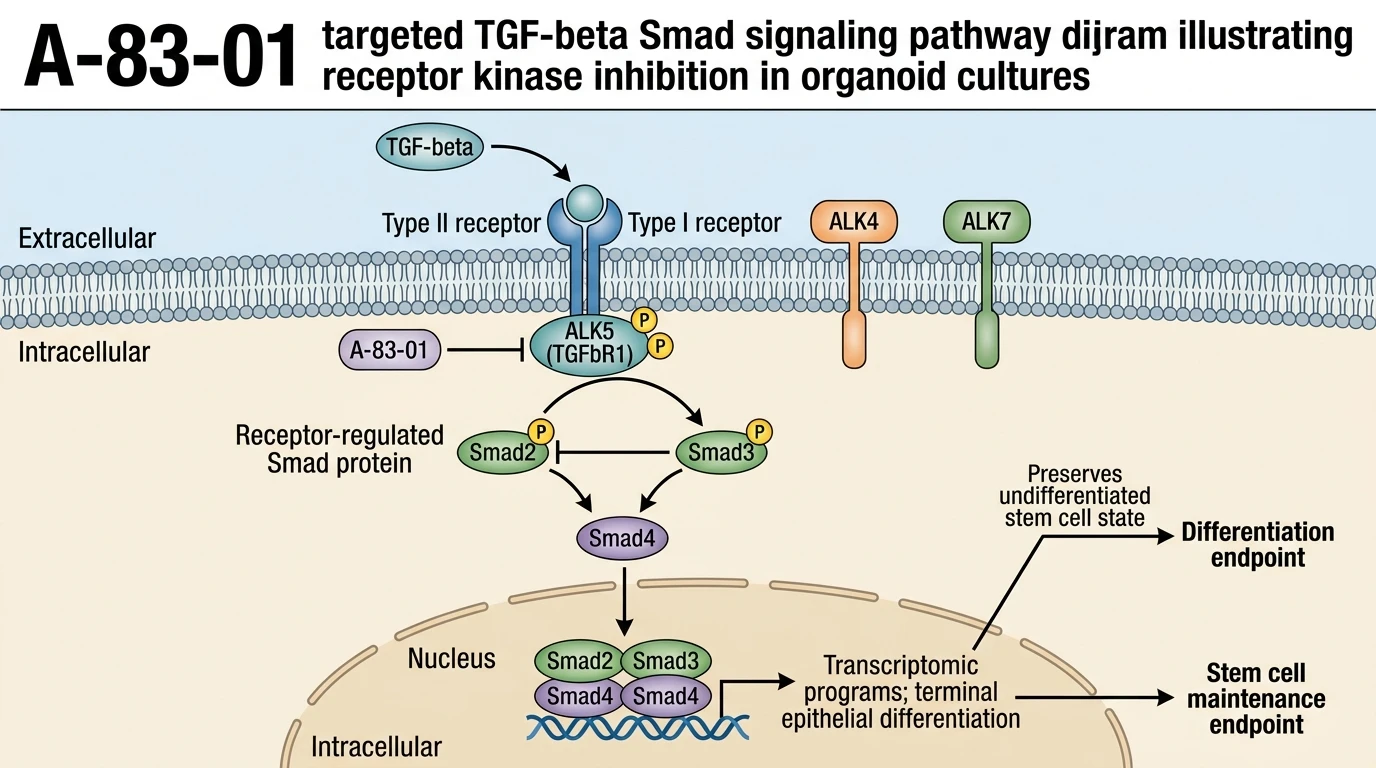
A-83-01 selectively inhibits the ATP-binding site of ALK5 (TGFbR1), ALK4, and ALK7 kinase domains. By blocking receptor autophosphorylation, the compound prevents downstream phosphorylation and nuclear translocation of Smad2 and Smad3. This inhibition suppresses TGFb-induced transcriptional cascades that trigger terminal differentiation in intestinal epithelial progenitors. Consequently, stem cells retain self-renewal capacity during extended in vitro culture. Concurrent secondary inhibition of non-canonical off-targets—including VEGFR, RIPK2, MINK1, p38a MAPK, and FGFR1—alters collateral immune, vascular, and cell cycle signaling profiles in complex multicellular culture systems.
Suppression of Smad2/3 Phosphorylation Preserves Intestinal Stemness
Transforming growth factor-beta signals enforce terminal epithelial differentiation. In human colorectal organoid cultures, ligand engagement of the ALK5 receptor triggers phosphorylation of cytosolic Smad2 and Smad3 at their C-terminal serine residues. This phosphorylation event promotes nuclear translocation. When the small molecule inhibitor A8301 is introduced, ATP-competitive binding at the ALK5 kinase domain blocks this active phosphorylation cascade. Stem cell differentiation halts rapidly. Under these defined in vitro conditions, Lgr5-positive intestinal stem cells retain their capacity for self-renewal, enabling sustained organoid passaging across multiple generations without lineage commitment.
Kinome Profiling Reveals Polypharmacological Off-Target Interferences
Kinase selectivity remains a contextual variable. Beyond its primary affinity for ALK5, ALK4, and ALK7, biochemical profiling indicates that A-83-01 engages non-target kinases at physiologically relevant nanomolar to micromolar concentrations. Off-target inhibition affects multiple pathways. Cross-reactivity against VEGFR and FGFR1 alters receptor tyrosine kinase signaling, while inhibition of p38a MAPK and RIPK2 disrupts downstream inflammatory and stress-response networks. MINK1 activity drops under identical assay conditions. In complex co-culture or multicellular organoid systems, these off-target events can mask phenotypic responses, confounding data interpretation regarding pure TGF-beta signaling downstream.
Protocol Design Recommendations for Short-Term Functional Assays
Experimental design requires targeted media manipulation. While continuous exposure to A8301 is required for maintaining stem cell pools, its persistent presence during acute drug screening or cell fate assays introduces unwanted bioassay artifacts. Kinase washouts prevent baseline cross-reactivity. Removing the compound from the culture medium 24 to 48 hours prior to functional testing restores baseline physiological responsiveness across collateral signaling pathways. Target engagement profiles must be systematically controlled. Researchers evaluating anti-angiogenic or inflammatory phenotypes in organoid models should account for these off-target kinetics during quantitative data normalization and assay optimization.