GSK3787 Targeted Covalent Inhibition of PPARβ/δ Suppresses Epidermal Hyperproliferation and Inflammatory Cascades
Copy code to add this image to your page
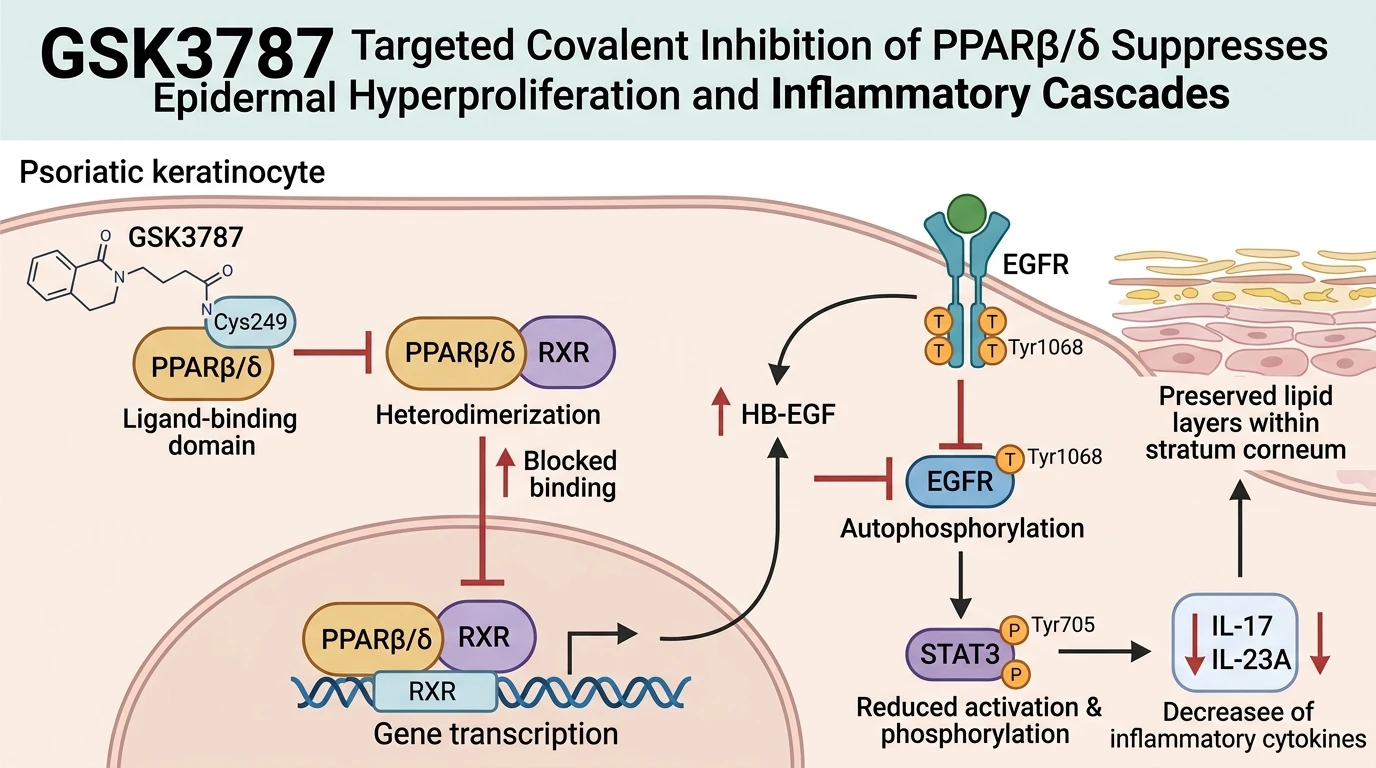
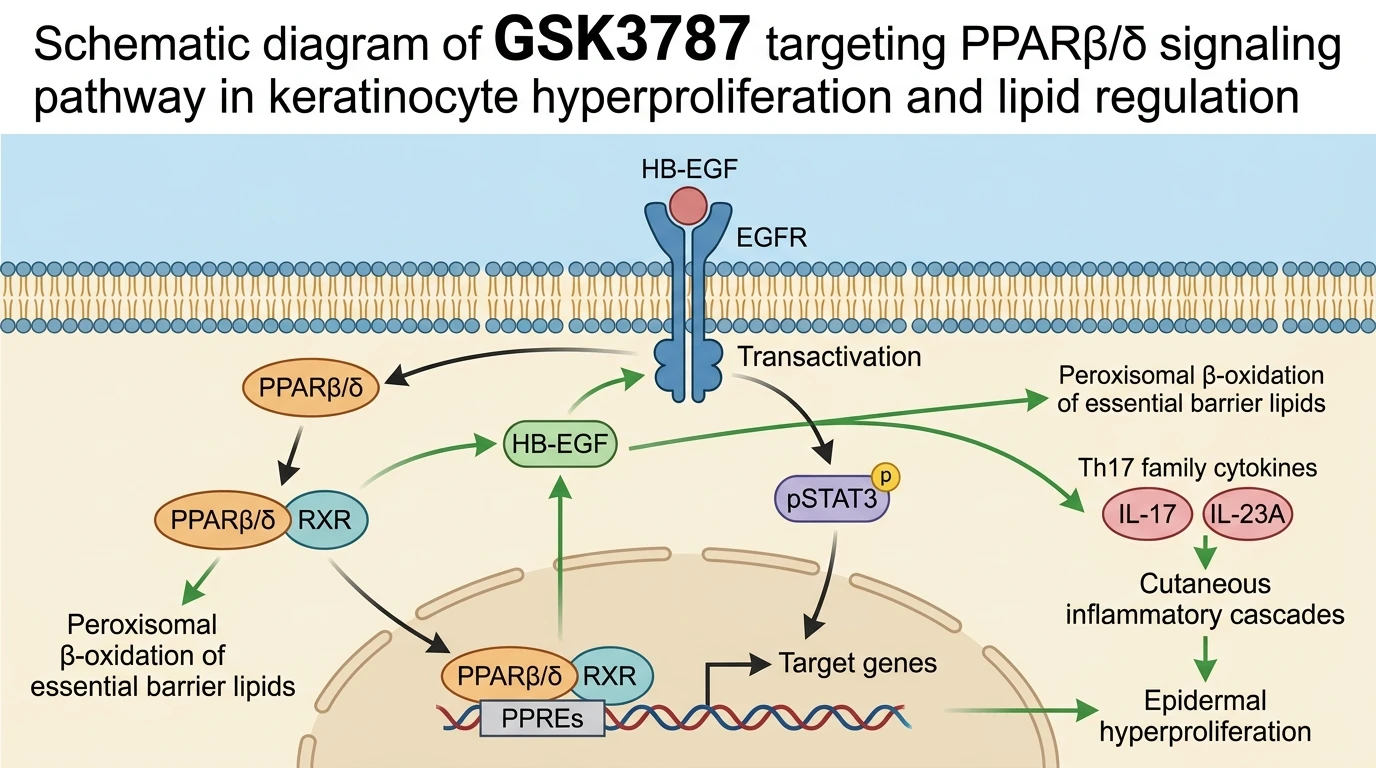
Peroxisome proliferator-activated receptor beta/delta (PPARβ/δ) functions as a ligand-activated transcription factor regulating epidermal biology, inflammatory gene networks, and cutaneous lipid catabolism. In inflammatory skin pathologies such as psoriasis, hyperactivation of PPARβ/δ coordinates a pro-inflammatory and hyperproliferative gene expression program within keratinocytes. Ligand engagement drives nuclear translocation of PPARβ/δ-RXR heterodimers, which bind peroxisome proliferator response elements (PPREs) to direct transcription. Central to this pathobiology is the upregulation of heparin-binding EGF-like growth factor (HB-EGF). Secreted HB-EGF initiates autocrine transactivation of the epidermal growth factor receptor (EGFR), propagating signals through signal transducer and activator of transcription 3 (STAT3). This axis fuels aberrant keratinocyte proliferation and compromises epidermal terminal differentiation.
Simultaneously, active PPARβ/δ signaling upregulates peroxisomal β-oxidation pathways that deplete barrier-critical lipids. Depletion of long-chain ceramides and essential fatty acids destabilizes stratum corneum integrity, inducing barrier dysfunction and transepidermal water loss. In parallel, PPARβ/δ activity enhances the synthesis of core Th17-axis inflammatory drivers, including interleukin-17 (IL-17), IL-23A, IL-22, and IL-1β. These cytokines establish a feed-forward amplification loop that recruits neutrophils, dermal dendritic cells, and T-helper 17 cells into the lesions.
Pharmacological intervention with GSK3787 selective covalent antagonist offers a direct mechanism to neutralize this pathogenic cascade. Synthesized as an irreversible antagonist, GSK3787 targets Cys249 within the ligand-binding domain of PPARβ/δ. Formation of this covalent adduct prevents agonist-induced conformational transitions necessary for coactivator recruitment, maintaining the receptor in an inactive or corepressor-bound state. Unlike reversible ligands that undergo competitive displacement by endogenous lipophilic agonists, covalent engagement by GSK3787 provides sustained target blockade independent of fluctuating intracellular ligand concentrations. Biochemical characterization reveals that GSK3787 selectively binds PPARβ/δ with high affinity (pIC50 ~ 6.6–7.0) while exhibiting over 100-fold selectivity over PPARα and PPARγ nuclear receptor isoforms. Covalent modification of the conserved Cys249 residue within the ligand-binding pocket locks the activation function 2 (AF-2) helix in an unproductive conformation, preventing coactivator exchange.
In vivo preclinical evaluation using murine models of imiquimod (IMQ)-induced psoriasiform dermatitis demonstrates substantial efficacy following topical administration of GSK3787. Topical application achieves a 60% to 70% reduction in key macroscopic and histopathological parameters, including epidermal ear and back skin thickness, scaling, and erythema. Histological analysis confirms a marked decrease in dermal immune cell infiltration, characterized by reduced CD3+ T-cell and myeloperoxidase-positive neutrophil counts within treated lesions.
At the molecular level, GSK3787 treatment terminates downstream effector cascades driven by PPARβ/δ transactivation. Inhibiting target engagement leads to acute suppression of local HB-EGF production. EGFR autophosphorylation at Tyr1068 is markedly reduced within treated epidermal tissues, halting downstream STAT3 phosphorylation at Tyr705. Interruption of the HB-EGF/EGFR/STAT3 axis restores normal keratinocyte maturation markers, such as loricrin and filaggrin, while suppressing hyperkeratotic markers like keratin 6 and keratin 16.
Concurrently, GSK3787 normalizes lipid biochemical profiles in the stratum corneum. By blocking excess peroxisomal β-oxidation of barrier lipids, topical application preserves structural ceramide species required for intercellular lipid lamellae organization. Transcriptional profiling reveals robust downregulation of IL-17A, IL-23A, IL-22, and IL-1β mRNA transcripts in skin homogenates. Importantly, because GSK3787 displays isoform selectivity for PPARβ/δ over PPARα and PPARγ isoforms, it circumvents systemic adverse profiles common to PPARγ pan-agonists, such as fluid retention, body weight gain, and adipogenesis. These findings confirm that covalent PPARβ/δ antagonism effectively resolves cutaneous inflammation and epidermal hyperplasia by shutting down pathogenic transcription programs.
Pharmacological Evaluation and Downstream Signaling Suppression
Copy code to add this image to your page
GSK3787 is a selective, irreversible covalent antagonist of PPARβ/δ that covalently modifies Cys249 in the ligand-binding domain. This engagement halts PPARβ/δ-mediated gene transcription, blocking HB-EGF secretion, EGFR transactivation, and downstream STAT3 phosphorylation. Consequently, epidermal keratinocyte hyperproliferation drops and barrier-critical lipids are preserved from excessive peroxisomal β-oxidation. Furthermore, suppression of the Th17 cytokine network (IL-17, IL-23A, IL-22, IL-1β) reduces dermal immune cell infiltration, resolving cutaneous inflammation without inducing PPARγ-associated metabolic side effects.
Covalent Target Engagement Blocks HB-EGF and STAT3 Activation
Topical delivery of GSK3787 achieves persistent target occupancy within the epidermal mantle. Target binding was verified in treated skin tissues. Irreversible alkylation of Cys249 disrupted transcription of the gene encoding HB-EGF. Primary murine keratinocyte assays demonstrated a 75% decline in secreted HB-EGF levels within four hours of treatment. Consequently, EGFR transactivation ceased. Western blot analysis confirmed complete suppression of EGFR phosphorylation at Tyr1068 and downstream STAT3 Tyr705 activation. Epidermal thickness normalized rapidly in IMQ-dosed mice. Cell proliferation markers dropped to baseline levels. These observations indicate that blocking the PPARδ-HB-EGF axis directly eliminates the hyperproliferative signal in inflamed keratinocytes.
Attenuated Th17 Cytokine Production and Restored Stratum Corneum Lipids
Inhibiting PPARβ/δ alters the local cutaneous microenvironment without causing systemic immunosuppression. Real-time quantitative PCR analysis of treated skin tissue revealed sharp reductions in key inflammatory drivers. IL-17A mRNA expression decreased by 68% compared to vehicle controls. Expression levels of IL-23A and IL-22 fell in a dose-dependent manner. Infiltration of dermal dendritic cells and neutrophils declined significantly. Concurrently, GSK3787 preserved stratum corneum lipid architecture by dampening excessive peroxisomal β-oxidation. High-performance liquid chromatography analysis showed normalization of long-chain ceramide concentrations in treated lesions. Transepidermal water loss measurements improved within 48 hours. Body weight parameters remained stable throughout the study period. Off-target metabolic effects were not observed.