GW441756 targeting TRKA suppresses post-infarction mammary tumor progression
Copy code to add this image to your page
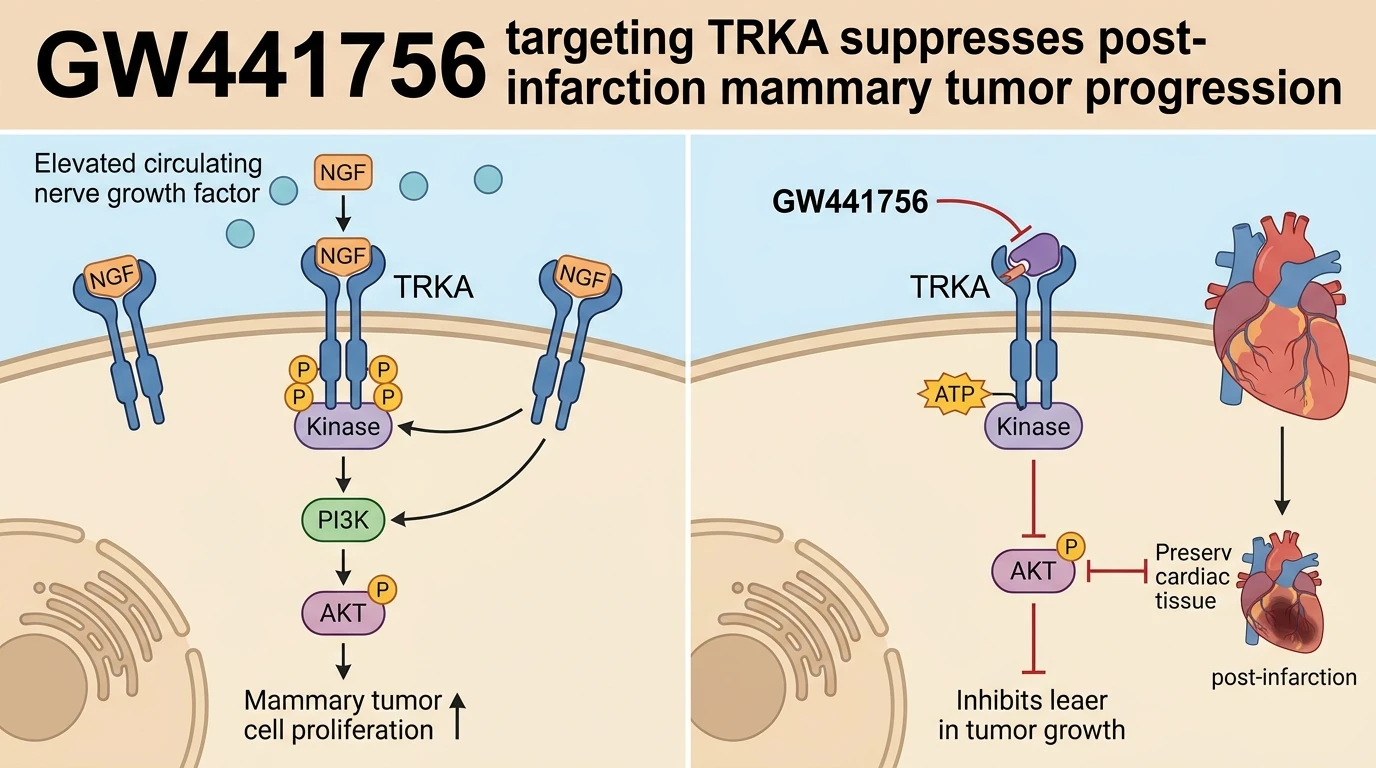
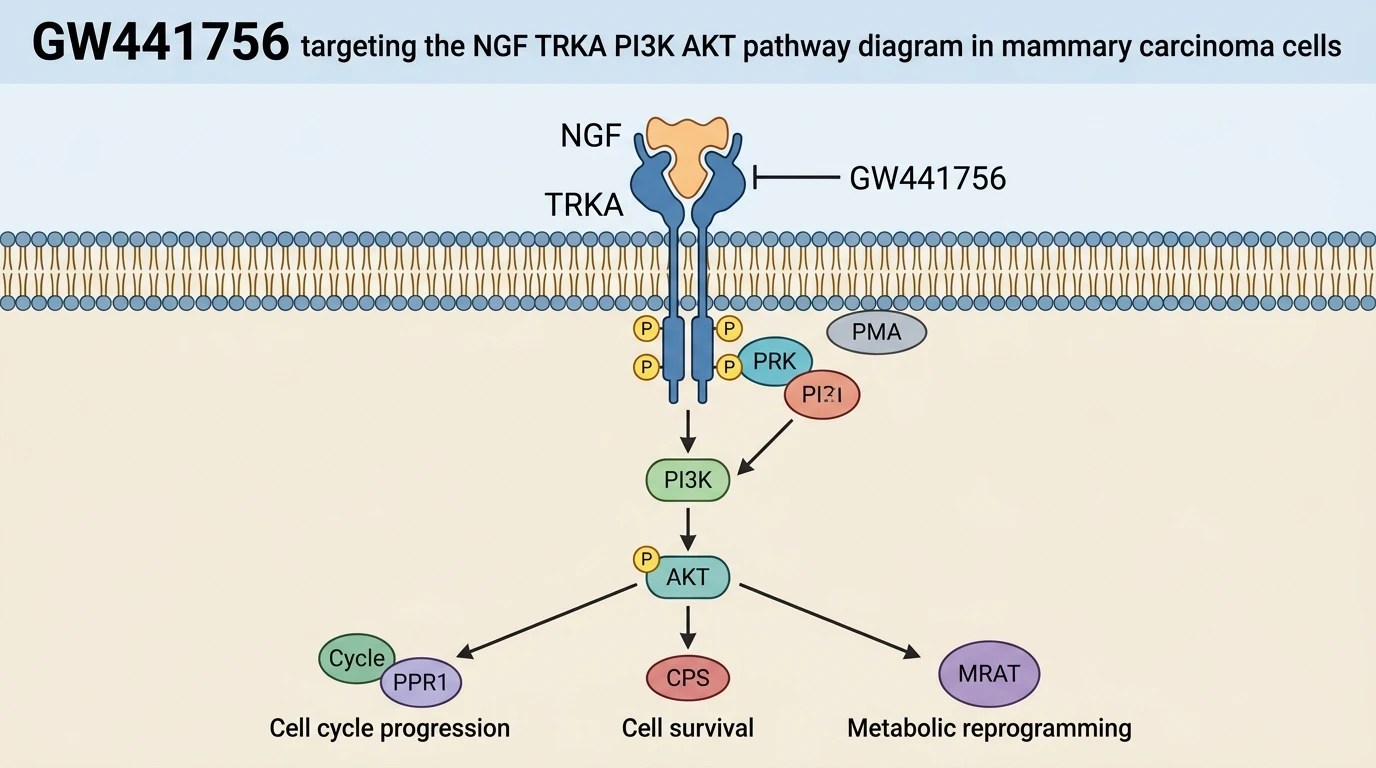
Myocardial infarction accelerates systemic pathological cross-talk, driving extra-cardiac disease processes through systemic biochemical signals. Acute ischemic injury in the myocardium triggers a pronounced systemic elevation of nerve growth factor (NGF). Both local cardiac tissue and circulating serum demonstrate sustained increases in NGF concentrations following ischemic insult. Tumor cells expressing tropomyosin receptor kinase A (TRKA)—the primary high-affinity receptor for NGF—respond directly to this elevated ligand state. Ligand engagement induces TRKA homodimerization and trans-autophosphorylation at key intracellular tyrosine residues, particularly Tyr670, Tyr674, and Tyr675 within the activation loop. This autophosphorylation event serves as a critical docking scaffold for intracellular signaling mediators.
Downstream of TRKA activation, the phosphatidylinositol 3-kinase (PI3K) and protein kinase B (AKT) axis undergoes robust activation. Phosphorylation of AKT at serine-473 and threonine-308 promotes intracellular proliferation pathways and suppresses apoptotic cascades in orthotopic mammary carcinoma models. In cultured tumor cell lines subjected to elevated NGF concentrations, cellular proliferation rates double within 48 hours. Biochemical analyses confirm that NGF stimulation directly triggers immediate AKT phosphorylation, establishing an explicit mechanistic bridge between ischemic heart failure and accelerated tumor progression.
Selective pharmacological target engagement offers a distinct vector to break this neuro-cardiac-oncology loop. Pharmacological inhibition of TRKA by the small-molecule agent GW441756 demonstrates potent, dose-dependent suppression of receptor activation. Utilizing precise biological assays detailed in standard protocols such as kinase assay methodologies, in vitro kinetic profiling confirms competitive binding of GW441756 to the ATP-binding pocket of TRKA, blocking catalytic activity with high specificity over related receptor tyrosine kinases. Application of GW441756 in nanomolar concentrations suppresses NGF-mediated TRKA tyrosine phosphorylation in mammary tumor cell lines. Genetic knockdown using targeted TRKA siRNA phenocopies this pharmacological response. Both interventions eliminate downstream AKT phosphorylation without affecting total AKT protein abundance, confirming high target selectivity within the signaling network.
In vivo evaluation utilizing murine models of post-myocardial infarction breast cancer clarifies the systemic therapeutic impact. In non-infarcted control mice, mammary tumors maintain moderate growth kinetics. In contrast, post-MI mice show accelerated tumor volume expansion over a 21-day observation period. Daily systemic administration of GW441756 significantly reduces tumor burden and cell proliferation indices in MI-bearing mice. Histological examinations show decreased Ki-67 positivity in primary tumor tissue, confirming reduced mitotic activity. Furthermore, terminal TUNEL staining demonstrates increased apoptotic fractions within the tumor parenchyma following compound administration.
Crucially, targeted TRKA inhibition exhibits no adverse side effects on underlying cardiovascular pathology. Serial echocardiographic measurements reveal that GW441756 treatment maintains left ventricular ejection fraction and fractional shortening at baseline post-MI levels. Infarct size remains unchanged compared to vehicle-treated controls, indicating that TRKA inhibition does not exacerbate myocardial necrosis or impair scar formation. Hemodynamic assessments confirm no alterations in mean arterial pressure or heart rate following chronic dosing. These empirical findings demonstrate that targeting the systemic NGF-TRKA-AKT signaling axis selectively attenuates tumor progression without compromising cardiac repair mechanisms in heart failure models.
At the cellular level, the selectivity of GW441756 prevents non-specific off-target inhibition of secondary receptor tyrosine kinases such as TRKB, TRKC, or VEGFR2 at therapeutic doses. Immunoblot analysis of lysate fractions confirms that while TRKA autophosphorylation is blocked, collateral kinase pathways remain unaffected. This target fidelity minimizes systemic toxicities frequently observed with broad-spectrum tyrosine kinase inhibitors. In primary cell lines isolated from mammary tumors, treatment with GW441756 blocks NGF-induced S6 kinase phosphorylation and cyclin D1 expression, arresting cells in the G1 phase of the cell cycle.
Quantitative analysis of systemic inflammatory markers in post-MI animals further indicates that the antitumor effect of GW441756 operates primarily through direct TRKA pathway blockade rather than secondary immunosuppression. Serum levels of pro-inflammatory cytokines, including interleukin-6 and tumor necrosis factor-alpha, showed identical trajectories in both vehicle and treated MI cohorts. Consequently, the mitigation of tumor growth in this comorbidity model stems directly from interrupting ligand-receptor communication between the healing myocardium and the neoplastic epithelium.
Pharmacological Evaluation of TRKA Inhibition in Vivo
Copy code to add this image to your page
Myocardial infarction increases circulating nerve growth factor (NGF), which binds to tumor-expressed TRKA receptors. Receptor activation triggers downstream PI3K-AKT signaling, accelerating tumor cell proliferation. Pharmacological inhibition using GW441756 or TRKA siRNA silences NGF-induced TRKA and AKT phosphorylation. In post-MI murine models, GW441756 reduces tumor burden and mitotic activity without worsening cardiac ejection fraction or infarct size, demonstrating pathway-specific antitumor efficacy.
Attenuation of NGF-Driven TRKA and AKT Phosphorylation
Exogenous nerve growth factor exposure markedly enhances TRKA phosphorylation in mammary tumor cell lines. Small-molecule inhibition using GW441756 completely abrogates this biochemical response at low nanomolar concentrations. Downstream AKT phosphorylation at Ser473 decreased rapidly following compound administration. Genetic silencing via siRNA confirmed that these signaling changes resulted specifically from TRKA blockade. Western blot analysis verified that total TRKA and AKT levels remained unaffected throughout the assays. These data confirm high biochemical selectivity under controlled in vitro culture conditions.
In Vivo Suppression of Post-MI Mammary Tumor Growth
Post-myocardial infarction mice displayed accelerated tumor growth relative to sham-operated controls. Daily treatment with GW441756 significantly attenuated tumor growth rates over three weeks. Tumors harvested from treated animals exhibited lower mitotic indices upon immunohistochemical analysis. Ki-67 positive nuclear staining dropped by over forty percent. Importantly, echocardiographic parameters remained stable throughout the study period. Left ventricular dimensions and ejection fraction showed no statistically significant differences between treated and control cohorts. Infarct scar area was preserved without expansion.