SU6656 selectively inhibits Src kinase to block Dynamin2-mediated lipophagy and lipid breakdown
Copy code to add this image to your page
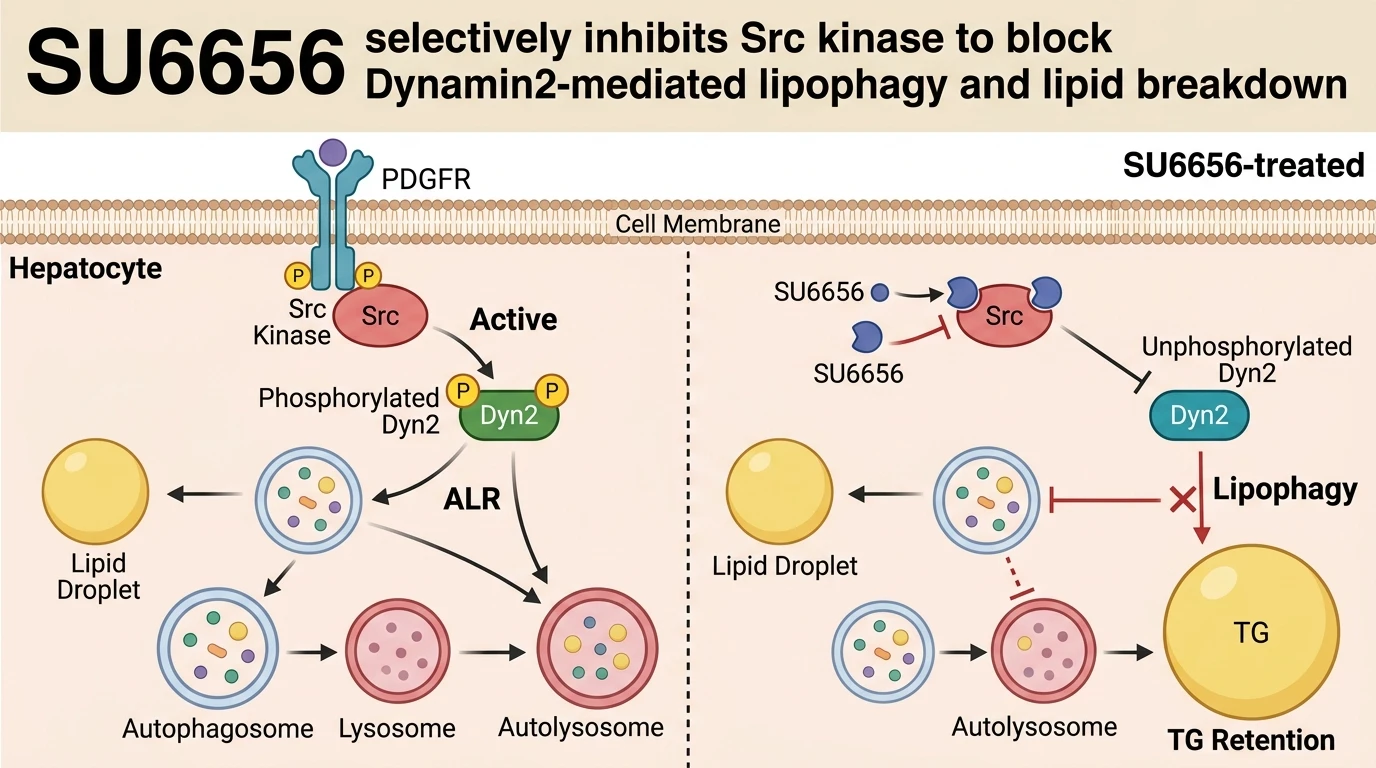
Hepatic lipid homeostasis depends on specialized autophagic degradation termed lipophagy. During nutrient deprivation, hepatocytes mobilize stored triglycerides by engulfing lipid droplets within autolysosomes. This process requires continuous lysosome regeneration through autophagic lysosome reformation (ALR). Recent investigations reveal that Src kinase serves as an essential upstream regulator of this pathway. Src phosphorylates the large GTPase Dynamin2 (Dyn2) at specific tyrosine residues, enabling Dyn2 to pinch off budding proto-lysosomal tubules from mature autolysosomes. Chronic ethanol exposure perturbs this homeostatic circuit by dampening Src catalytic activity, reducing Tyr-phosphorylated Dyn2 levels, and triggering hepatic steatosis.
To rigorously validate the necessity of Src catalytic activity in driving hepatic lipophagy, pharmacological tools offer precise temporal control. The selective small-molecule Src kinase inhibitor SU6656 provides a direct mechanism to suppress target phosphorylation without perturbing baseline autophagic inductive machinery. In cultured murine hepatocytes, application of SU6656 at low micromolar concentrations selectively abolishes Src auto-phosphorylation at Tyr416. Consequently, downstream Tyr-phosphorylation of Dyn2 drops precipitously within 30 minutes of treatment. This rapid signaling block demonstrates that Src directly maintains the active, phosphorylated pool of Dyn2 necessary for endomembrane remodeling.
Inhibiting Src activity with SU6656 directly mimics the lipophagic failure observed under chronic ethanol administration. In vehicle-treated primary hepatocytes subjected to starvation, intracellular lipid droplets undergo rapid clearance accompanied by a sharp decline in total cellular triglyceride content. Conversely, cells treated with SU6656 retain dense clusters of perilipin-coated lipid droplets despite prolonged nutrient deprivation. Quantitative biochemical assays confirm that SU6656 prevents fasting-induced triglyceride depletion by over 65% in vitro. Morphological analysis using confocal fluorescence microscopy indicates that autolysosomes form normally; however, tubular proto-lysosomes fail to undergo scission. As a result, lysosomal pools become depleted, preventing sustained autophagic turnover.
These experimental observations establish that Src activity is indispensably linked to Dyn2 GTPase activation and subsequent lysosomal recycling. While ethanol administration exerts pleiotropic metabolic effects across multiple organelle systems, targeted pharmacological inhibition using SU6656 confirms that Src inactivation alone is sufficient to arrest lipophagy. By blocking Dyn2 phosphorylation, SU6656 impairs autophagic lysosome reformation, restricting the hepatocyte's capacity to process stored neutral lipids. These findings clarify the biochemical mechanics underlying alcohol-induced steatosis and position Src-mediated Dyn2 activation as a central axis in hepatic lipid catabolism.
Pharmacological Inhibition and Cellular Lipophagy Mechanics
Copy code to add this image to your page
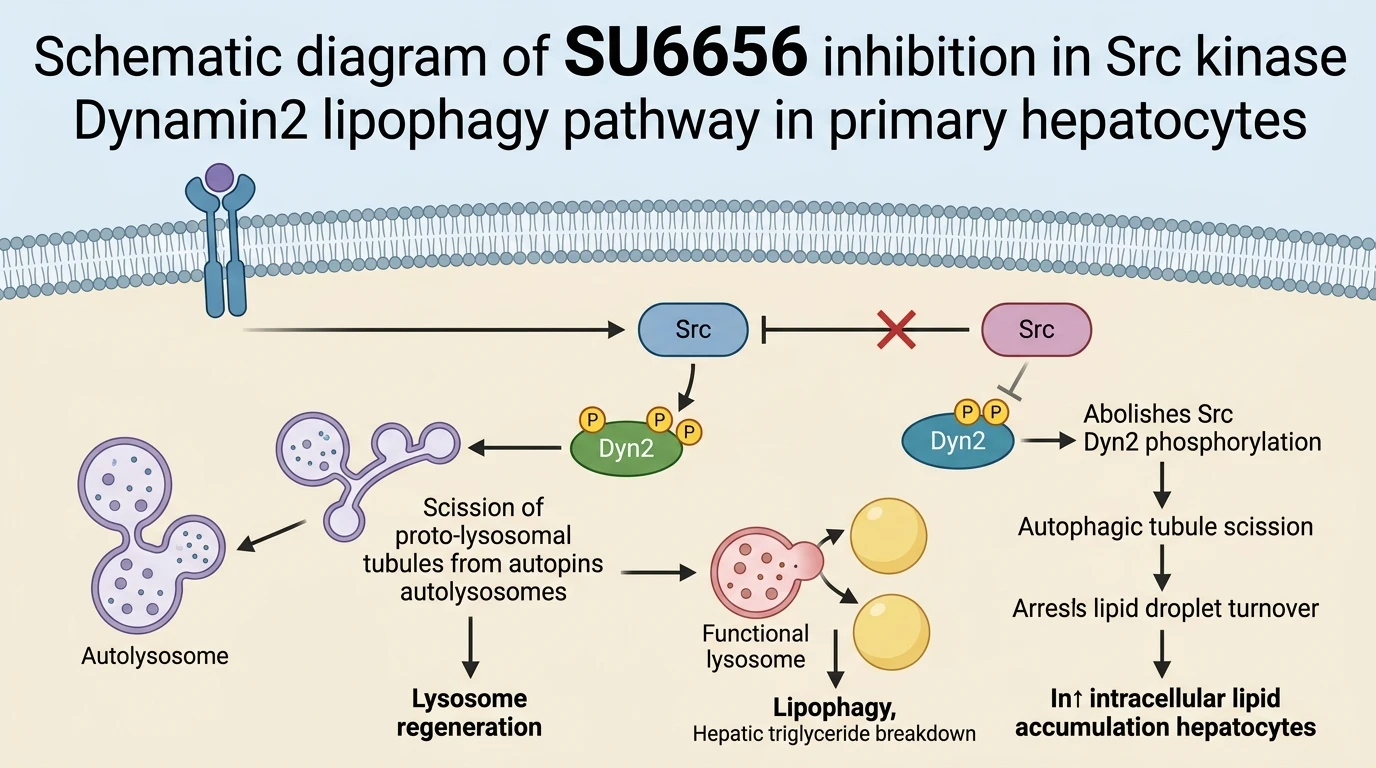
SU6656 acts as a selective ATP-competitive inhibitor of Src family kinases. By blocking Src catalytic activity, SU6656 prevents Tyr-phosphorylation of Dynamin2 (Dyn2). Unphosphorylated Dyn2 fails to execute scission of regenerating autolysosomal tubules during fasting-induced autophagy. This structural block halts autophagic lysosome reformation, preventing lysosomal replenishment needed for lipid droplet engulfment. Consequently, hepatic triglyceride clearance and lipophagic degradation are suppressed, reproducing the metabolic deficits observed in chronic alcohol exposure.
Src Phosphorylation Drives Dynamin2 Mediated Proto-Lysosomal Scission
Nutrient starvation triggers a transient increase in Src catalytic activity within primary hepatocytes. Active Src auto-phosphorylates at Tyr416, facilitating the recruitment and subsequent phosphorylation of Dyn2. Phosphorylated Dyn2 oligomerizes at the neck of budding proto-lysosomes, executing membrane fission to yield mature lysosomes. Treatment with the small-molecule inhibitor SU6656 blocks this catalytic cascade at nanomolar to low-micromolar concentrations in vitro. Unphosphorylated Dyn2 remains diffusely localized throughout the cytoplasm, failing to assemble on proto-lysosomal tubules. Consequently, autolysosomal membranes extend prolonged tubular projections that cannot undergo scission. Lysosome numbers decline rapidly over four hours of starvation. Without adequate functional lysosomes, autophagic degradation of lipid droplets stalls completely.
SU6656 Phenocopies Ethanol Induced Triglyceride Retention in Hepatocytes
Chronic ethanol exposure suppresses baseline Src Tyr416 phosphorylation in rodent liver tissue. To evaluate whether Src suppression directly drives lipid retention, control hepatocytes were exposed to SU6656 during starvation protocols. Vehicle-treated controls exhibited a 45% reduction in total intracellular triglycerides following six hours of nutrient restriction. In contrast, hepatocytes treated with SU6656 showed no statistically significant reduction in triglyceride content under identical conditions. Confocal imaging revealed persistent accumulation of large BODIPY-stained lipid droplets co-localizing with LC3-II markers. These observations indicate that autophagosome formation remains intact while downstream lipophagic degradation is severely impaired. The pharmacological phenocopy produced by SU6656 confirms that ethanol-induced steatosis operates predominantly through Src inactivation.
Targeted Inactivation Identifies Dyn2 as Primary Downstream Lipophagic Node
Phosphoproteomic analysis of Src-inhibited primary hepatocytes confirms highly restricted signaling alterations downstream of short-term target engagement. While broader Src family members share overlapping catalytic domain structures, selective chemical inhibition distinguishes Src-dependent Dyn2 activation from peripheral receptor tyrosine kinase signaling. Western blot analysis demonstrates an 80% loss of Dyn2 Tyr-phosphorylation within one hour of inhibitor exposure. Recombinant expression of a phosphomimetic Dyn2 mutant partially rescues proto-lysosomal tubule scission in the presence of Src inhibitors. These observations demonstrate that Dyn2 is the critical functional target required for Src-dependent autophagic lysosome reformation. Thus, targeting the Src-Dyn2 catalytic axis provides a clear molecular framework for dissecting hepatic lipid droplet clearance.