PF-4708671 S6 Kinase inhibitor Targets p70S6K to Suppress Non-Small Cell Lung Cancer Growth
Copy code to add this image to your page
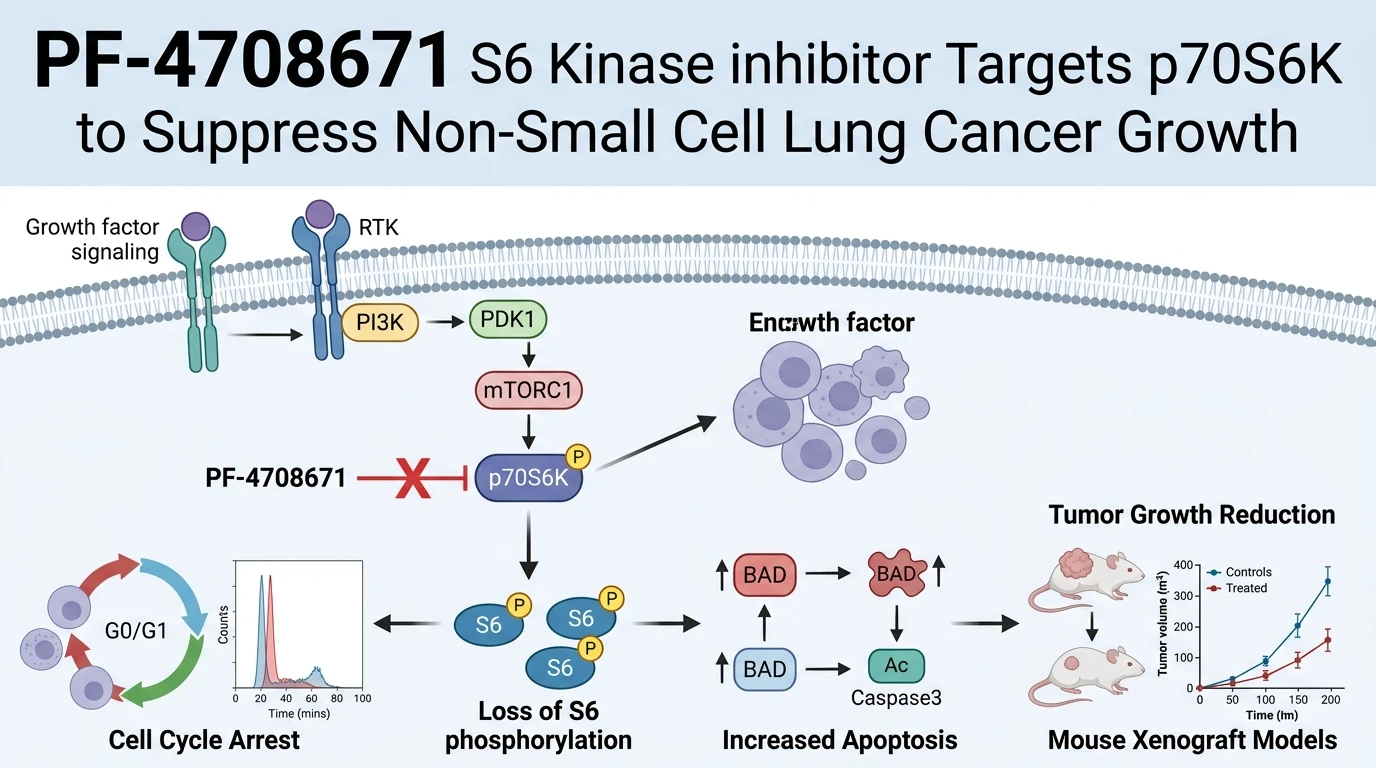
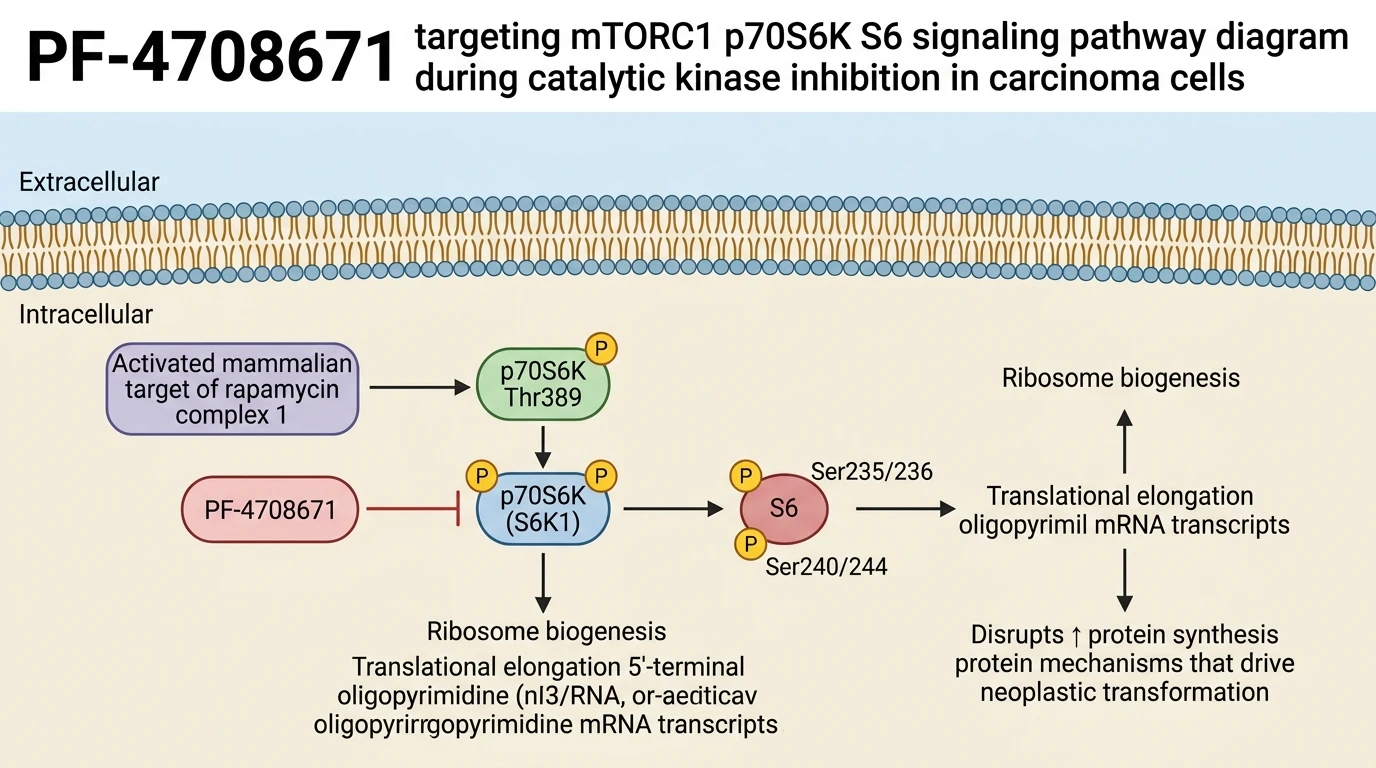
The p70S6K (S6K1) kinase acts as a primary downstream effector of the mechanistic target of rapamycin complex 1 (mTORC1) signaling node. Elevated signaling through this pathway routinely drives aberrant protein translation, hyperproliferation, and enhanced migratory potential in human solid tumors, particularly non-small cell lung cancer (NSCLC). Phosphorylation of p70S6K at Thr389 by mTORC1 triggers its activation, enabling the kinase to phosphorylate its direct downstream target, ribosomal protein S6. This event stimulates the recruitment of ribosomal subunits to 5'-terminal oligopyrimidine (TOP) mRNAs, accelerating the translation of structural ribosomal proteins and key cell cycle regulators. To dissect the precise contribution of this axis in NSCLC models, targeted pharmacological intervention remains essential. The PF-4708671 S6 Kinase inhibitor serves as a potent and selective ATP-competitive inhibitor designed specifically for p70S6K, offering a valuable tool to characterize target engagement and functional dependence in lung cancer models.
In vitro characterization across multiple representative NSCLC cell lines—including adenocarcinoma models A549 and NCI-H460 alongside squamous cell carcinoma model SK-MES-1—demonstrated robust inhibition of p70S6K enzymatic activity upon treatment with PF-4708671. Immunoblotting assays revealed a concentration-dependent loss of phosphorylation at p70S6K and its direct target ribosomal protein S6 at Ser235/236 and Ser240/244. Inhibiting S6 phosphorylation directly impairs cap-dependent translation machinery, reducing the synthesis of factors required for cell division and cellular movement.
Alongside primary target suppression, molecular analysis revealed compensatory and downstream signaling alterations following p70S6K inhibition. Exposure to PF-4708671 led to a marked increase in the protein levels of BAD, Caspase3, and total ERK across the tested NSCLC cell lines. The upregulation of the pro-apoptotic protein BAD and the executioner protease Caspase3 indicates an increased susceptibility to apoptotic signaling cascades. However, quantitative annexin V staining indicated that actual apoptotic execution remained modest under standard culture conditions. Simultaneously, the elevated expression or activation of ERK points to adaptive cross-talk within the mitogen-activated protein kinase (MAPK) cascade, a common resistance pathway activated when mTORC1/S6K signaling is suppressed.
Phenotypically, treatment with PF-4708671 exerted time- and concentration-dependent suppression of NSCLC cell proliferation and matrigel invasion. Flow cytometry demonstrated that this antiproliferative effect stems primarily from robust cell cycle arrest at the G0/G1 boundary. By blocking progression into S phase, the compound halts DNA synthesis and prevents mitotic entry. The suppression of cellular invasion indicates that S6K signaling regulates additional downstream effectors involved in cytoskeletal remodeling and matrix degradation.
To determine whether these in vitro anti-tumor actions translate to complex physiological environments, PF-4708671 was evaluated in vivo using NCI-H460 xenograft-bearing nude mice. Systemic administration of the compound produced significant inhibition of xenograft growth compared to vehicle-treated controls. Tumor volume progression was markedly blunted over the course of treatment, resulting in substantial reductions in final tumor weight. Western blot analysis of harvested tumor tissue confirmed sustained reductions in S6 phosphorylation, validating that systemic tumor regression correlated directly with on-target p70S6K suppression. These findings establish that targeted p70S6K inhibition via PF-4708671 effectively impairs NSCLC progression both in cell culture and in pre-clinical mouse models.
The distinct cellular profile observed with PF-4708671 highlights the therapeutic nuances of targeting S6K directly rather than inhibiting upstream mTORC1 or PI3K nodes. Upstream mTOR inhibitors often provoke feedback activation of AKT through the loss of S6K-mediated IRS1 degradation. By acting downstream at the level of p70S6K, PF-4708671 avoids immediate feedback activation of AKT while successfully suppressing S6-driven translation. Although compensatory upregulation of ERK highlights potential resistance mechanisms, combining p70S6K inhibitors with MEK or ERK targeted therapies may provide a dual blockade strategy. Consequently, PF-4708671 serves as a critical biological tool for elucidating the precise role of ribosomal protein S6 activation in pulmonary malignancies and refining multi-targeted kinase inhibitor combinations.
Pharmacological Characterization and In Vivo Antitumor Efficacy
Copy code to add this image to your page
PF-4708671 functions as a selective inhibitor of p70S6K (S6K1) kinase activity. By directly blocking catalytic phosphorylation of downstream effector ribosomal protein S6, it attenuates translation machinery in non-small cell lung cancer models. This biochemical suppression yields concentration-dependent G0/G1 cell cycle arrest and reduced invasion, while altering compensatory signaling markers such as ERK, BAD, and Caspase3.
Inhibition of S6 Phosphorylation Causes G0/G1 Cell Cycle Arrest
In vitro analyses across NSCLC lines demonstrate target-specific pathway modulation. The PF-4708671 S6 Kinase inhibitor suppressed phosphorylation of p70S6K and S6 in A549, SK-MES-1, and NCI-H460 cells. Cellular proliferation decreased significantly. Arrest occurred predominantly at the G0/G1 boundary. S phase entry was suppressed in a concentration-dependent manner. Although BAD and Caspase3 levels increased, apoptosis remained minor. Adaptive elevation of ERK protein was also recorded. These biochemical shifts highlight a predominant cytostatic mechanism under tested assay conditions.
PF-4708671 Suppresses H460 Xenograft Tumor Volume and Weight
Evaluation in NCI-H460 murine xenograft models confirmed target suppression in vivo. Daily administration of PF-4708671 significantly reduced overall tumor burden. Xenograft volume accumulation slowed relative to vehicle control cohorts. Final tumor weight measurements dropped noticeably at study completion. Ex vivo tissue immunoblotting demonstrated reduced ribosomal S6 phosphorylation within harvested tumors. Toxicities remained minimal across the tested dosing range. These animal observations support the therapeutic potential of targeting p70S6K in pulmonary malignancies.