LDN-193189 Inhibits BMP Receptor Signaling to Drive Lineage Reprogramming in Glioma Cells
Copy code to add this image to your page
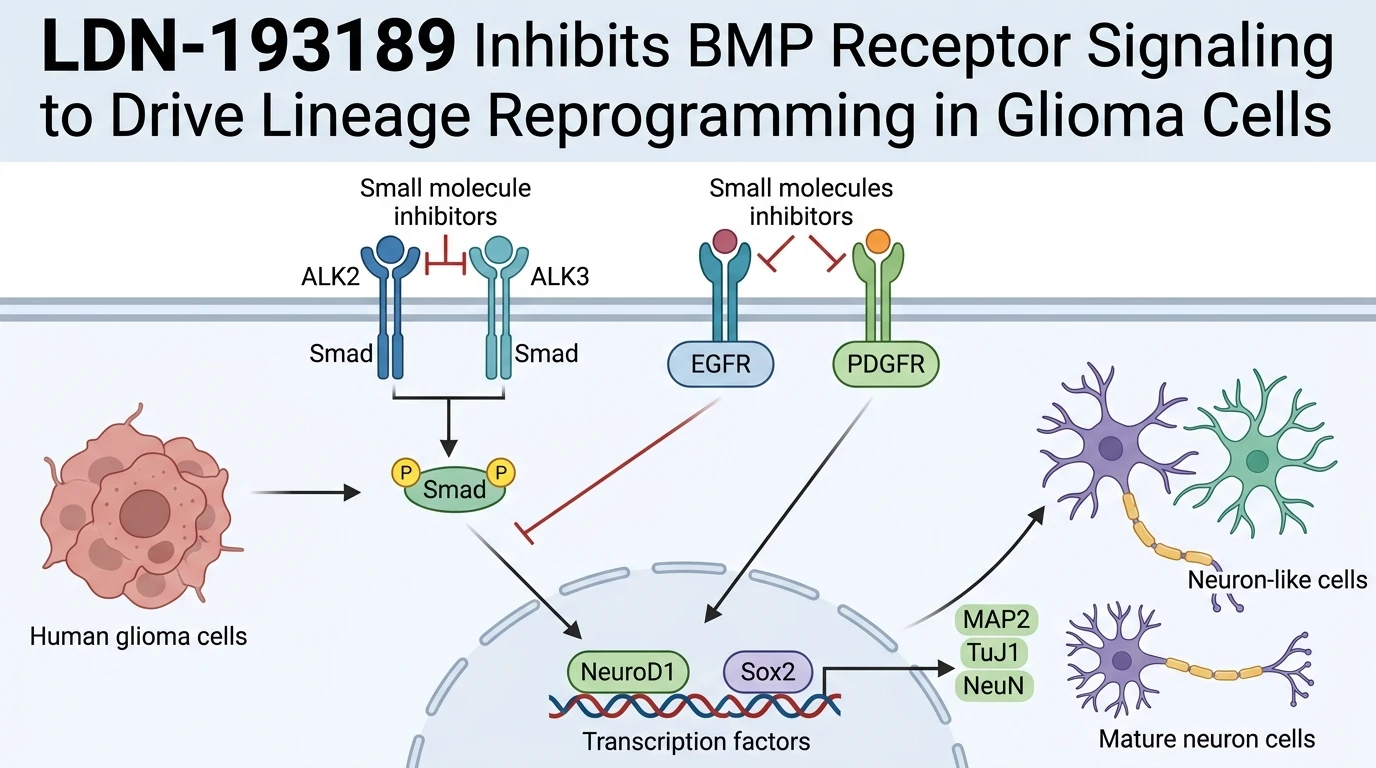
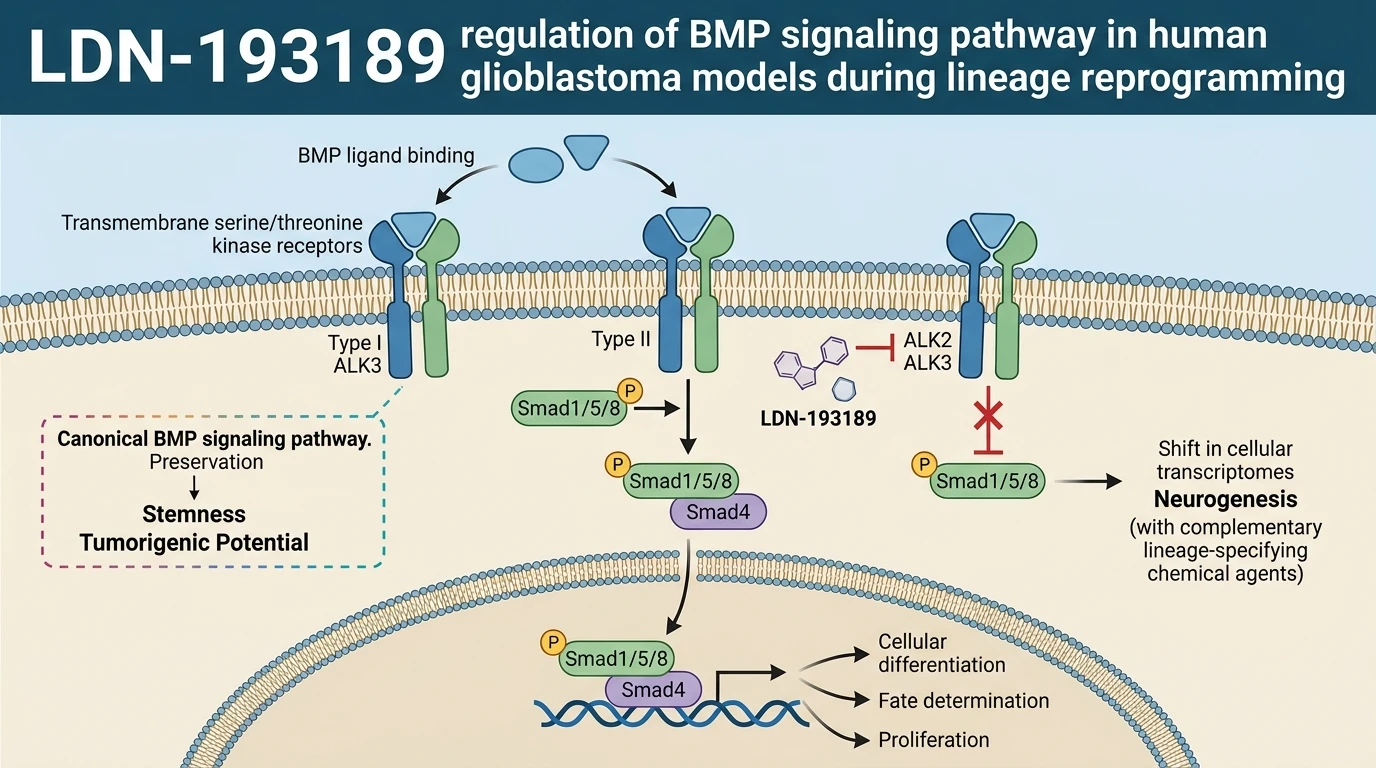
Glioblastoma remains an aggressive central nervous system malignancy characterized by dense cellular heterogeneity, rapid proliferation, and resistance to conventional cytotoxic regimes. Traditional therapeutic strategies focus on inducing apoptosis or DNA damage. However, targeting tumor cell plasticity through lineage conversion offers an alternative pharmacologic avenue. Forced differentiation converts malignant progenitor phenotypes into post-mitotic somatic lineages, halting aberrant cell division. In human glioma cell lines, the small-molecule inhibitor LDN-193189 functions as an antagonist of the Bone Morphogenetic Protein (BMP) signaling pathway by selectively inhibiting the kinase activities of type I BMP receptors ALK2 (ACVR1) and ALK3 (BMPR1A). Blocking these receptor kinases prevents the C-terminal phosphorylation of intracellular Smad1/5/8 transducers, thereby silencing downstream canonical gene expression that maintains glioma cell stemness.
To achieve functional lineage conversion, LDN-193189 was evaluated within a defined chemical cocktail designated SLCDS. This multi-target combination comprises five small-molecule compounds: SB431542 (a TGF-beta inhibitor), LDN-193189 (a BMP pathway inhibitor), CHIR99021 (a GSK3 beta inhibitor), DAPT (a gamma-secretase and Notch pathway inhibitor), and SKL2001 (an activator of Wnt/beta-catenin signaling). Under specified in vitro culture conditions, administration of the SLCDS cocktail induces direct cellular reprogramming of patient-derived human glioma cells into morphologically and phenotypically mature neuron-like cells. Mechanistically, simultaneous suppression of BMP and TGF-beta signaling cascades relieves transcriptional repression on neurogenic loci. Concurrently, Notch inhibition and GSK3 modulation accelerate neuronal fate commitment without requiring viral gene delivery or ectopic genetic overexpression.
Evaluation of treated glioma cultures demonstrates a structural transformation accompanied by distinct biochemical shifts. Upregulation of early neural progenitor indicators and mature neuronal markers confirms lineage redirection. Immunocytochemical assays and quantitative transcript profiling register marked elevation of doublecortin (DCX), neuron-specific class III beta-tubulin (TuJ1), microtubule-associated protein 2 (MAP2), neuronal nuclear protein (NeuN), and glutamate decarboxylase 67 (GAD67). This multi-marker expression pattern indicates progression toward functional neuronal subtypes. Furthermore, key neural transcription factors including NeuroD1 and Sox2 experience rapid transcriptional activation following exposure to SLCDS. NeuroD1 functions as a master regulator driving neuronal maturation and terminal differentiation, while early transient Sox2 dynamics support initial state transition prior to somatic stabilization.
In parallel with neurogenic induction, exposure to the chemical cocktail imposes pronounced anti-proliferative effects across tested glioma models. Malignant progression relies heavily on hyperactive receptor tyrosine kinase signaling and sustained mitotic activity. Within the SLCDS assay conditions, expression levels of primary oncogenic drivers—including epidermal growth factor receptor (EGFR) and platelet-derived growth factor receptor (PDGFR)—are suppressed. Cellular proliferation markers such as Ki67 drop substantially, accompanied by decreased expression of vimentin, an intermediate filament protein associated with mesenchymal tumor traits and invasive migration. High-throughput transcriptomic profiling validates these phenotypic observations. Whole-genome RNA sequencing reveals widespread activation of gene networks controlling neurogenesis, synaptic transmission, and intrinsic tumor suppression. Simultaneously, transcriptomic clusters associated with cell cycle progression, DNA replication, and glioblastoma oncogenesis undergo downregulation, establishing chemical lineage conversion as a viable pharmacodynamic strategy.
Pharmacological Lineage Conversion and Transcriptomic Reprogramming Mechanics
Copy code to add this image to your page
Targeted inhibition of BMP receptor ALK2/ALK3 signaling by LDN-193189, within the multi-factor chemical cocktail SLCDS, triggers direct lineage reprogramming of human glioma cells into mature neuron-like phenotypes. This pharmacologic intervention upregulates neural transcription factors (NeuroD1) and functional neuronal markers (TuJ1, MAP2, NeuN, GAD67, DCX). Simultaneously, the treatment downregulates primary oncogenic markers including EGFR, PDGFR, Ki67, and vimentin. Transcriptomic analyses confirm systemic activation of neurogenic gene cascades alongside downregulation of cell cycle progression pathways, effectively arresting tumor proliferation through forced lineage commitment in vitro.
Chemical Reprogramming Induces Neuronal Transcription Factors and Functional Markers
Targeting cellular plasticity through small-molecule combinations provides a non-genetic method for modifying cell fate. In patient-derived human glioma cultures exposed to the SLCDS cocktail, target inhibition by LDN-193189 alters intracellular signaling cascades required for maintaining undifferentiated cell states. Transcriptional profiling shows rapid elevation of master neural regulators. NeuroD1 mRNA levels increase significantly within days of treatment initiation; Sox2 dynamics adjust accordingly during early lineage conversion. Morphological changes follow these transcriptional shifts. Glioma cells lose their astrocytic processes, extending elongated, branched neurite-like projections positive for TuJ1 and MAP2. Immunofluorescence analysis confirms mature nuclear localization of NeuN and cytoplasmic expression of GAD67. Downstream Smad phosphorylation ceased under these assay conditions. Cellular conversion proceeded without genomic integration artifacts.
Targeted ALK2/ALK3 Blockade Suppresses Oncogenic Receptor Expression and Proliferation
Malignant glioma cells depend on sustained receptor tyrosine kinase activity for cell survival and division. Suppressing BMP receptor activity through ALK2/ALK3 inhibition disrupts these proliferative maintenance loops. In the presence of LDN-193189, glioma cultures exhibit reductions in total protein levels of EGFR and PDGFR. Mitotic activity declines synchronously. Quantitative immunoassay measurements confirm a lower Ki67 labeling index relative to untreated controls. Mesenchymal structural proteins, notably vimentin, show marked transcript decay. Transcriptomic enrichment analysis highlights suppression of signaling nodes linked to cell cycle progression and focal adhesion. Conversely, gene sets governing synaptic vesicle transport and ion channel activity exhibit marked enrichment. The selectivity margin remained consistent across independent primary glioma lines.