Mitochondrial pyruvate carrier Inhibitors
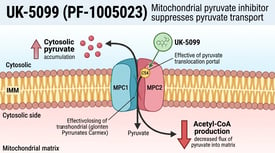
The Mitochondrial pyruvate carrier (MPC) is a crucial heterodimeric protein complex, composed of MPC1 and MPC2, embedded within the inner mitochondrial membrane. Its primary function is to facilitate the active transport of pyruvate, the end-product of glycolysis, from the cytosol into the mitochondrial matrix. Once inside the mitochondria, pyruvate is a key substrate for pyruvate dehydrogenase (PDH), which converts it to acetyl-CoA, feeding into the tricarboxylic acid (TCA) cycle and oxidative phosphorylation (OXPHOS). This process is central to aerobic respiration and ATP production. Therefore, MPC acts as a critical gatekeeper, controlling the entry of glycolytically derived carbon into mitochondrial metabolism and linking glycolysis to oxidative phosphorylation. Its activity is tightly regulated and responsive to cellular metabolic demands. Dysregulation or altered activity of MPC is implicated in several significant diseases, particularly those characterized by metabolic reprogramming. In cancer, many tumor cells exhibit the Warburg effect, relying heavily on aerobic glycolysis even in the presence of oxygen. However, some cancers, or specific tumor microenvironments (e.g., hypoxia), can also upregulate mitochondrial metabolism.
Inhibiting MPC in cancer cells can disrupt their ability to utilize pyruvate for mitochondrial respiration, forcing them to rely more heavily on glycolysis or inducing metabolic stress, potentially sensitizing them to other therapies or leading to cell death. MPC is thus a promising target for various cancers, including lung, breast, prostate, and glioblastoma. Beyond oncology, MPC activity influences glucose and lipid metabolism, suggesting roles in metabolic diseases such as insulin resistance, type 2 diabetes, and non-alcoholic fatty liver disease (NAFLD). In cardiovascular diseases, MPC plays a role in cardiac energy metabolism, with implications for myocardial ischemia-reperfusion injury and heart failure. Mitochondrial dysfunction, often involving pyruvate metabolism, is also a hallmark of many neurological disorders. Research into MPC inhibitors is currently in the preclinical stage, with no approved drugs or agents in clinical trials specifically targeting MPC. However, MPC inhibitors are emerging as promising therapeutic agents, particularly in oncology and metabolic disorders. Several small molecule inhibitors have been identified and characterized, serving primarily as research tools to validate MPC as a therapeutic target. Notable examples include UK5099, a benzothiazepine derivative that is a widely used and potent MPC inhibitor, and MSDC-0160, a thiazolidinedione derivative.
Other compounds like SR1383 and GW501516 have also been explored. These inhibitors have demonstrated efficacy in *in vitro* and *in vivo* cancer models, showing potential to suppress tumor growth and sensitize cells to other treatments by disrupting mitochondrial metabolism. The focus is on developing more selective and potent compounds with favorable pharmacokinetic profiles. MPC inhibitors can be classified based on their chemical scaffolds (e.g., benzothiazepines, thiazolidinediones, pyrazoles) and their selectivity for MPC over other mitochondrial transporters. Most are small molecules designed to block the pyruvate transport channel. Key challenges in their development include achieving high selectivity for MPC to minimize off-target effects on other mitochondrial or cellular processes, and managing potential systemic metabolic side effects given MPC's central role in energy metabolism. For neurological applications, blood-brain barrier penetration is a critical consideration. Combination therapy is a significant strategy, where MPC inhibitors could be combined with glycolysis inhibitors, PDH activators, or conventional chemotherapies to exploit metabolic vulnerabilities in cancer cells and enhance therapeutic outcomes. The ability of MPC inhibition to induce metabolic shifts and stress in cancer cells makes it a compelling target for novel anti-cancer strategies, with UK5099 being a crucial research tool for further exploration of this pathway.