UK-5099 (PF-1005023) Mitochondrial pyruva inhibitor suppresses pyruvate transport
Copy code to add this image to your page
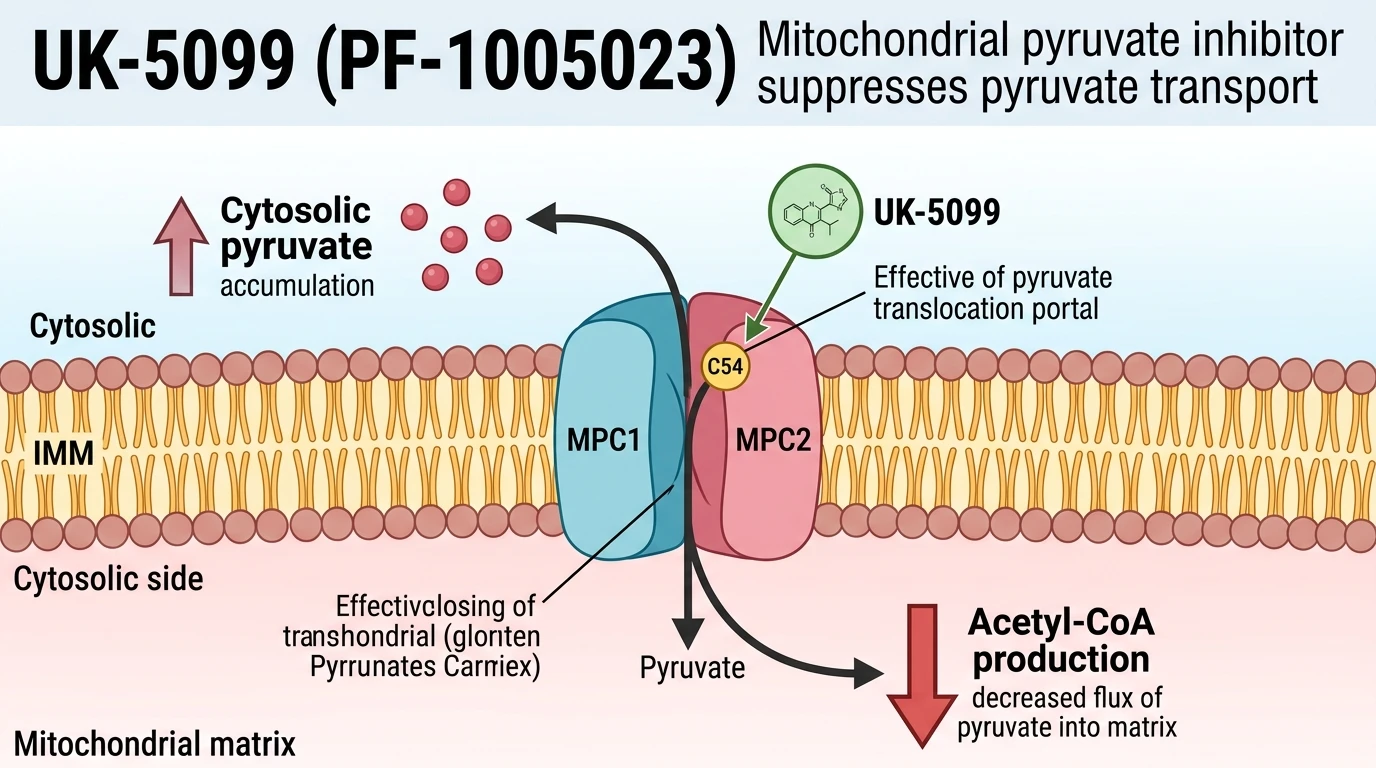
Mitochondrial pyruvate transport represents a fundamental metabolic junction connecting cytosolic glycolysis to inner-matrix oxidative phosphorylation. The mitochondrial pyruvate carrier (MPC) complex consists of two essential transmembrane proteins, MPC1 and MPC2, embedded within the inner mitochondrial membrane. Under physiological conditions, this heterodimeric transporter facilitates the influx of glycolytically derived pyruvate into the mitochondrial matrix. Matrix pyruvate subsequently undergoes oxidative decarboxylation by the pyruvate dehydrogenase complex to form acetyl-CoA, driving the tricarboxylic acid (TCA) cycle and supporting electron transport chain activity. Pharmacological suppression of this transport system forces cells to reallocate metabolic flux toward compensatory pathways, such as cytosolic lactate production or amino acid oxidation. The small molecule UK-5099 (PF-1005023) operates as a potent, cell-permeable inhibitor of this pathway, engaging the carrier through covalent modification. Structural analyses demonstrate that the compound selectively target the MPC2 subunit by forming a covalent adduct with the C54 cysteine residue. Covalent modification of C54 physically blocks the substrate-binding pore, halting pyruvate translocation. Consequently, mitochondrial respiration drops while glycolysis increases to compensate for energy demands. Despite the established utility of this molecule in vitro, robust quantitative assays for in vivo pharmacokinetic profiling were historically limited. To address this analytical gap, recent pharmacological studies developed and validated a simple, sensitive, and rapid liquid chromatography-tandem mass spectrometry (LC-MS/MS) bioanalytical method for measuring drug concentration in murine plasma matrices. Bioanalytical method validation established linear range performance across concentrations from 5 to 5000 ng/mL, demonstrating excellent sensitivity for systemic quantification. Extraction efficiency evaluations demonstrated high recoveries exceeding 95%, alongside robust stability parameters across processing and storage conditions. Quantitative analysis following single intraperitoneal administration at 20 mg/kg in BALB/c mice revealed rapid systemic absorption mechanics. The observed peak plasma concentration (Cmax) reached 82,500 ng/mL within 0.25 hours post-dosing. Systemic exposure as measured by the area under the concentration-time curve (AUC0-t) totaled 42,103 h·ng/mL. Notably, the compound exhibited an extended systemic elimination profile, displaying a terminal elimination half-life (T1/2) of 13.36 hours in murine plasma. These empirical pharmacokinetic parameters provide critical baseline values for evaluating dosing schedules in translational models. By restricting mitochondrial pyruvate utilization, the compound alters cellular bioenergetics in parasitic organisms and neoplastic tissues. In models evaluating crystallographic structural data and functional bioenergetics, attenuation of pyruvate entry disrupts metabolic homeostasis. In obligate intracellular pathogens such as Toxoplasma gondii, metabolic dependence on host-derived or parasite-generated pyruvate renders the organism vulnerable to MPC blockade. Similarly, targeted inhibition using the UK-5099 (PF-1005023) Mitochondrial pyruva inhibitor alters tumor cell reliance on oxidative phosphorylation, creating metabolic vulnerabilities that can be exploited in combination therapies.
In Vivo Pharmacokinetics and Bioenergetic Reprogramming Mechanics
Copy code to add this image to your page
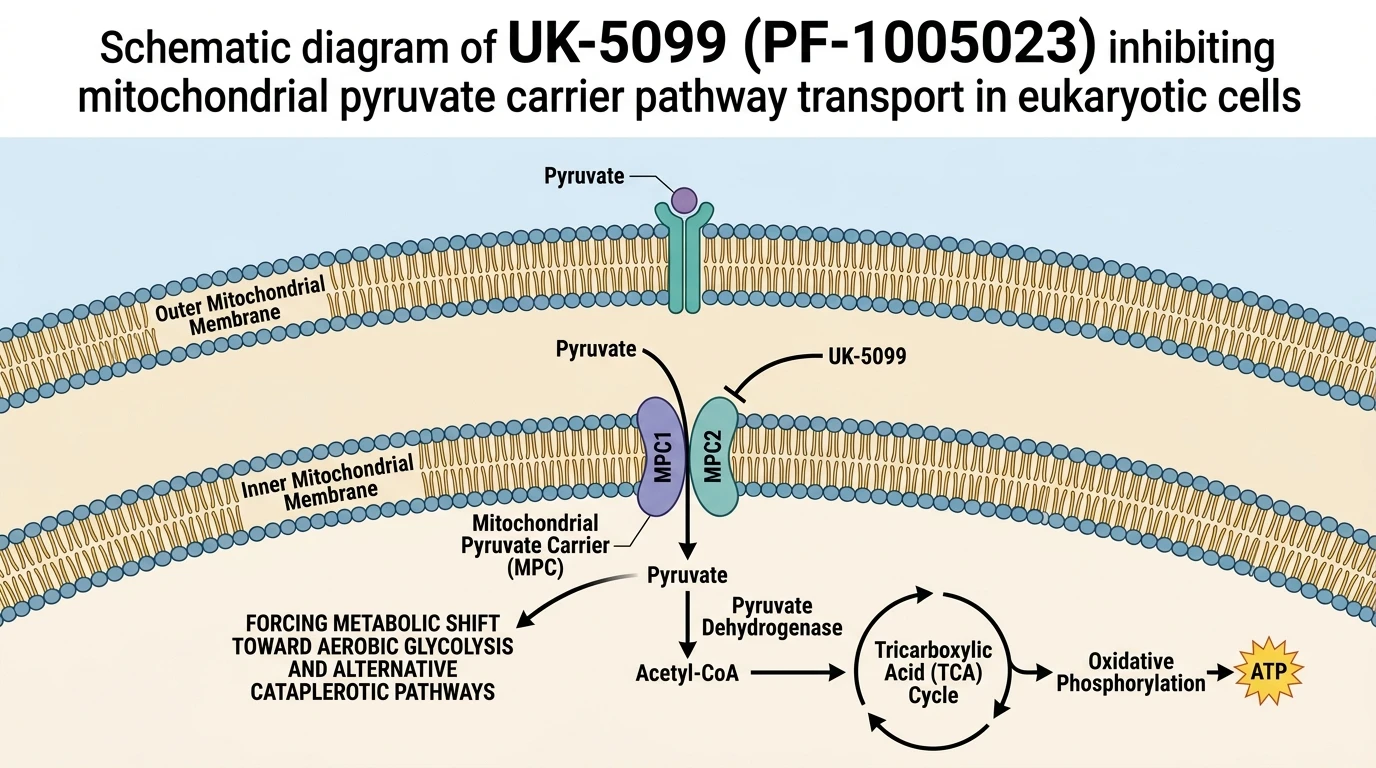
UK-5099 covalently modifies cysteine residue C54 of the MPC2 subunit within the heterodimeric mitochondrial pyruvate carrier complex. This structural modification blocks pyruvate transport across the inner mitochondrial membrane into the matrix. Consequently, mitochondrial pyruvate oxidation is suppressed, forcing cellular energy production toward aerobic glycolysis and alternative metabolic pathways.
Quantification and Bioanalytical Validation in Murine Plasma
Bioanalytical quantification required high specificity to detect plasma concentrations accurately. An LC-MS/MS assay was developed and validated across a broad analytical range from 5 to 5000 ng/mL. Extraction recovery consistently exceeded 95% across quality control tiers. Stability testing confirmed sample integrity during benchtop handling and freeze-thaw cycles. Precise measurement ensured reliable pharmacokinetic modeling in subsequent animal cohorts.
Systemic Exposure Dynamics Following Intraperitoneal Administration
In vivo characterization proceeded in female BALB/c mice following a single 20 mg/kg intraperitoneal dose. Absorption occurred rapidly. Peak plasma concentrations reached 82,500 ng/mL at 0.25 hours post-injection. The UK-5099 (PF-1005023) Mitochondrial pyruva inhibitor displayed a total systemic exposure of 42,103 h·ng/mL AUC0-t. The terminal half-life measured 13.36 hours in plasma—indicating sustained systemic retention suitable for daily dosing regimens.
Metabolic Disruption and Downstream Parasitic Applications
Target engagement at MPC2 C54 produces marked metabolic shifting. Suppressing mitochondrial pyruvate influx blocks acetyl-CoA synthesis from glycolytic streams. Intracellular lactate production rises as a compensatory response. These bioenergetic disruptions impair metabolic flexibility in rapidly proliferating systems. Observations in Toxoplasma gondii and transformed cell lines support further preclinical translation.