Caerulein (Cerulein, FI-6934) CCK receptor agonist drives acinar hyperstimulation and GHS-R1a downregulation
Copy code to add this image to your page
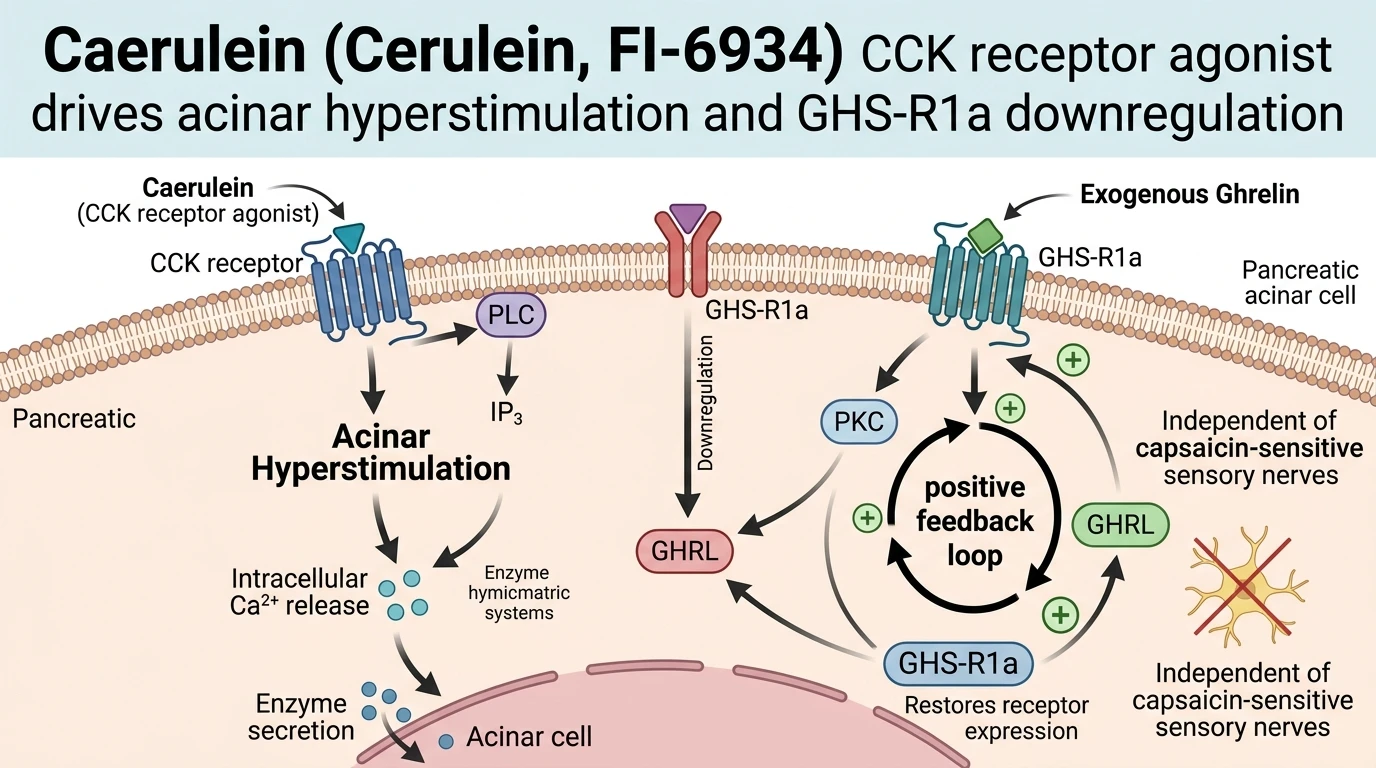
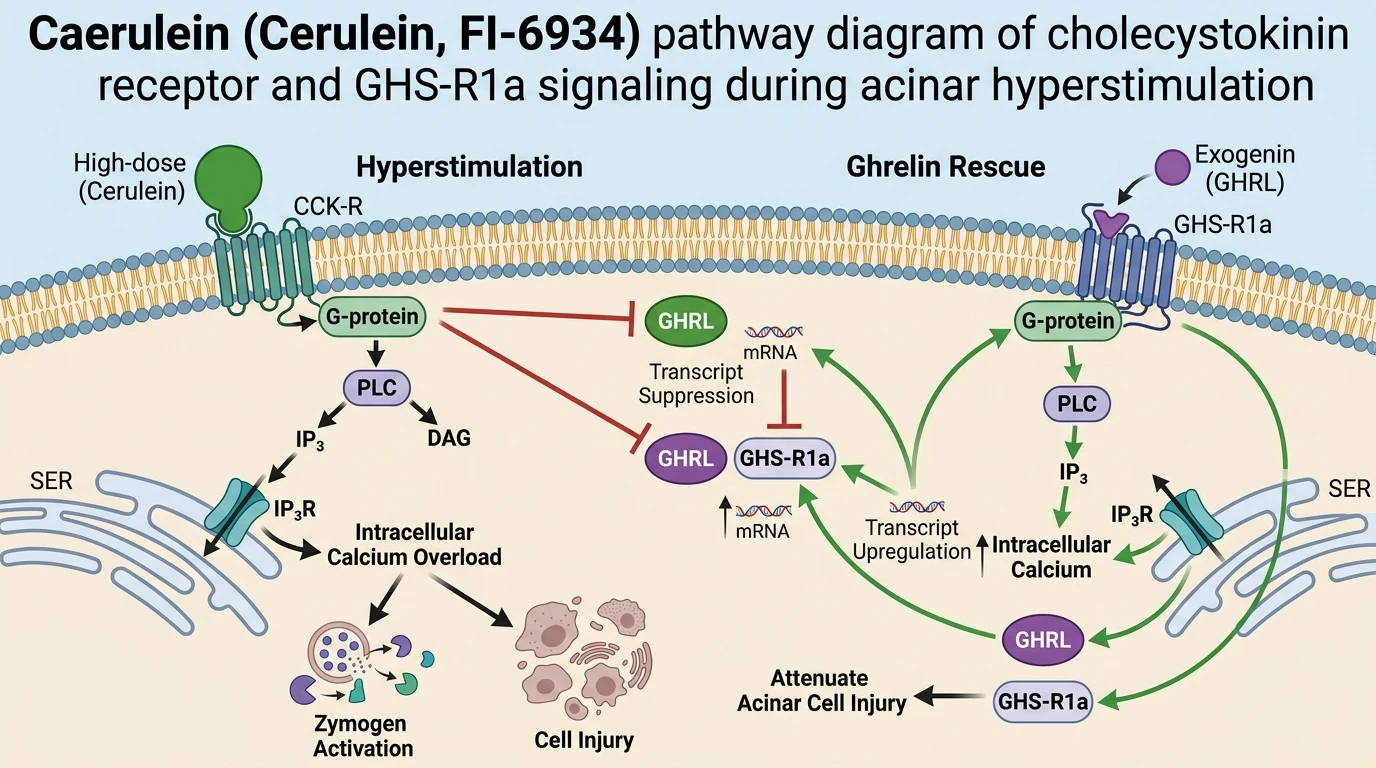
Cholecystokinin receptor hyperstimulation remains a classic experimental model for investigating acute pancreatitis pathophysiology. The synthetic decapeptide Caerulein (Cerulein, FI-6934) functions as an orthosteric analogue of cholecystokinin (CCK), demonstrating high affinity for CCK1 (CCK-A) receptors expressed on pancreatic acinar cells. At physiological concentrations, CCK receptor engagement regulates physiological digestive enzyme secretion through oscillatory intracellular calcium signaling. However, application of supramaximal concentrations of the Caerulein (Cerulein, FI-6934) CCK receptor agonist (10^-8 M) alters intracellular signal transduction, inducing sustained cytosolic calcium elevation, premature intracellular zymogen activation, vacuolization, and cellular damage in isolated rat pancreatic acinar cells and AR42J rat pancreatic acinar cell lines.
Beyond immediate acinar cell injury, supramaximal engagement of the CCK receptor by Caerulein (Cerulein, FI-6934) profoundly alters endogenous protective peptidergic networks within the exocrine pancreas. Specifically, hyperstimulation suppresses the local ghrelin system, downregulating both the ligand ghrelin (GHRL) and its functional receptor, growth hormone secretagogue receptor 1a (GHS-R1a). Under non-pathological conditions, the ghrelin/GHS-R1a signaling axis maintains exocrine tissue architecture and moderates inflammatory signaling cascades. Quantitative RT-PCR and Western blot analyses confirm that exposure to 10^-8 M caerulein suppresses GHS-R1a and GHRL expression at both mRNA and protein levels across isolated primary acinar cells and cultured AR42J models. This observed suppression highlights a core molecular mechanism through which persistent CCK receptor overactivation disables intrinsic cytoprotective defenses.
To define the regulatory architecture of this pathway, experimental models evaluated the restorative potential of exogenous ghrelin administration under basal and hyperstimulated conditions. Exogenous ghrelin treatment—administered either in vitro at 10^-7 M or in vivo at 50 ug/kg intraperitoneally—completely reversed caerulein-induced suppression of both GHS-R1a and GHRL transcript levels. Intriguingly, ghrelin enhanced its own gene expression and receptor density even under baseline non-stimulated conditions. This phenomenon demonstrates an autocrine and paracrine positive feedback loop wherein GHS-R1a activation directly stimulates GHRL gene transcription and receptor protein synthesis.
Because primary sensory afferent nerves mediate classical pancreatic inflammatory reflexes, studies investigated whether neurogenic pathways were necessary for ghrelin-mediated receptor recovery. Ablation of primary sensory neurons using systemic capsaicin administration failed to abolish exogenous ghrelin-induced upregulation of GHS-R1a and GHRL expression. Thus, the ghrelin positive feedback loop operates through direct engagement with pancreatic acinar GHS-R1a receptors rather than dependent neurogenic reflex arcs. These findings establish that the Caerulein (Cerulein, FI-6934) CCK receptor agonist suppresses endogenous protective ghrelin synthesis directly within the acinar compartment, while exogenous GHS-R1a ligation overcomes this pathway suppression through direct, cell-autonomous feedback mechanisms.
Pharmacological Modulation of Acinar GHS-R1a and Ghrelin Expressions
Copy code to add this image to your page
Caerulein acts as a potent cholecystokinin receptor agonist, driving acinar hyperstimulation and acute pancreatitis phenotypes. At supramaximal concentrations (10^-8 M), caerulein downregulates GHS-R1a and ghrelin (GHRL) expression at mRNA and protein levels in pancreatic acinar cells and AR42J models. Exogenous ghrelin administration (50 ug/kg i.p. or 10^-7 M) activates GHS-R1a, initiating an autocrine positive feedback loop that restores GHS-R1a and GHRL expression independently of sensory nerve integrity, thereby protecting pancreatic acinar cells from pancreatitis-associated injury.
Caerulein Hyperstimulation Suppresses Acinar GHS-R1a and GHRL Transcripts
Supramaximal stimulation of pancreatic acinar cells rapidly destabilizes peptide receptor expression. Exposure to the Caerulein (Cerulein, FI-6934) CCK receptor agonist at 10^-8 M significantly suppressed GHS-R1a and GHRL mRNA abundance in isolated rat primary acinar cells. Protein expression followed a matching downward trajectory. Identical suppression occurred in cultured AR42J pancreatic cells. Intracellular calcium overload drives this initial transcript loss. The observed downregulation persisted across all evaluated incubation intervals under in vitro testing conditions.
Exogenous Ghrelin Rescues Transcriptional Deficits via Positive Feedback
Direct peptide administration restores local receptor density. Exogenous ghrelin treatment at 10^-7 M in vitro or 50 ug/kg intraperitoneally in vivo fully rescued GHS-R1a expression following challenge with Caerulein (Cerulein, FI-6934). Capsaicin-induced sensory nerve ablation did not disrupt this restorative response. Ghrelin stimulates its own expression through a direct autocrine positive feedback loop. This cytoprotective mechanism operates independently of primary afferent nerve signaling in rat acinar models.