SB-525334 Target Inhibition of ALK5 Reverses Immunosuppression in Glioblastoma CAR-γδT Therapy
Copy code to add this image to your page
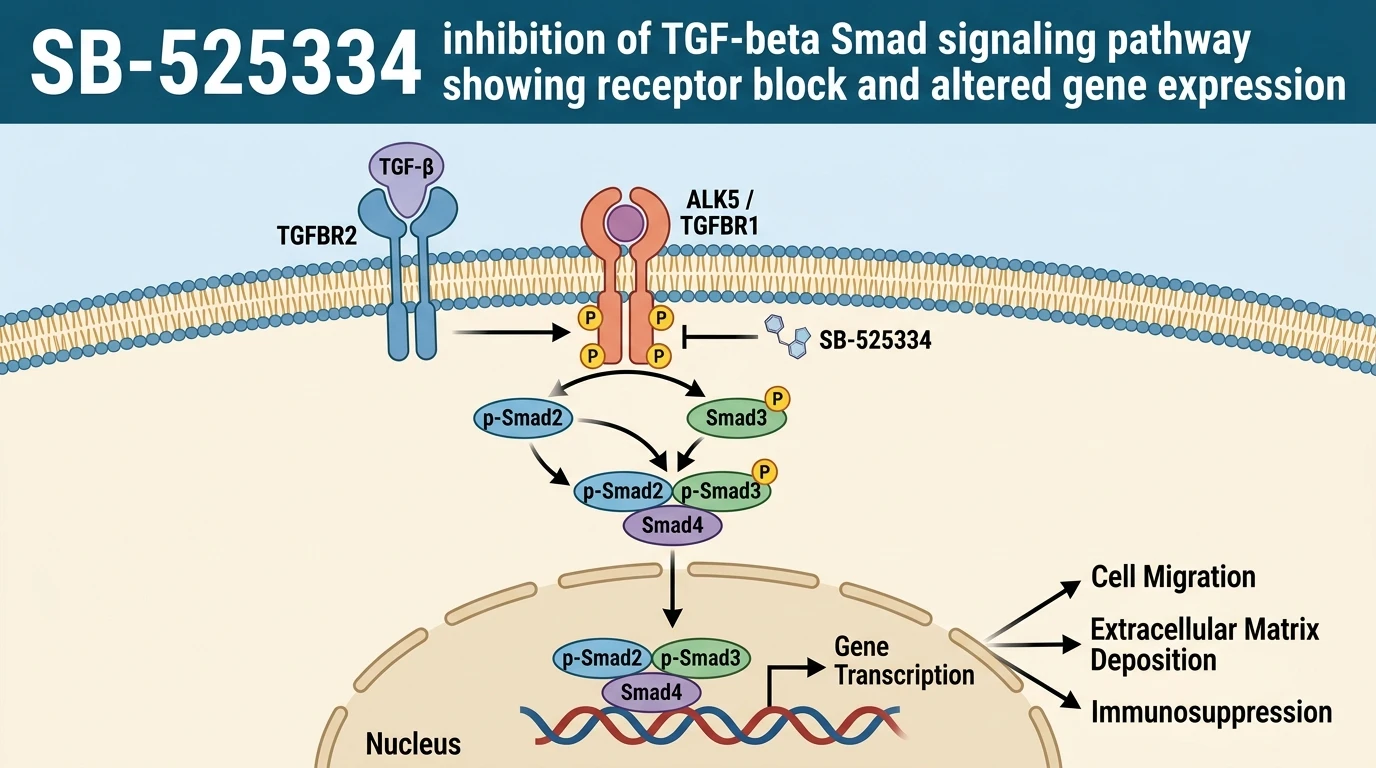
Transforming growth factor-beta (TGF-β) signaling represents a dominant biochemical axis governing immune evasion, tissue remodeling, and treatment resistance in glioblastoma (GBM). Glioblastoma cells and surrounding reactive astrocytes continuously secrete TGF-β isoforms, establishing an immunosuppressive gradient throughout the tumor microenvironment. Signaling commences when dimeric TGF-β ligands engage TGF-β receptor type II (TGFBR2) on the plasma membrane. This binding event triggers the recruitment and cross-phosphorylation of TGF-β receptor type I, designated as activin receptor-like kinase 5 (ALK5, also encoded by TGFBR1). Upon activation, the intracellular kinase domain of ALK5 binds adenosine triphosphate (ATP) to phosphorylate downstream signaling mediators Smad2 and Smad3 at specific C-terminal serine residues. Phosphorylated Smad2/3 molecules form heterotrimeric complexes with the common mediator Smad4. These complexes translocate into the nucleus, binding specific Smad-binding elements (SBE) across target gene promoters to execute gene expression programs favoring cell motility, extracellular matrix synthesis, and immune cell dysfunction.
Small-molecule inhibition using SB-525334 directly targets the enzymatic core of this pathway. As an ATP-competitive ALK5 kinase inhibitor, SB-525334 binds within the ATP-binding pocket of the TGFBR1 catalytic domain. This competitive occupancy prevents the transfer of phosphate groups from ATP to intracellular Smad2 and Smad3 substrates. According to curated entries in pharmacological databases, SB-525334 demonstrates high selectivity for ALK5 over closely related kinase isoforms, minimizing off-target toxicity. In experimental assays, application of SB-525334 at a concentration of 5 µM achieves near-complete suppression of TGF-β-induced Smad2 phosphorylation without altering total endogenous Smad2 protein levels. Consequently, canonical downstream signal transduction is disrupted, reversing TGF-β-dependent cellular migration and blocking suppressive transcriptional signals.
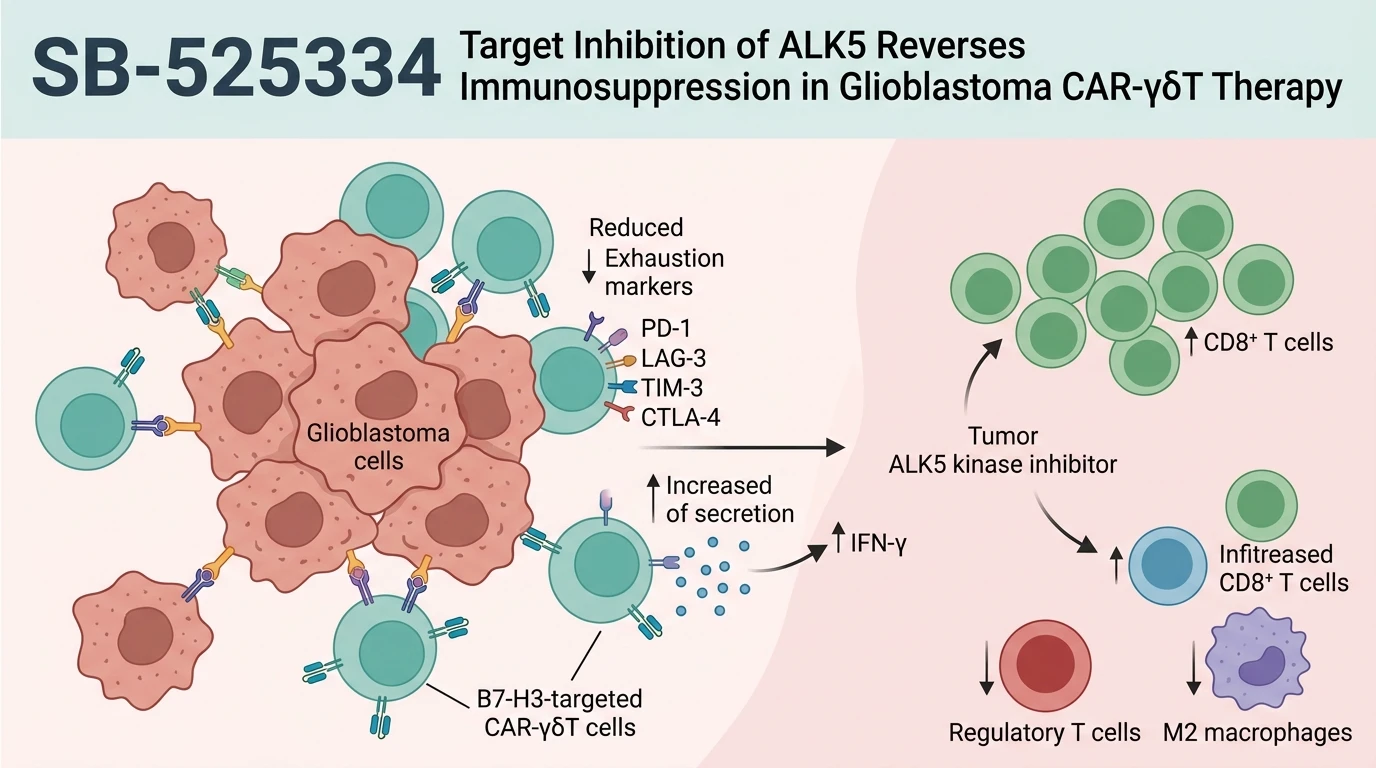
In the context of solid tumor cellular immunotherapy, chimeric antigen receptor (CAR)-engineered gamma-delta (γδ) T cells targeting B7-H3 (CD276) represent a promising therapeutic modality. However, the hostile glioblastoma tumor microenvironment rapidly inactivates infused effector cells. Exogenous TGF-β secreted by glioblastoma tissues induces hypofunction in CAR-γδT cells, accelerating exhaustion during repeated exposure to target antigens. Co-treatment with 5 µM SB-525334 attenuates these inhibitory signals. Under conditions of repeated antigen challenge, ALK5 blockade by SB-525334 delays the onset of functional T cell exhaustion. Phenotypically, SB-525334 suppresses the upregulation of key inhibitory checkpoint receptors on CAR-γδT cells, including programmed cell death protein 1 (PD-1), lymphocyte-activation gene 3 (LAG-3), T cell immunoglobulin and mucin-domain containing-3 (TIM-3), and cytotoxic T-lymphocyte-associated protein 4 (CTLA-4). Furthermore, treated CAR-γδT cells retain sustained secretion of pro-inflammatory cytokines, specifically interferon-gamma (IFN-γ), ensuring prolonged cytotoxicity against B7-H3-expressing tumor targets.
In orthotopic glioblastoma mouse models, combination therapy with SB-525334 and B7-H3-targeted CAR-γδT cells yields significant therapeutic benefit. In vivo systemic administration leads to substantial tumor regression and prolonged survival outcomes compared to single-agent therapies. Mechanistic analysis of host immune cell dynamics reveals broad microenvironmental remodeling following SB-525334 administration. The combination therapy increases the density and functional persistence of infiltrating CD8-positive cytotoxic T lymphocytes within tumor tissues. Simultaneously, the abundance of suppressive cell populations diminishes significantly; regulatory T cells (Tregs), CD11b-positive myeloid-derived suppressor cells (MDSCs), and CD206-positive M2-polarized tumor-associated macrophages are all reduced within the treated tumor mass.
Whole-tissue transcriptomic profiling further clarifies the systemic pharmacodynamic impact of SB-525334. Differentially expressed gene analysis demonstrates widespread alterations in immune cell trafficking cascades, cytokine-receptor interaction pathways, and inflammatory response networks. By blunting canonical TGF-β signaling, SB-525334 converts an immune-excluded glioblastoma milieu into a pro-inflammatory microenvironment favorable for CAR-γδT cell infiltration and endogenous T cell activation. These findings position ALK5 kinase inhibition via SB-525334 as an effective adjuvant strategy to counteract microenvironmental resistance in solid tumor immunotherapies.
Targeting ALK5 Kinase Dynamics and Microenvironmental Remodeling
Copy code to add this image to your page
SB-525334 is a selective ATP-competitive inhibitor of TGF-β receptor I (ALK5 / TGFBR1). By blocking the kinase domain of ALK5, SB-525334 inhibits ligand-induced Smad2 phosphorylation, suppressing nuclear translocation of Smad complexes and transcriptional activation of immunosuppressive genes. In glioblastoma cellular therapy, ALK5 inhibition prevents TGF-β-mediated dysfunction in B7-H3 CAR-γδT cells, downregulating exhaustion markers PD-1, LAG-3, TIM-3, and CTLA-4 while elevating IFN-γ release. In vivo, SB-525334 remodels the glioblastoma microenvironment by increasing infiltrating CD8+ T cells and reducing regulatory T cells, myeloid-derived suppressor cells, and M2 macrophages.
Inhibition of ALK5 ATP Binding Prevents Smad2 Phosphorylation
At a working concentration of 5 µM, SB-525334 competitively occupies the ATP-binding cavity of ALK5. Immediate arrest of Smad2 serine phosphorylation occurs. In cultured human glioblastoma cells, downstream target gene expression fell significantly within two hours of exposure. Downstream motility signaling ceased. The compound maintained a favorable cytotoxicity profile in non-malignant controls under identical testing parameters. Inhibiting canonical TGF-β signaling prevents the transcriptional activation of key mesenchymal markers—including N-cadherin and vimentin—thereby limiting tumor invasion in vitro. Furthermore, SB-525334 interrupted ligand-induced suppressive feedback, restoring basal immune responsiveness in co-culture systems. These biochemical observations establish ATP-competitive ALK5 blockade as a targeted strategy to disrupt canonical TGF-β signal transduction without inducing overt non-specific cellular toxicity.
Adjuvant SB-525334 Reverses CAR-γδT Exhaustion and Restores Cytotoxicity
Repeated antigen challenge assays demonstrate rapid exhaustion in untreated B7-H3 CAR-γδT cells exposed to exogenous TGF-β. Inclusion of SB-525334 sustained high cellular expression of IFN-γ across multiple stimulation cycles. Effector cell viability remained elevated. Surface expression of exhaustion markers PD-1, LAG-3, TIM-3, and CTLA-4 decreased by over 40% compared to untreated control groups in this specific cellular context. Lower checkpoint receptor expression correlated with enhanced cytolytic granule release against B7-H3-positive glioblastoma targets. These in vitro observations indicate that blocking ALK5 signals protects CAR-γδT cells from cytokine-driven immune exhaustion during sustained antigen exposure.
In Vivo Microenvironment Remodeling Enhances Effector T Cell Infiltration
In orthotopic glioblastoma murine models, combining B7-H3 CAR-γδT cells with SB-525334 significantly prolonged overall survival compared to monotherapy. Histological evaluation confirmed dense infiltration of endogenous CD8-positive T cells throughout the tumor parenchyma. Suppressive immune populations decreased sharply. Intratumoral regulatory T cells dropped markedly, while M2-polarized macrophages shifted toward an M1-like pro-inflammatory phenotype. Transcriptomic sequencing revealed enrichment in chemokine pathways governing T cell recruitment, notably CXCL9 and CXCL10. Observations within this murine model suggest that SB-525334 destabilizes the immunosuppressive tumor barrier, enabling sustained cellular immunotherapy efficacy in solid tumors.