Melanocortin Receptor Inhibitors
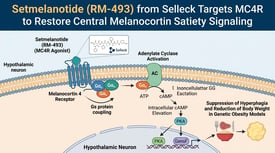
Melanocortin receptors (MCRs) constitute a family of five G protein-coupled receptors (MC1R-MC5R) that are activated by endogenous melanocortin peptides, primarily alpha-melanocyte-stimulating hormone (α-MSH) and adrenocorticotropic hormone (ACTH). These receptors are widely distributed throughout the body and mediate diverse physiological functions. MC1R is primarily involved in skin and hair pigmentation. MC2R is exclusively expressed in the adrenal cortex and mediates ACTH-stimulated glucocorticoid synthesis. MC3R and MC4R are predominantly found in the central nervous system, where they play critical roles in regulating energy homeostasis, appetite, sexual function, and inflammation. MC5R is involved in exocrine gland function, such as sebaceous gland activity. Upon binding of melanocortin peptides, MCRs typically couple to Gs proteins, leading to the activation of adenylyl cyclase and increased intracellular cAMP levels, which then modulate downstream signaling pathways. Inhibitors of MCRs block the binding of these endogenous ligands, thereby preventing receptor activation and subsequent signaling. Dysregulation of the melanocortin system is implicated in a variety of diseases.
While agonists of MC4R are extensively studied for obesity (e.g., Setmelanotide for genetic forms of obesity), MC4R antagonists are being explored for conditions where increased appetite or weight gain is desired, such as cachexia (severe wasting syndrome) associated with cancer or chronic diseases. MC1R, MC3R, and MC4R are also involved in inflammatory processes, suggesting potential for antagonists in certain inflammatory or autoimmune conditions, though agonists are often considered anti-inflammatory. Modulating MC4R activity also has implications for sexual dysfunction. Current research progress on MCR inhibitors (antagonists) is largely in the preclinical stage. Most clinical development in the melanocortin system has focused on agonists, particularly for MC4R in obesity. However, significant efforts are underway to identify selective antagonists for specific MCR subtypes. Various peptide and non-peptide antagonists have been developed for MC3R and MC4R, aiming to modulate appetite and energy expenditure. For example, some MC4R antagonists have been investigated for their potential to increase food intake in animal models of cachexia. Despite promising preclinical data, no direct MCR inhibitors (antagonists) have received regulatory approval as drugs.
The complexity of the melanocortin system and the potential for off-target effects or unintended consequences of broad MCR inhibition pose significant challenges to clinical translation. Common classifications of MCR inhibitors are based on their receptor subtype selectivity (e.g., MC1R, MC3R, MC4R antagonists), their chemical nature (peptide vs. non-peptide small molecules), and their mechanism of action (e.g., competitive antagonists). Other relevant general knowledge includes the intricate interplay of MCRs in both central and peripheral systems, which necessitates careful consideration of potential side effects when developing systemic inhibitors. A major challenge is achieving high subtype selectivity to avoid off-target effects, especially given the overlapping functions and expression patterns of some MCRs. For instance, MC4R modulation can affect cardiovascular parameters, requiring careful safety profiling. Combination therapy strategies, such as combining MCR antagonists with other appetite stimulants or anti-inflammatory agents, are being explored to enhance therapeutic efficacy. Key research tool compounds include specific peptide antagonists (e.g., SHU9119 for MC3/4R) and non-peptide small molecules, as well as receptor knockout or transgenic animal models, which are invaluable for dissecting the precise roles of individual MCRs in health and disease. The development of MCR inhibitors represents a promising but challenging area for addressing complex metabolic and inflammatory disorders.