Setmelanotide (RM-493) from Selleck Targets MC4R to Restore Central Melanocortin Satiety Signaling
Copy code to add this image to your page
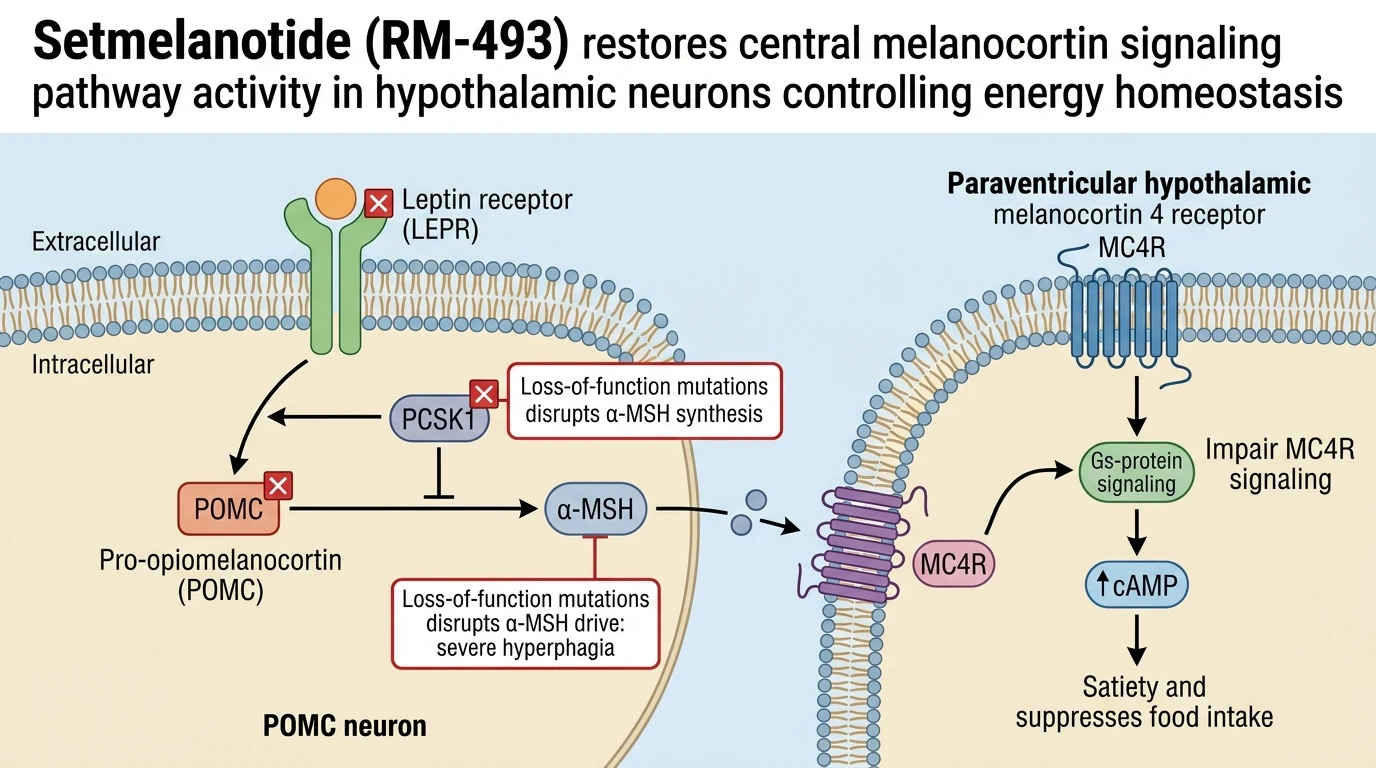
Central energy homeostasis depends upon the hypothalamic melanocortin circuit, wherein anorexigenic signaling cascades suppress appetite and maintain metabolic equilibrium. Within the arcuate nucleus, pro-opiomelanocortin (POMC) precursor cleavage by proprotein convertase subtilisin/kexin type 1 (PCSK1) generates alpha-melanocyte-stimulating hormone (alpha-MSH), an endogenous peptide ligand. Released alpha-MSH projects to the paraventricular nucleus of the hypothalamus, where it binds and activates the melanocortin 4 receptor (MC4R). Upstream genetic disruption—such as inactivating mutations in POMC, PCSK1, or the leptin receptor (LEPR) gene—arrests endogenous ligand biosynthesis. The resulting absence of MC4R activation produces uninterrupted hunger, leading to profound hyperphagia and early-onset severe obesity.
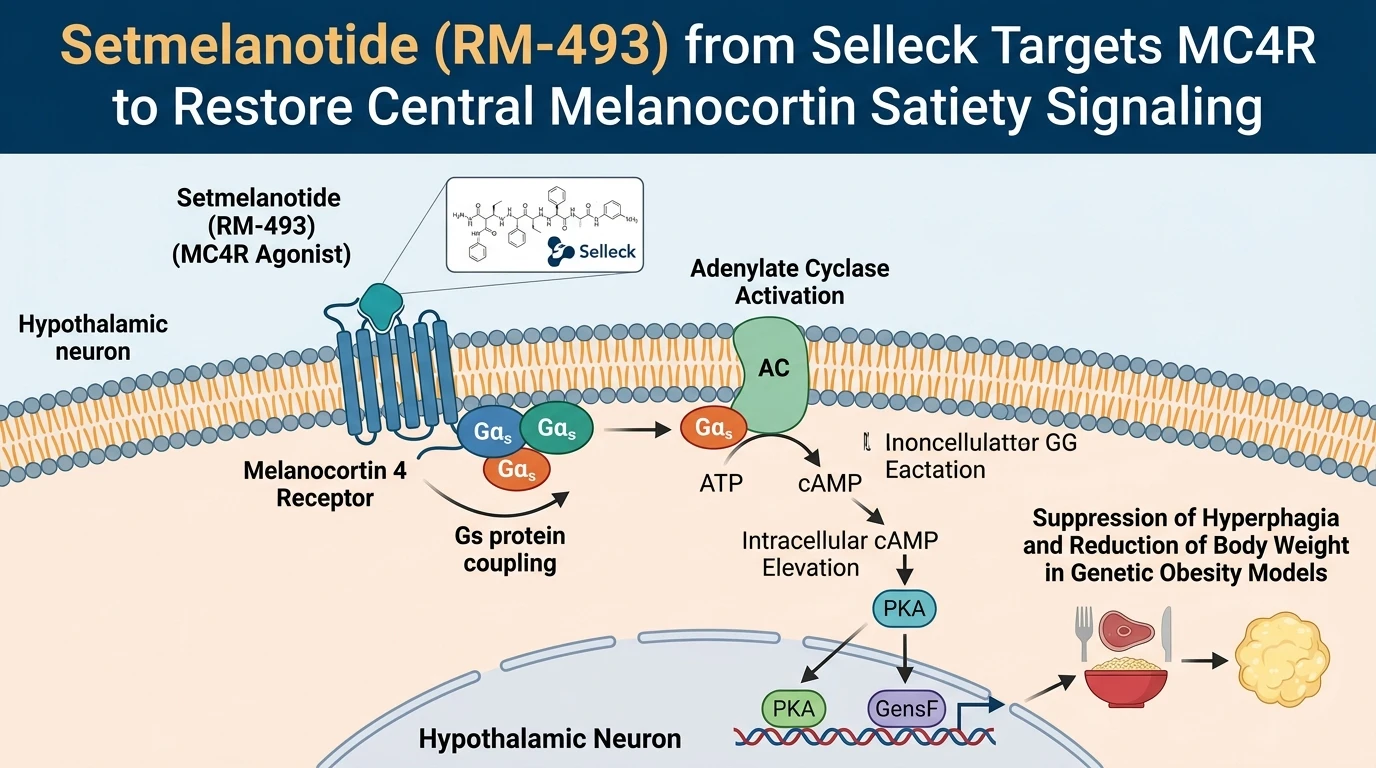
Setmelanotide (RM-493) was developed as an 8-amino-acid cyclic peptide agonist engineered to restore signaling at the level of the MC4R node. By operating downstream of leptin reception and POMC enzymatic cleavage, Setmelanotide (RM-493) from Selleck bypasses genetic blockades in alpha-MSH synthesis. Upon engagement with MC4R, the compound stimulates heterotrimeric Gs-protein coupling, driving adenylate cyclase activation and subsequent intracellular cyclic AMP (cAMP) accumulation. This intracellular cascade reinstates anorexigenic output in the paraventricular nucleus, overriding central satiety deficits caused by inherited genetic variations.
Pharmacological characterization in recombinant human receptor assays confirms that Setmelanotide exhibits sub-nanomolar affinity for MC4R (EC50 approximately 0.27 nM). The compound displays high selectivity for MC4R over other melanocortin receptor isoforms, particularly MC3R and MC5R. While ancestral melanocortin agonists frequently induced transient hypertension and tachycardia due to off-target vascular reactivity, Setmelanotide demonstrates a favorable cardiovascular profile in preclinical models. In rodent and non-human primate studies, repeated subcutaneous administration produced robust, dose-dependent suppressions of hyperphagia. Caloric restriction induced by the agonist led to selective depletion of adipose tissue depots without depleting lean muscle mass, alongside improvements in systemic insulin sensitivity.
Translational clinical studies validated these pre-clinical mechanisms in human cohorts suffering from rare monogenic and syndromic obesity disorders. Phase 2 and Phase 3 clinical trials focused on pediatric and adult patients harboring bi-allelic loss-of-function variants in POMC, PCSK1, or LEPR, as well as individuals diagnosed with Bardet-Biedl Syndrome (BBS). Clinical endpoints demonstrated striking responses to daily subcutaneous dosing. In BBS trial cohorts, patients achieved an average 5.5% reduction in total body weight after 52 weeks of continuous therapy, alongside statistically significant reductions in Likert-scale hunger assessments. Similar efficacy was recorded in POMC and LEPR deficiency cohorts, where severe hyperphagia receded within weeks of initiating treatment.
Safety evaluations across clinical trials identified predictable adverse effect profiles linked to melanocortin receptor distribution. Skin hyperpigmentation was observed in the majority of subjects, resulting from low-affinity cross-activation of cutaneous melanocortin 1 receptors (MC1R). Gastrointestinal symptoms—predominantly mild to moderate nausea, vomiting, and abdominal discomfort—were reported primarily during early dose-escalation phases. Injection-site reactions and spontaneous erections were occasionally documented, mirroring known central melanocortin pathway activity.
Pharmacological Evaluation and Central Pathway Modulation
Copy code to add this image to your page
Setmelanotide (RM-493) acts as a selective agonist of the melanocortin 4 receptor (MC4R) in the central nervous system. By binding directly to MC4R in the paraventricular nucleus of the hypothalamus, it triggers Gs-coupled protein signaling, increasing intracellular cyclic AMP (cAMP) levels. This activation restores downstream anorexigenic signaling, bypassing upstream genetic defects in POMC, PCSK1, or LEPR pathways. Consequently, Setmelanotide restores satiety signaling, suppresses severe hyperphagia, and significantly reduces body weight in rare genetic obesity disorders.
MC4R Agonism Restores Hypothalamic cAMP Second Messenger Activation
Targeted activation of hypothalamic MC4R directly drives intracellular signaling cascades responsible for satiety. Setmelanotide (RM-493) binds to the extracellular loops of MC4R; this binding event stimulates heterotrimeric Gs-protein alpha subunits within the paraventricular nucleus. Consequently, membrane-bound adenylate cyclase catalyzes the synthesis of cyclic AMP (cAMP). Intracellular cAMP levels rise rapidly following receptor binding. In primary neuronal culture models and recombinant cell assays, Setmelanotide (RM-493) from Selleck elicited potent agonist activity with sub-nanomolar half-maximal effective concentrations (EC50 = 0.27 nM). Downstream protein kinase A (PKA) activation ensues—promptly phosphorylating transcription factors such as CREB—to downregulate orexigenic neuropeptides like NPY and AgRP. This specific signal transduction sequence bypasses broken upstream steps in POMC processing; hypothalamic signaling balance is thus re-established under controlled experimental conditions.
Clinical Reduction of Weight and Hyperphagia in BBS Patients
Clinical trials in patient cohorts with rare genetic obesity syndromes confirmed the functional impact of restored MC4R signaling. In individuals presenting with Bardet-Biedl Syndrome (BBS), central melanocortin defects manifest as intractable hyperphagia and severe early-onset weight gain. Administration of Setmelanotide (RM-493) produced measurable improvements in body weight and appetite scoring metrics. Across a 52-week clinical study period, patients exhibited an average body weight reduction of 5.5%. Daily hunger scores dropped significantly during the primary evaluation phase. The most frequent treatment-emergent adverse events included cutaneous hyperpigmentation, mild nausea, and episodic vomiting. These side effects reflected peripheral MC1R cross-reactivity and transient gastrointestinal sensitivity. The clinical observations substantiate targeted MC4R engagement as an effective mechanism for suppressing hyperphagia in genetically stratified populations.