AS1842856 Inhibits FOXO3a Mediated Apoptosis in ACADL Expressing Lung Adenocarcinoma
Copy code to add this image to your page
Acyl-CoA dehydrogenase long chain (ACADL) functions as an essential mitochondria-associated metabolic enzyme whose expression is severely dysregulated in lung adenocarcinoma (LUAD). In clinical tissue specimens and cell culture models, diminished ACADL expression correlates strongly with advanced pathological stage and poor clinical survival. Functional restitution of ACADL via ectopic expression paradigms suppresses cancer cell phenotype metrics across multiple parameters. Specifically, ACADL overexpression diminishes cell proliferation, restricts cellular migration velocity, and impairs invasive capacity in vitro. Concurrently, it induces a marked upregulation of apoptotic cell death.
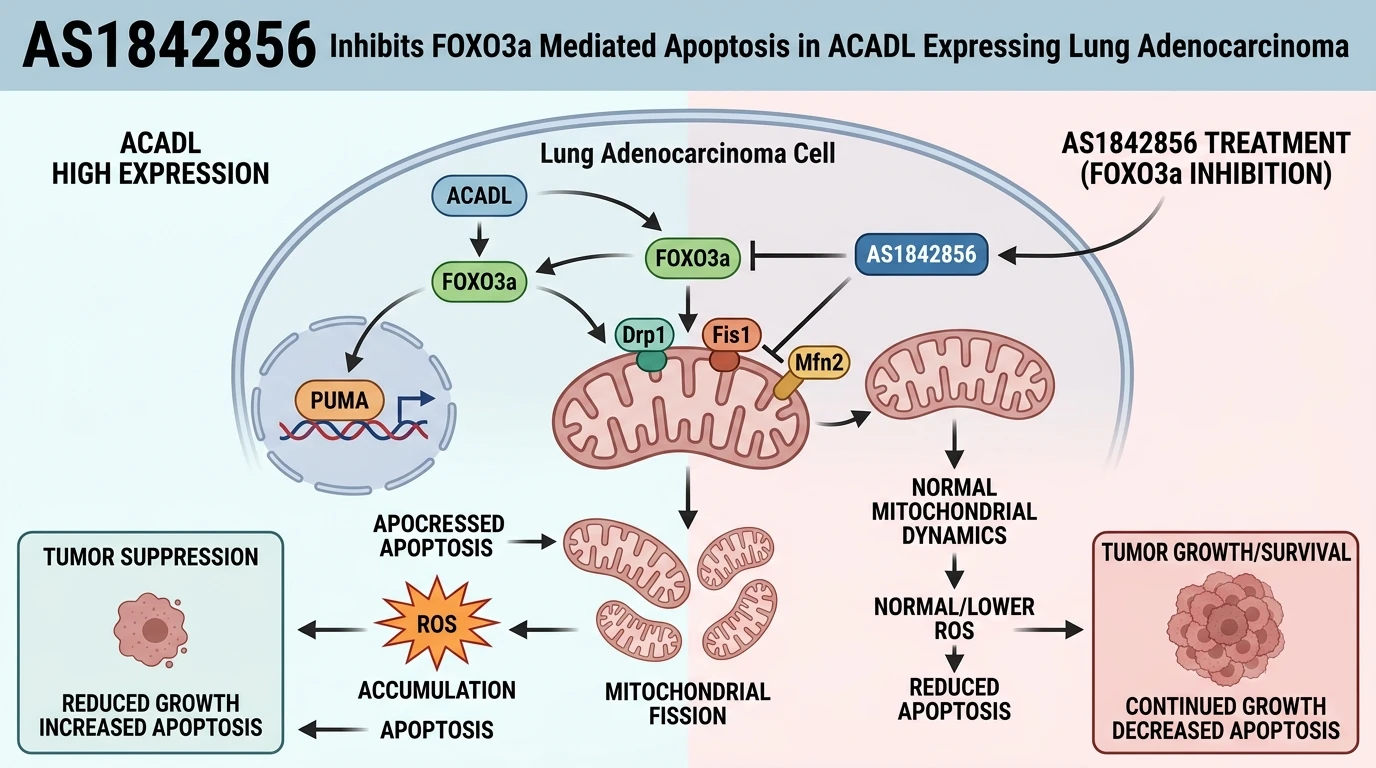
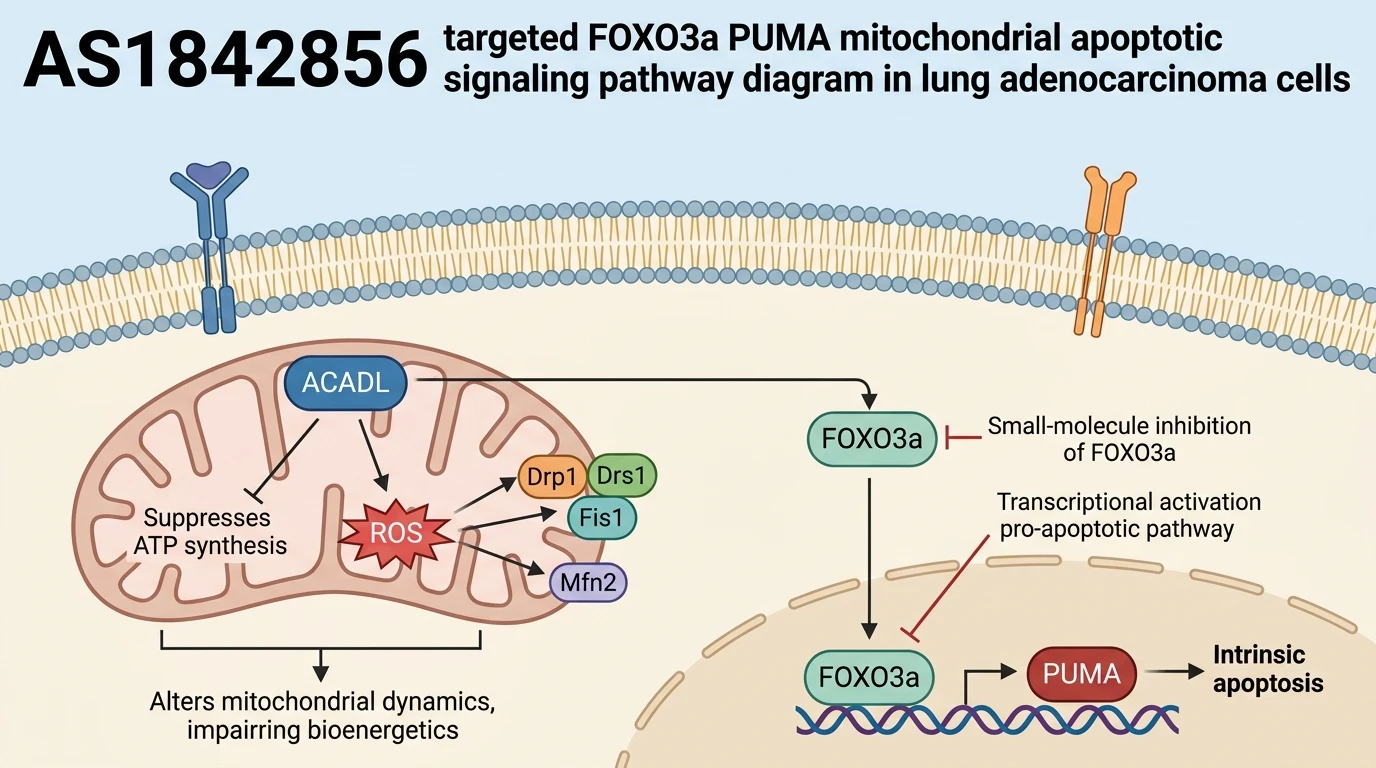
Mitochondrial metabolic remodeling represents a primary mechanism through which ACADL enforces growth restriction in LUAD. Forced expression of ACADL directly disrupts oxidative phosphorylation efficiency, yielding a pronounced decrease in intracellular ATP concentration. This energetic deficit is accompanied by a concurrent burst of reactive oxygen species (ROS) accumulation within the mitochondrial matrix. In parallel, ACADL restructures the physical dynamics of the mitochondrial network. Western blot and immunofluorescence analyses reveal that ACADL elevates the structural fission drivers Drp1 (dynamin-related protein 1) and Fis1 (mitochondrial fission 1 protein). Conversely, it suppresses expression of the outer membrane fusion mediator Mfn2 (mitofusin-2). This shift toward mitochondrial fragmentation compromises organelle integrity, precipitating mitochondrial membrane depolarization and the release of pro-apoptotic factors into the cytosol.
At the signal transduction level, ACADL activates the transcription factor Forkhead box O3a (FOXO3a). Elevated FOXO3a activity leads to downstream upregulation of p53 upregulated modulator of apoptosis (PUMA), establishing a functional ACADL/FOXO3a/PUMA signaling axis. Similar downstream metabolic and apoptotic pathways are actively investigated in leading cancer biology laboratories focusing on stress response mechanisms.
To validate whether FOXO3a activity is strictly required for ACADL-mediated phenotypes, targeted pharmacological inhibition provides definitive biological clarity. The compound AS1842856 functions as a cell-permeable, selective FOXO3a inhibitor that directly binds to FOXO3a and attenuates its transactivation potential. In xenograft animal models, systemic administration of AS1842856 substantially counteracts the tumor-suppressive effects of ACADL. Treatment with AS1842856 rescues tumor volume progression, reduces mitochondrial ROS accumulation, restores mitochondrial membrane potential, and decreases apoptotic markers. These experimental results establish that ACADL functions as a mitochondrial tumor suppressor primarily through FOXO3a-dependent transcriptional mechanisms in lung adenocarcinoma.
Pharmacological Reversal of ACADL Tumor Suppression
Copy code to add this image to your page
ACADL functions as a mitochondrial tumor suppressor in lung adenocarcinoma by disrupting mitochondrial bioenergetics and stimulating ROS generation. ACADL shifts mitochondrial dynamics toward fission by upregulating Drp1 and Fis1 while suppressing Mfn2, subsequently activating the FOXO3a/PUMA transcriptional axis to trigger intrinsic apoptosis. Pharmacological intervention using the small-molecule inhibitor AS1842856 directly targets FOXO3a activity, reversing ACADL-driven ATP depletion, ROS accumulation, and tumor suppressive phenotypes in vivo.
ACADL Induces Mitochondrial Fragmentation and Energetic Collapse
Elevated ACADL expression directly alters mitochondrial architecture and bioenergetics in lung adenocarcinoma cells. Intracellular ATP levels fall rapidly following ACADL induction. Simultaneously, mitochondrial reactive oxygen species accumulate to toxic threshold levels. Quantitative immunoblotting indicates that ACADL upregulates mitochondrial fission factors Drp1 and Fis1, while downregulating fusion effector Mfn2. This structural imbalance triggers organelle fragmentation. Mitochondrial membrane potential decreases significantly under these metabolic conditions. The resulting organelle stress initiates the execution phase of apoptosis.
FOXO3a Inhibition by AS1842856 Attenuates Xenograft Tumor Suppression
FOXO3a functions as the key downstream effector linking ACADL expression to PUMA-mediated cell death. Nuclear accumulation of FOXO3a directly transactivates the pro-apoptotic factor PUMA. To evaluate therapeutic target dependency in vivo, researchers deployed the selective small-molecule inhibitor AS1842856 in murine xenograft models. Administration of AS1842856 significantly restored tumor growth in ACADL-overexpressing xenografts. Cellular ROS generation dropped substantially following drug treatment. Furthermore, AS1842856 suppressed PUMA transcription and rescued mitochondrial bioenergetics. These animal model findings demonstrate that ACADL requires functional FOXO3a signaling to execute tumor suppression.