ASP2215 (Gilteritinib) targets FLT3 and AXL receptor tyrosine kinases in relapsed AML
Copy code to add this image to your page
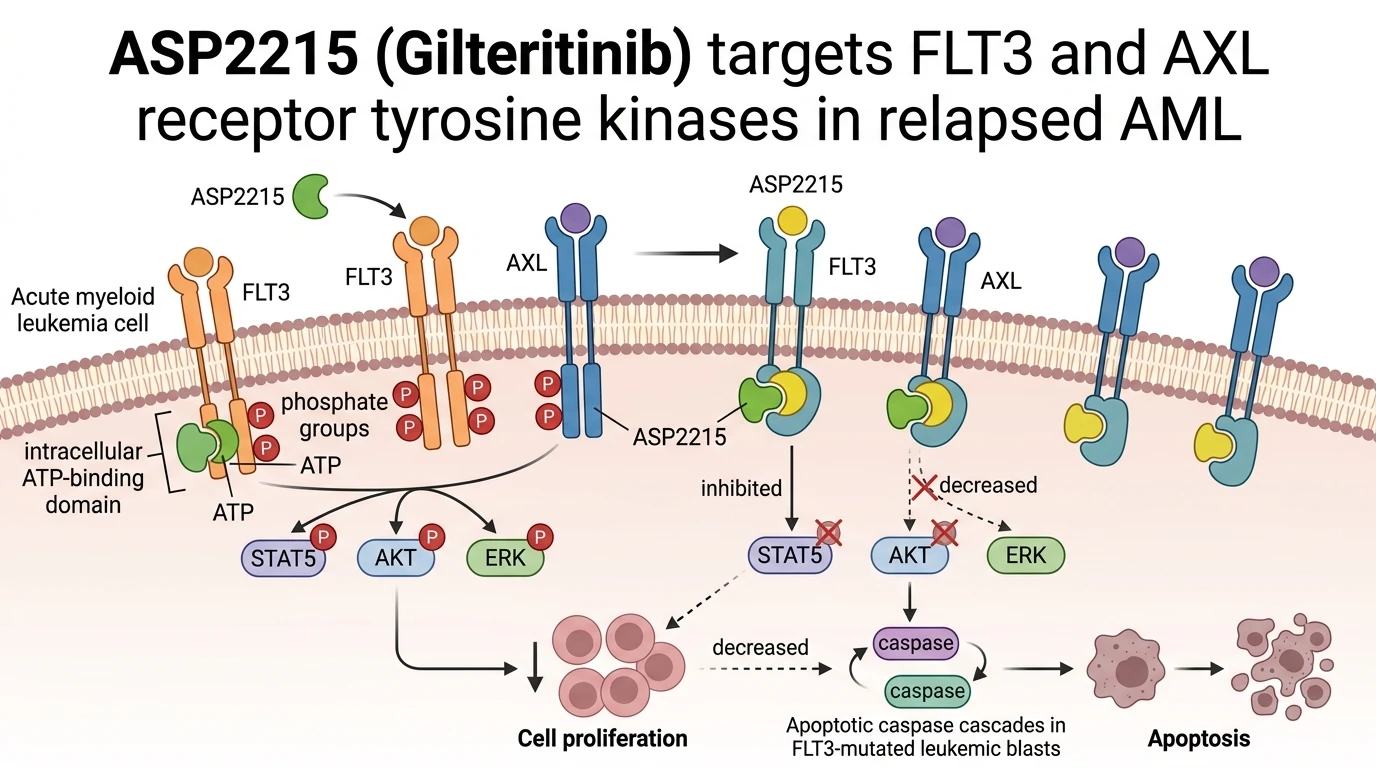
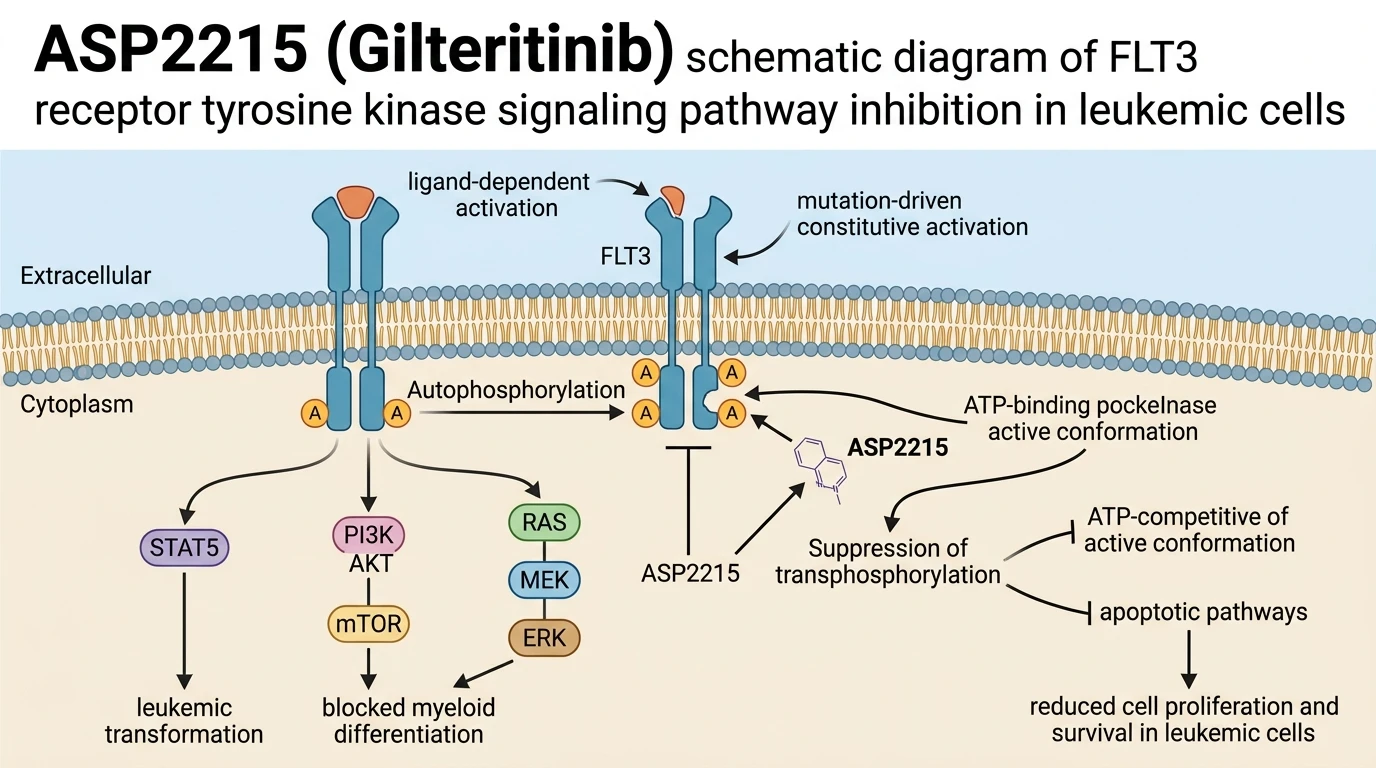
Receptor tyrosine kinase signaling dictates the survival, maturation, and expansion of early hematopoietic progenitor cells within the bone marrow niche. Aberrant activation of Fms-like tyrosine kinase 3 (FLT3) through internal tandem duplication (ITD) within the juxtamembrane domain or point mutations within the tyrosine kinase domain (TKD)—most prominently at codon D835—drives acute myeloid leukemogenesis in approximately 30% of adult AML cases. These oncogenic alterations induce ligand-independent homodimerization and constitutive transphosphorylation, triggering downstream activation of STAT5, PI3K/AKT, and MAPK/ERK signaling cascades. ASP2215 (Gilteritinib) was developed as a potent, orally bioavailable Type I receptor tyrosine kinase inhibitor capable of engaging both active and inactive conformations of FLT3-ITD and FLT3-TKD mutant receptors. Beyond its primary high-affinity targeting of FLT3, ASP2215 concurrently inhibits AXL, a receptor tyrosine kinase frequently overexpressed in resistant AML blasts that mediates microenvironment-driven survival cues, alongside anaplastic lymphoma kinase (ALK). By occupying the intracellular ATP-binding pocket with nanomolar binding affinity, ASP2215 blocks autophosphorylation events essential for downstream effector recruitment, restoring apoptotic signaling and halting leukemic cell proliferation.
At the biochemical level, Type I kinase inhibitors like ASP2215 bind to the conserved ATP-binding pocket regardless of whether the activation loop adopts an active or inactive conformation. This structural mechanism allows effective engagement of FLT3 mutants carrying TKD activation loop alterations, such as D835Y or I836, which confer resistance to Type II inhibitors that require an inactive kinase conformation. In vitro enzymatic assays demonstrate single-digit nanomolar IC50 values against both FLT3-ITD and TKD point mutants. Furthermore, simultaneous blockade of AXL kinase addresses a key microenvironmental survival pathway, as bone marrow stroma-derived AXL activation frequently contributes to persistence of residual leukemic stem cells during target blockade. This dual receptor target profile suppresses downstream STAT5 transactivation, decreases cyclin D1 transcription, and triggers cleavage of poly(ADP-ribose) polymerase (PARP) and caspase-3, driving leukemic cell populations into programmed cell death.
Clinical translation of targeted kinase inhibitors in relapsed or refractory (R/R) FLT3-mutated AML requires evaluation outside rigid clinical trial protocols to reflect heterogenous patient populations. A real-world multicenter observational study conducted across Italian hematology centers evaluated clinical outcomes in 205 adult patients presenting with R/R FLT3-mutated AML treated with monotherapy. Within this heavily pretreated cohort, ASP2215 elicited an overall response rate (ORR) of 52.2%, with complete remission (CR) achieved in 43.4% of patients. The median overall survival (OS) across the entire real-world cohort reached 10.3 months. These empirical metrics indicate that targeted mono-inhibition retains substantial antileukemic activity in real-world clinical practice, where patients often present with advanced age, compromised performance status, and multiple prior therapeutic lines.
The strategic application of targeted kinase inhibition as a cytoreductive bridge to allogeneic stem cell transplantation (allo-SCT) represents an important determinant of curative potential in R/R AML. Among transplant-eligible individuals within the Italian cohort, treatment produced an ORR of 62.9%. Crucially, 48% of these transplant-eligible patients were successfully bridged to allo-SCT after attaining clinical disease control. Post-transplant longitudinal survival tracking revealed 1-year and 3-year overall survival rates of 65.2% and 56.1%, respectively. These observations indicate that achieving rapid, high-quality cytoreduction with targeted kinase inhibitor therapy allows a substantial proportion of patients to undergo consolidative stem cell transplantation, leading to durable long-term survival in a subset of individuals.
The clinical utility of targeted inhibition was also examined in the setting of disease recurrence following allogeneic stem cell transplantation. Relapse post-allo-SCT represents an adverse clinical scenario characterized by severe therapeutic resistance and poor survival expectations. Within this specific post-transplant relapse subgroup, administration yielded an ORR of 54.3% and a median OS of 11.1 months, confirming therapeutic responsiveness even after cellular therapy failure. However, molecular profiling identified significant genomic modifiers that altered survival outcomes. The acquisition of novel secondary FLT3 mutations at relapse significantly compromised patient survival. Similarly, co-existing TP53 mutations exerted a marked negative prognostic impact, restricting post-treatment survival duration. These real-world observations highlight the potent therapeutic capacity of target blockade while underscoring how subclonal evolution and co-occurring driver mutations delineate survival boundaries in relapsed leukemic disease.
Real-World Efficacy and Biomarker-Driven Survival Stratification
Copy code to add this image to your page
ASP2215 (Gilteritinib) functions as a highly potent, oral Type I receptor tyrosine kinase inhibitor targeting both FLT3-ITD and FLT3-TKD mutations alongside AXL and ALK kinases. By competitively binding the intracellular ATP-binding pocket of active and inactive kinase conformations, ASP2215 prevents autophosphorylation and abolishes constitutive downstream activation of STAT5, AKT, and ERK signaling networks. Consequently, this target blockade selectively arrests cell cycle progression and induces apoptotic cell death in FLT3-mutated acute myeloid leukemia blasts, offering dual activity against primary driver mutations and secondary resistance mechanisms.
Cytoreductive Efficacy and Allogeneic Transplantation Bridging Rates
Targeted kinase suppression demonstrates clear therapeutic value in advanced myeloid leukemia. In the multicenter Italian real-world study, treatment with ASP2215 induced overall responses in 52.2% of patients with relapsed or refractory disease. The complete remission rate reached 43.4%. Among transplant-eligible individuals, overall response rates increased significantly to 62.9% following targeted receptor mono-inhibition. Disease control enabled successful bridging. Exactly 48% of eligible candidates received allogeneic stem cell transplantation following disease stabilization. Post-transplant survival outcomes remained encouraging. Patients receiving subsequent stem cell grafts sustained 1-year and 3-year overall survival rates of 65.2% and 56.1%, respectively.
Post-Transplant Recurrence Outcomes and Molecular Resistance Factors
Post-transplant relapse presents a major clinical challenge. Administration of ASP2215 within this post-transplant relapse cohort achieved an overall response rate of 54.3% alongside a median survival of 11.1 months. Specific molecular alterations constrained overall benefit. Patients carrying co-existing TP53 mutations or acquiring novel FLT3 mutations at relapse experienced significantly shortened overall survival compared to wild-type cohorts. Clonal evolution limits monotherapy duration. Genomic profiling during targeted therapy provides essential insights into emerging secondary resistance mechanisms.