Thiamet G OGA inhibitor Regulates ATF4 and Mitochondrial Stress in Alzheimer Models
Copy code to add this image to your page
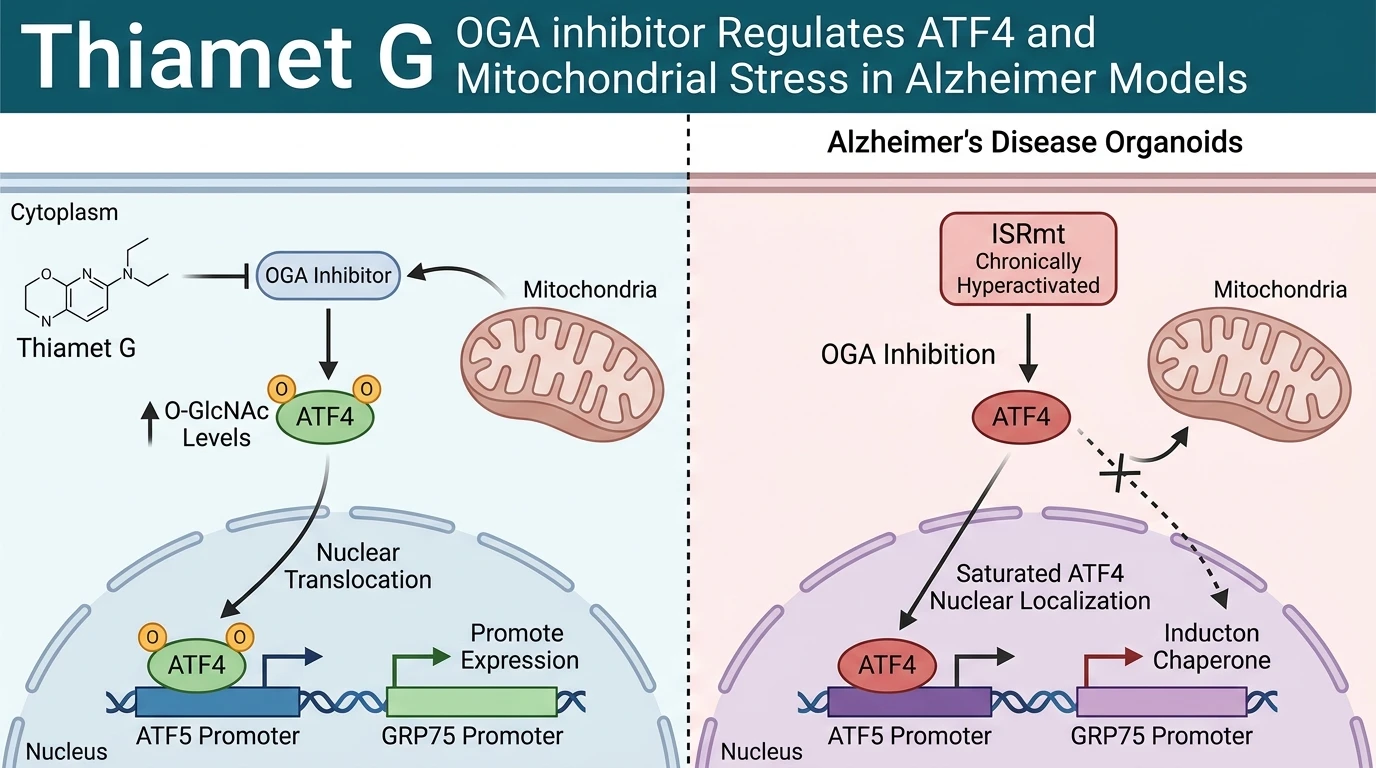
Reversible O-linked N-acetylglucosamine (O-GlcNAc) modification operates as a dynamic nutrient- and stress-sensing post-translational modification on cytosolic and nuclear proteins. The enzymatic cleavage of this sugar moiety is catalyzed exclusively by O-GlcNAcase (OGA). Application of the potent small-molecule Thiamet G rapidly suppresses OGA catalytic activity, yielding a pronounced accumulation of cellular O-GlcNAcylated substrates. Recent pharmacological investigations demonstrate that this elevated O-GlcNAcylation state directly engages intracellular stress response circuits. Specifically, target engagement by the Thiamet G OGA inhibitor initiates the mitochondrial integrated stress response (ISRmt) under standard metabolic conditions.
The mechanistic link between O-GlcNAc elevation and mitochondrial homeostasis centers on Activating Transcription Factor 4 (ATF4). Under basal conditions in healthy cellular systems, treatment with Thiamet G elevates total ATF4 protein concentration without altering baseline transcript abundance. This protein stabilization is accompanied by rapid nuclear translocation of ATF4. Once localized within the nucleus, ATF4 occupies canonical promoter binding motifs of downstream stress response targets. Prominent among these target genes is ATF5, alongside key mitochondrial matrix chaperones such as Glucose-Regulated Protein 75 (GRP75/HSPA9). GRP75 assists in folding nuclear-encoded proteins imported into the mitochondrial matrix. Consequently, OGA inhibition bolsters organellar protein quality control capacity.
Quantitative biochemical analyses confirm that Thiamet G-induced ATF4 activation relies on intracellular O-GlcNAc dynamics rather than canonical eukaryotic initiation factor 2 alpha (eIF2α) phosphorylation cascades. In unperturbed physiological states, this non-canonical induction serves an adaptive function. Mitochondrial chaperone synthesis increases. Matrix protein aggregation diminishes. Organellar respiratory parameters remain intact.
However, this homeostatic regulation exhibits profound alterations within neurodegenerative disease environments. In murine models of Alzheimer's disease (such as 5xFAD mice) and patient-derived human cerebral organoids, baseline ISRmt activity is already chronic and marked by hyperactivation. Endogenous ATF4 protein levels in these pathological tissues remain constitutively elevated. Promoters for downstream targets, including ATF5 and GRP75, demonstrate maximal basal occupancy.
Under these pathological conditions, administering the Thiamet G OGA inhibitor fails to elicit further ATF4 nuclear translocation or chaperone upregulation. The regulatory link connecting O-GlcNAc modifications to ISRmt activation becomes uncoupled. Quantitative chromatin immunoprecipitation assays indicate that ATF4 promoter engagement reaches a ceiling effect in Alzheimer's models. Neither additional O-GlcNAc accumulation nor acute OGA blockade alters downstream transcription in this context. Consequently, while OGA inhibition reliably stimulates adaptive mitochondrial stress pathways in baseline cellular contexts, this specific pharmacodynamic arm loses responsiveness during late-stage neurodegenerative pathology.
Pharmacological Characterization and Pathological Uncoupling of OGA-Mediated ISRmt
Copy code to add this image to your page
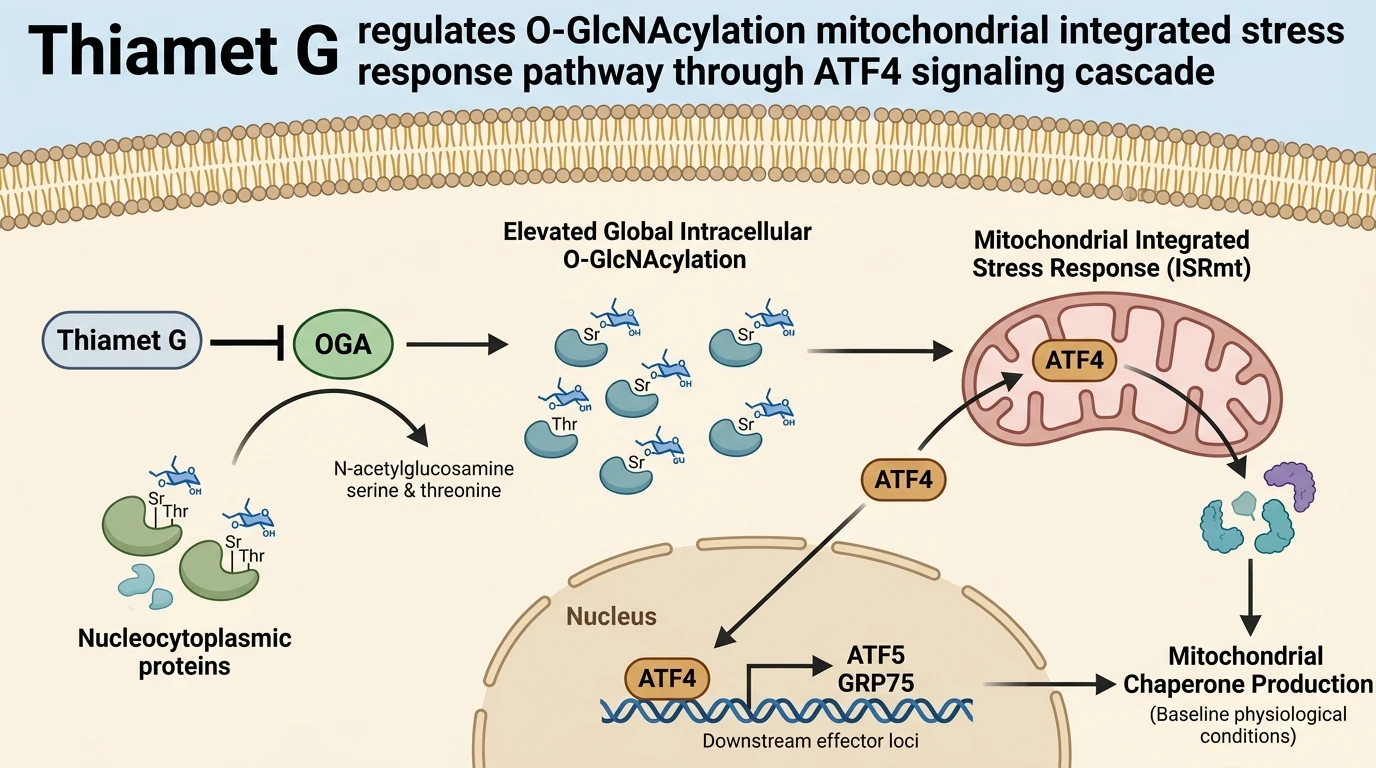
Thiamet G selectively inhibits O-GlcNAcase (OGA), inducing protein O-GlcNAcylation. In normal physiology, elevated O-GlcNAc levels stabilize ATF4, driving its nuclear translocation and binding to promoters of ATF5 and GRP75 to stimulate the mitochondrial integrated stress response (ISRmt). In Alzheimer's disease models, ISRmt is chronically hyperactivated, causing ATF4 and downstream targets to uncouple from OGA inhibition.
Physiological Engagement of ATF4 and Downstream Chaperone Upregulation
In standard in vitro cell cultures and healthy wild-type rodent tissues, acute treatment with Thiamet G causes a rapid increase in total protein O-GlcNAcylation. Target engagement occurs within hours at low nanomolar concentrations. The resulting accumulation of O-GlcNAc post-translational modifications stabilizes the transcription factor ATF4. Nuclear fractionations reveal enriched ATF4 localization. Chromatin immunoprecipitation assays confirm heightened occupancy at the ATF5 promoter region. Subsequently, expression of the mitochondrial matrix chaperone GRP75 increases significantly. This selective upregulation enhances mitochondrial proteostasis without inducing non-specific cytotoxicity.
Pathological Uncoupling and Resistance in Alzheimer's Disease Models
Evaluation of this pathway in 5xFAD transgenic mice and human iPSC-derived Alzheimer's cerebral organoids reveals a distinct pharmacodynamic divergence. Baseline ISRmt signaling in these neurodegenerative systems is hyperactivated. ATF4 expression remains elevated continuously. Downstream targets like GRP75 operate at maximal output. Applying the Thiamet G OGA inhibitor in this disease state fails to produce additional ATF4 nuclear accumulation. Downstream chaperone transcription does not change. Chronic pathological stress uncouples O-GlcNAc status from ISRmt transcriptional control. Therefore, the therapeutic window for OGA-driven ISRmt modulation depends heavily on baseline disease burden.