10058-F4 Inhibits c-Myc Max Heterodimerization via Extended Conformational Selection
Copy code to add this image to your page
Targeting intrinsically disordered proteins (IDPs) presents an enduring pharmacological hurdle due to their lack of stable, pre-formed binding pockets. The oncogenic transcription factor c-Myc relies on its C-terminal basic helix-loop-helix leucine zipper (bHLHZip) domain to heterodimerize with its obligate partner Max. Dimerization orders the protein structure, enabling high-affinity binding to canonical E-box DNA sequences (5'-CACGTG-3') and driving transcriptional programs across diverse malignancies. Monomeric c-Myc remains largely unstructured in solution. Small molecule engagement with such disordered ensembles requires distinct physical principles compared to classical ligand-receptor interactions. The low-molecular-weight inhibitor 10058-F4 specifically targets the monomeric c-Myc bHLHZip domain, disrupting functional dimerization with Max under in vitro and cellular assay conditions.
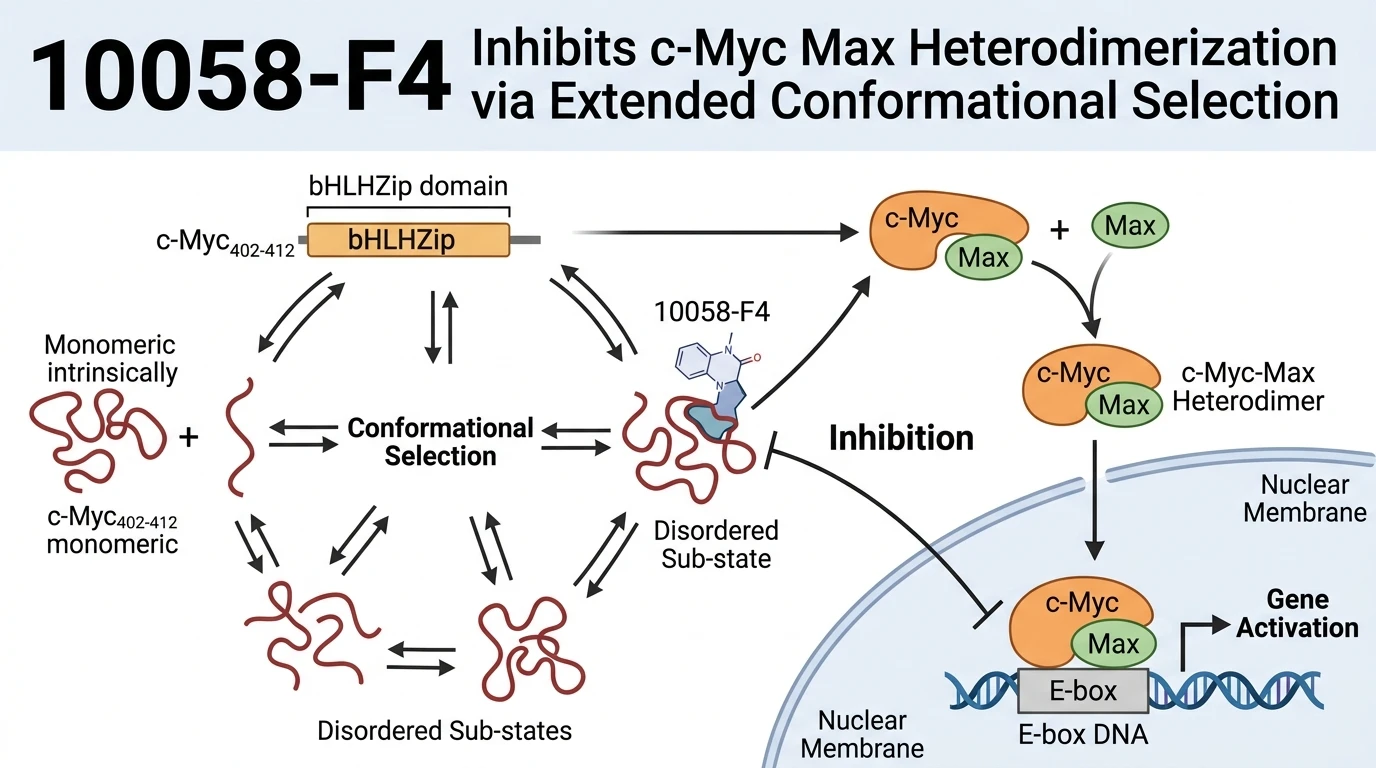
To elucidate the atomistic recognition mechanism of 10058-F4, advanced computational sampling techniques provide essential structural visibility. Bias-exchange metadynamics molecular dynamics (BEMD) simulations were utilized to map the free energy landscape of the c-Myc sequence spanning residues 402–412 (c-Myc402-412). Conventional simulations often fail to capture the extensive conformational heterogeneity characteristic of IDPs. BEMD circumvents energy barriers, allowing thorough exploration of accessible structural states. The resulting conformational ensemble demonstrates that c-Myc does not adopt a single well-defined tertiary structure upon exposure to the inhibitor. Instead, 10058-F4 maintains the unstructured character of the target peptide.
Ligand binding occurs through an extended conformational selection mechanism. In this model, 10058-F4 recognizes and binds weakly to multiple pre-existing sub-states within the unbound c-Myc ensemble. These sub-states exhibit varying degrees of compact hairpin-like structures, hydrophobic clustering, and transient salt bridges. Rather than inducing a global folding event, 10058-F4 stabilizes a heterogenous sub-population of monomeric conformations. The association is mediated by distributed hydrophobic contact networks alongside transient electrostatic interactions, avoiding rigid energetic locking. Quantitative modeling confirms that these bound configurations are already present at low statistical populations in the apo equilibrium.
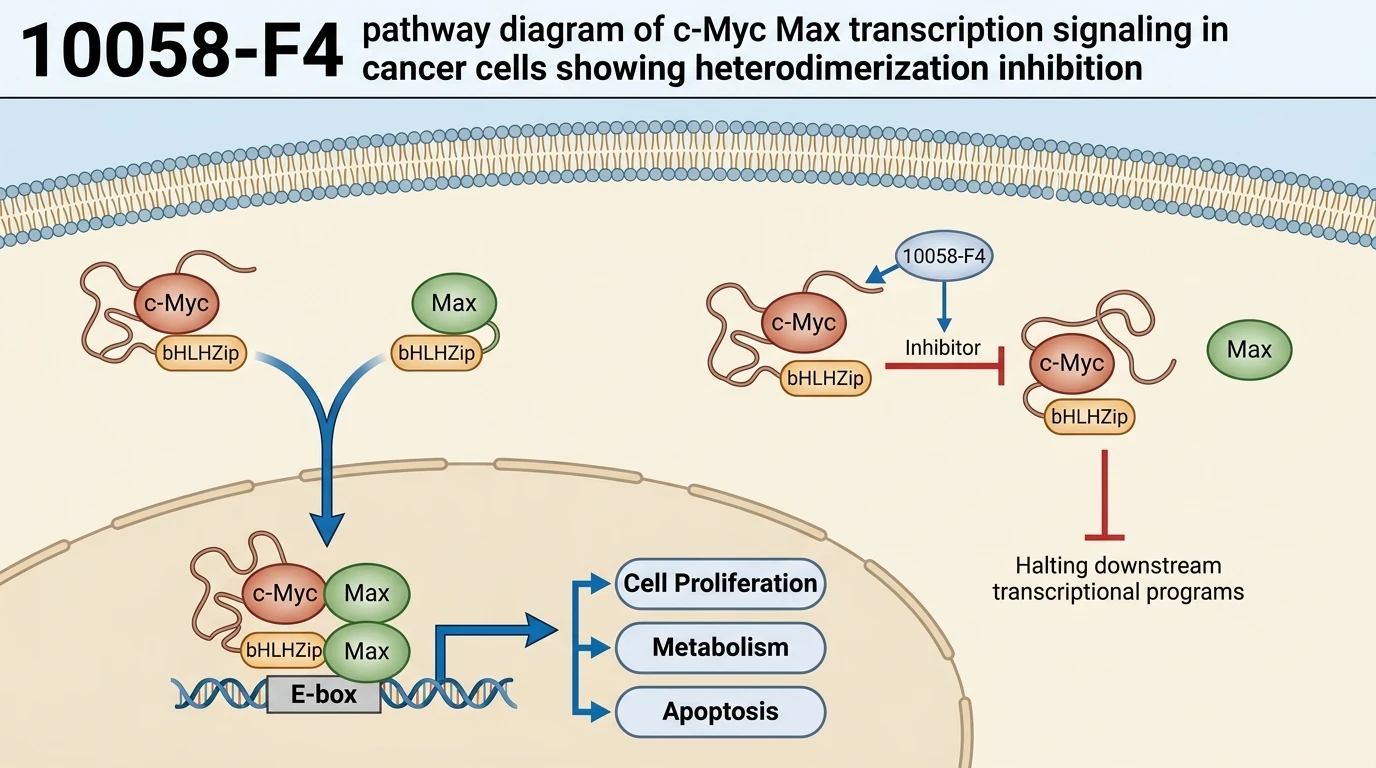
Crucially, the c-Myc conformations selected and stabilized by 10058-F4 are structurally incompatible with Max heterodimerization. The assembly of the c-Myc/Max complex requires c-Myc to adopt a continuous extended alpha-helix that pairs alongside the Max bHLHZip domain. Binding of 10058-F4 sequesters c-Myc into alternative non-helical states, sterically preventing the structural transition required for Max association. In vitro biochemical validation and biophysical assays corroborate these simulation metrics. Disruption of the heterodimer eliminates E-box promoter binding, leading to down-regulation of oncogenic driver genes. Researchers establishing cell-based models often utilize established viral production protocols to overexpress target constructs or reporter reporters for mechanistic validation. Overall, 10058-F4 demonstrates that small molecules can achieve targeted inhibition of IDPs by stabilizing non-functional monomeric ensembles rather than competing for a defined catalytic cleft.
Biophysical Mechanism and Structural Ensemble Dynamics
Copy code to add this image to your page
10058-F4 inhibits c-Myc/Max heterodimerization by binding to the monomeric, intrinsically disordered c-Myc bHLHZip domain (residues 402–412). Rather than inducing a static helical fold, 10058-F4 engages in weak, transient interactions across a broad conformational ensemble. This occurs via an extended conformational selection mechanism. The ligand stabilizes specific pre-existing apo conformations that are structurally incompatible with Max association, effectively preventing the formation of the functional transcriptional complex.
BEMD Simulations Map Disordered Monomeric Ensembles
Classical drug discovery strategies depend on rigid, pre-formed binding pockets. The intrinsically disordered c-Myc402-412 region lacks such architectural features. Bias-exchange metadynamics molecular dynamics (BEMD) simulations resolved this sampling challenge. Atomistic trajectories demonstrated that the unbound peptide exists in dynamic equilibrium across multiple low-energy basins. No dominant tertiary structure persists in solution. Short-lived alpha-helical segments form spontaneously, but decay within nanosecond timescales. The addition of 10058-F4 does not collapse this dynamic distribution into a unique, rigid complex. Instead, 10058-F4 engages multiple distinct peptide configurations simultaneously. Thermal fluctuations drive continuous reorientation of the small molecule across aromatic and hydrophobic side chains. The free energy profile reveals broad, shallow minima indicative of non-specific entropic retention.
Extended Conformational Selection Traps Non-Binding Substates
Distinguishing between induced-fit and conformational selection models is crucial for IDP pharmacology. The BEMD data support an extended conformational selection pathway. In this regime, 10058-F4 preferentially interacts with pre-existing, partially compact conformations in the apo ensemble. Thermodynamics favors ligand capture of specific disordered sub-states. This capture shifts the equilibrium away from the fully extended helical conformation necessary for partner recognition. Kinetic rates of binding remain moderate due to the diffuse contact surface. The inhibitor distributes its binding affinity across multiple residue contacts rather than relying on a single hot spot. Consequently, 10058-F4 acts as a dynamic shield, trapping c-Myc in states that cannot undergo folding-upon-binding with Max.
Steric Incompatibility Suppresses Direct Max Heterodimerization
Heterodimerization requires c-Myc and Max to form a four-helix bundle. Within this coiled-coil architecture, key leucine zipper residues align to form a hydrophobic core. Alignment requires structural regularity. Structural superposition of 10058-F4-bound c-Myc configurations onto the crystallographic c-Myc/Max dimer reveals severe geometric clashes. Steric overlap occurs between the bound inhibitor and the alpha-helical backbone of Max. Furthermore, 10058-F4 stabilizes local turn-like motifs in c-Myc, preventing the requisite continuous helical extension. The energetic barrier for Max association becomes prohibitively high under these conditions. As a result, 10058-F4 effectively abolishes functional transcription complex formation without directly contacting the Max protein.