Myc Inhibitors
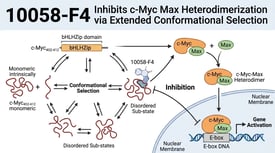
Myc is a proto-oncogenic transcription factor that plays a central role in regulating fundamental cellular processes, including cell proliferation, growth, metabolism, and apoptosis. It functions as a heterodimer with its binding partner MAX, forming a complex that binds to specific DNA sequences known as E-box motifs (CACGTG) in the promoters and enhancers of target genes. Upon binding, the Myc/MAX complex recruits transcriptional co-activators and chromatin remodeling enzymes, leading to the activation of a vast network of genes essential for cell cycle progression, ribosome biogenesis, and metabolic reprogramming. Conversely, MYC can also repress gene expression through indirect mechanisms. Due to its pervasive influence on cell growth and division, MYC is one of the most frequently amplified, overexpressed, or aberrantly activated oncogenes in human cancers. Its dysregulation is a driving force in a wide array of malignancies, including Burkitt lymphoma, neuroblastoma, breast cancer, lung cancer, colorectal cancer, and many others, making it a highly attractive, yet historically challenging, therapeutic target. The development of direct MYC inhibitors has been notoriously difficult, earning MYC the reputation of being an 'undruggable' target. This difficulty stems from its intrinsically disordered nature, lack of a well-defined catalytic pocket, and nuclear localization.
However, recent advancements have challenged this dogma. Current research progress can be broadly categorized into indirect and direct inhibition strategies. Indirect approaches aim to modulate MYC expression, stability, or activity through upstream or downstream pathways. For example, BET inhibitors (e.g., JQ1, OTX015) have shown efficacy by displacing BRD4 from chromatin, leading to the downregulation of MYC transcription. CDK inhibitors, particularly those targeting CDK7 and CDK9, can also impact MYC stability and transcriptional activity. Several of these indirect inhibitors are in various stages of clinical trials for different cancers. More recently, direct MYC inhibitors have emerged, focusing on disrupting the MYC/MAX dimerization or MYC-DNA binding. A notable example is Omomyc (OMO-103), a stapled peptide that directly inhibits MYC/MAX interaction.
Omomyc has entered early clinical trials for solid tumors, representing a significant breakthrough in direct MYC targeting. Other preclinical strategies include small molecules targeting MYC-MAX interaction, G-quadruplex stabilizers, and compounds that enhance MYC degradation. Challenges in MYC inhibition include the potential for widespread toxicity due to MYC's essential role in normal cell function, leading to a narrow therapeutic window. Furthermore, resistance mechanisms can arise through compensatory pathways or mutations that bypass MYC dependency. Inhibitors are classified by their mechanism (direct vs. indirect) and chemical nature (small molecules, peptides, PROTACs). To overcome these hurdles, combination therapy strategies are paramount. Combining MYC inhibitors with chemotherapy, immunotherapy, or other targeted agents (e.g., PARP inhibitors, BCL2 inhibitors) is being explored to achieve synergistic anti-tumor effects and mitigate resistance.
The ongoing development of novel direct inhibitors like Omomyc, coupled with sophisticated combination approaches, signifies a new era in targeting this once 'undruggable' oncogene, holding substantial promise for patients with MYC-driven cancers.