Finerenone (BAY 94-8862) Target Engagement in Heart Failure
Copy code to add this image to your page
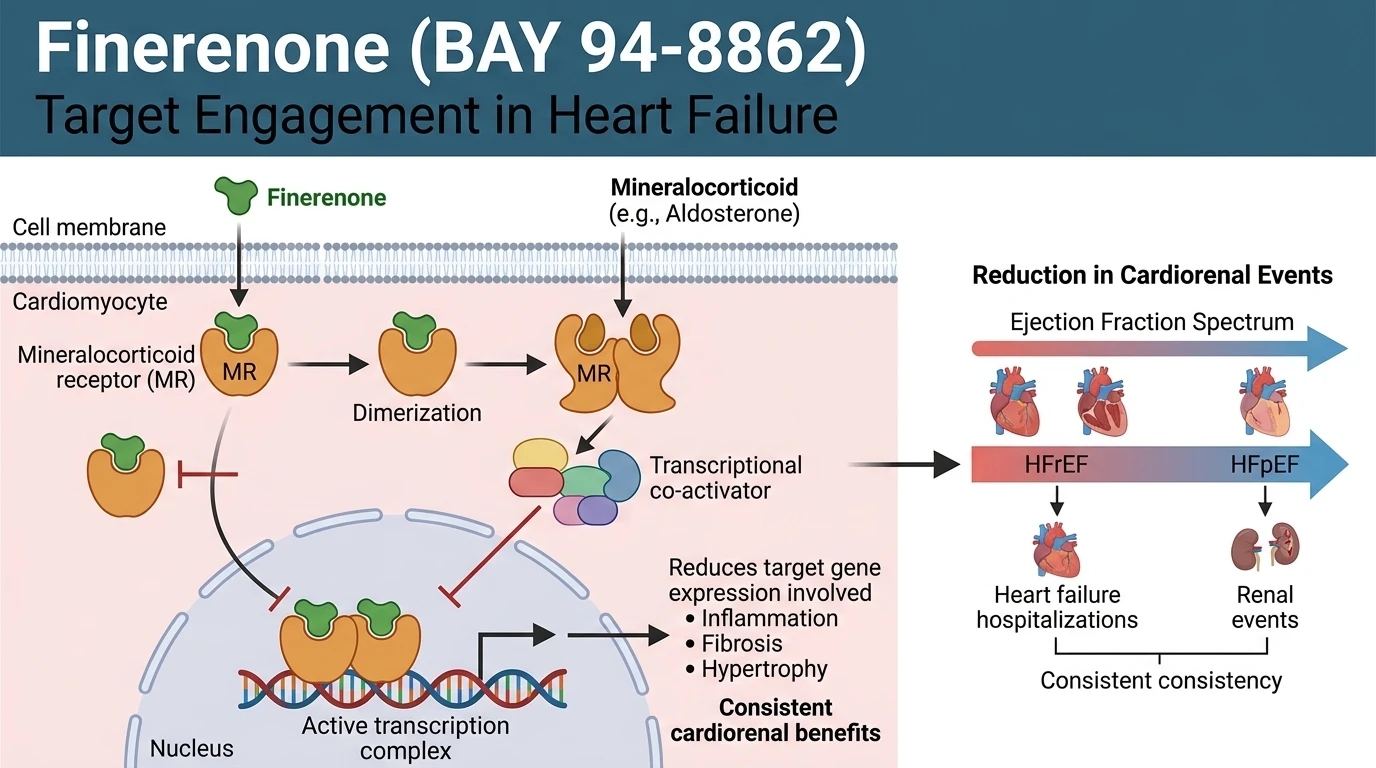
Mineralocorticoid receptor activation by excessive endogenous corticosteroids plays a central pathogenetic role in cardiovascular structural remodeling, renal fibrosis, and systemic endothelial dysfunction. In patients with heart failure with mildly reduced ejection fraction (HFmrEF) or heart failure with preserved ejection fraction (HFpEF), persistent receptor stimulation accelerates myocardial stiffening and impaired diastolic relaxation. Classical steroidal mineralocorticoid receptor antagonists bind the ligand-binding domain but retain partial agonist activity under specific cellular conditions. In contrast, translational cardiovascular pharmacology findings demonstrate that the nonsteroidal agent Finerenone (BAY 94-8862) acts as a bulky passive antagonist. By occupying a distinct hydrophobic pocket within the mineralocorticoid receptor ligand-binding domain, Finerenone (BAY 94-8862) alters the helix 12 conformation. This dynamic shift prevents co-activator protein recruitment, thereby suppressing downstream expression of connective tissue growth factor, galectin-3, and proinflammatory cytokines without triggering pro-inflammatory rebound phenomena.
Clinical evaluation in the prespecified analysis of the FINEARTS-HF trial evaluated the therapeutic impact of nonsteroidal mineralocorticoid receptor blockade across the spectrum of left ventricular ejection fraction (LVEF ≥40%). The study population encompassed individuals categorized under HFmrEF and HFpEF phenotypes. The primary composite outcome evaluated cardiovascular mortality alongside total worsening heart failure events, including both index hospitalizations and urgent outpatient clinical encounters. Administration of Finerenone (BAY 94-8862) resulted in a consistent, statistically significant reduction in primary composite event rates compared to placebo controls.
Prior therapeutic trials investigating neurohumoral pathways—such as angiotensin receptor-neprilysin inhibitors, angiotensin receptor blockers, and traditional steroidal mineralocorticoid receptor antagonists—frequently reported diminishing clinical efficacy at higher baseline LVEF levels. Specifically, historical trial datasets demonstrated an attenuation of therapeutic benefits when baseline LVEF exceeded 55% to 60%. In contrast, the prespecified analysis of the FINEARTS-HF study demonstrated no loss of therapeutic effect across upper ejection fraction categories. Patients with baseline LVEF ≥60% or even >70% experienced primary event rate reductions comparable to those observed in participants with mildly reduced ejection fraction (LVEF 40–49%). Rate ratios for recurrent worsening heart failure events remained favorable across all prespecified ejection fraction strata.
In addition to hard clinical endpoints, health-related quality of life outcomes were evaluated using the Kansas City Cardiomyopathy Questionnaire (KCCQ). Treatment with Finerenone (BAY 94-8862) produced sustained improvements in the KCCQ Total Symptom Score relative to baseline. Notably, these quality-of-life benefits were sustained across the full ejection fraction continuum, showing no attenuation in higher ejection fraction cohorts. The alignment between hard endpoint reduction and symptomatic improvement confirms that structural and biological benefits translate into patient-reported functional gains.
Safety outcomes were rigorously characterized across all LVEF subcategories. Mineralocorticoid receptor antagonism inherently modulates renal distal tubular potassium excretion, leading to expected biochemical shifts. The incidence of hyperkalemia (defined as serum potassium >5.5 mmol/L) was higher in the treatment arm compared to placebo, while hypokalemia rates were simultaneously decreased. Increases in serum creatinine were observed upon treatment initiation, reflecting hemodynamic adjustments in glomerular filtration pressure rather than structural nephrotoxicity. Importantly, the safety and tolerability profile remained consistent across lower, intermediate, and upper baseline LVEF categories. Discontinuation rates due to adverse events did not differ significantly across LVEF subgroups.
These empirical findings position nonsteroidal mineralocorticoid receptor antagonism as an effective therapeutic strategy for managing patients across the entire spectrum of HFmrEF and HFpEF. By maintaining therapeutic efficacy at higher ejection fractions without compromising safety, Finerenone (BAY 94-8862) addresses a long-standing therapeutic gap in heterogeneous heart failure populations.
Pharmacological Characterization Across Ejection Fraction Continuum
Copy code to add this image to your page
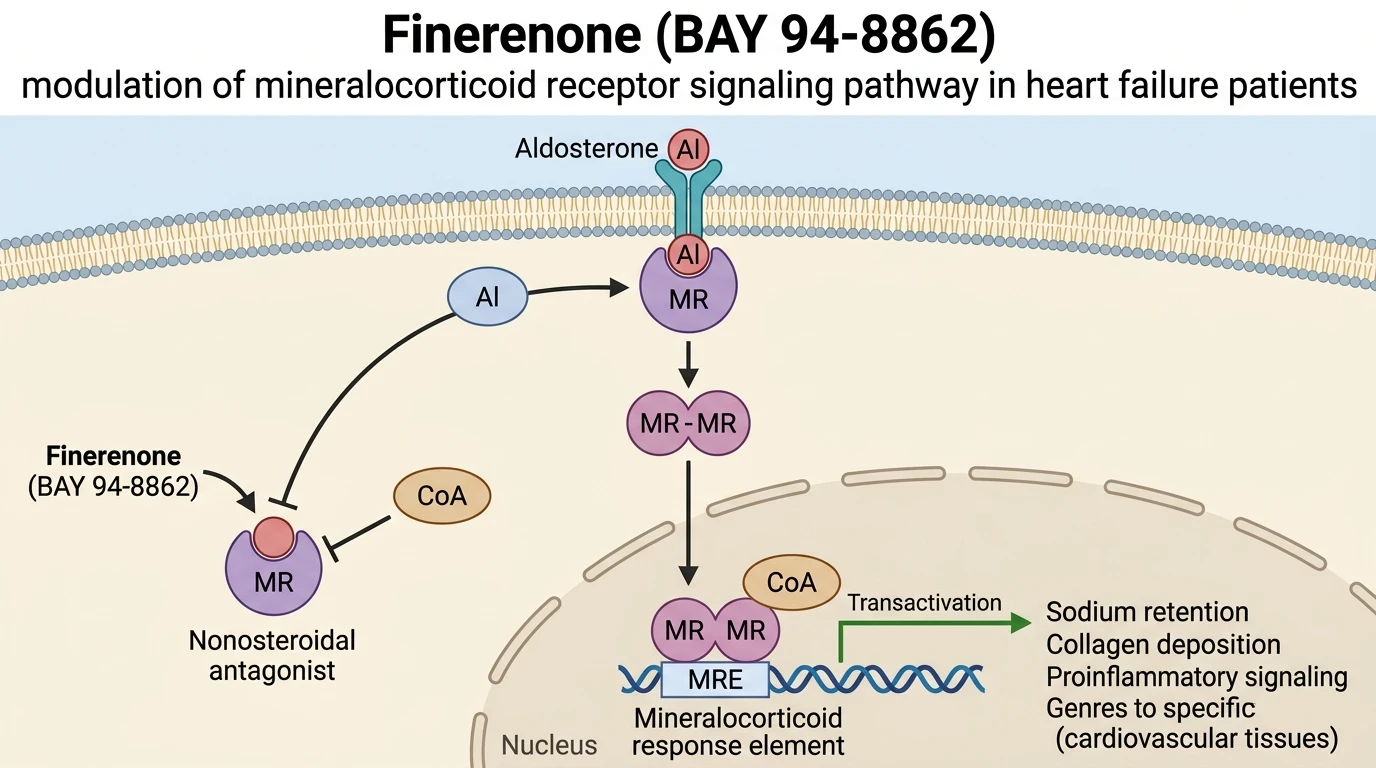
Finerenone (BAY 94-8862) acts as a high-affinity nonsteroidal mineralocorticoid receptor antagonist. By binding bulky, side-chain-specific regions within the receptor ligand-binding domain, it prevents cofactor recruitment and gene transcription tied to fibrotic tissue remodeling, sodium retention, and vascular inflammation.
Preserved Therapeutic Efficacy in Elevated Ejection Fractions
Neurohumoral modulation in HFpEF historically exhibited ceiling effects. Clinical benefits frequently diminished when baseline left ventricular ejection fraction exceeded 60%. In contrast, trial analysis confirms persistent primary endpoint reduction at LVEF thresholds above 70%. The drug binding kinetics prevent classic receptor-mediated transcriptional activation. Downstream tissue remodeling markers declined steadily. Finerenone (BAY 94-8862) sustained event rate reductions regardless of baseline contractility parameters. Rates of recurrent heart failure hospitalizations decreased consistently across all pre-specified subgroups. Symptom scores matched hard clinical outcome trajectories; patient-reported quality of life metrics improved predictably.
Renal Function Marker Kinetics and Serum Potassium Dynamics
Target engagement in renal tubular cells alters electrolyte excretion patterns. Serum potassium levels rose modestly following treatment initiation. Mild hyperkalemia occurred at expected therapeutic rates; clinical management required simple dosage titration or dietary monitoring. Serum creatinine showed initial transient rises. Glomerular filtration adjustments stabilized over extended study durations. The safety profile remained uniform across all ejection fraction bands. Discontinuation rates remained low throughout the evaluation period; adverse event frequencies aligned with mechanism-based expectations. Finerenone (BAY 94-8862) demonstrated favorable tolerability across diverse clinical cohorts.