NMDA (N-Methyl-D-aspartic acid) NMDAR agonist signaling and autoantibody-mediated receptor hypofunction in neuropsychiatric illness
Copy code to add this image to your page
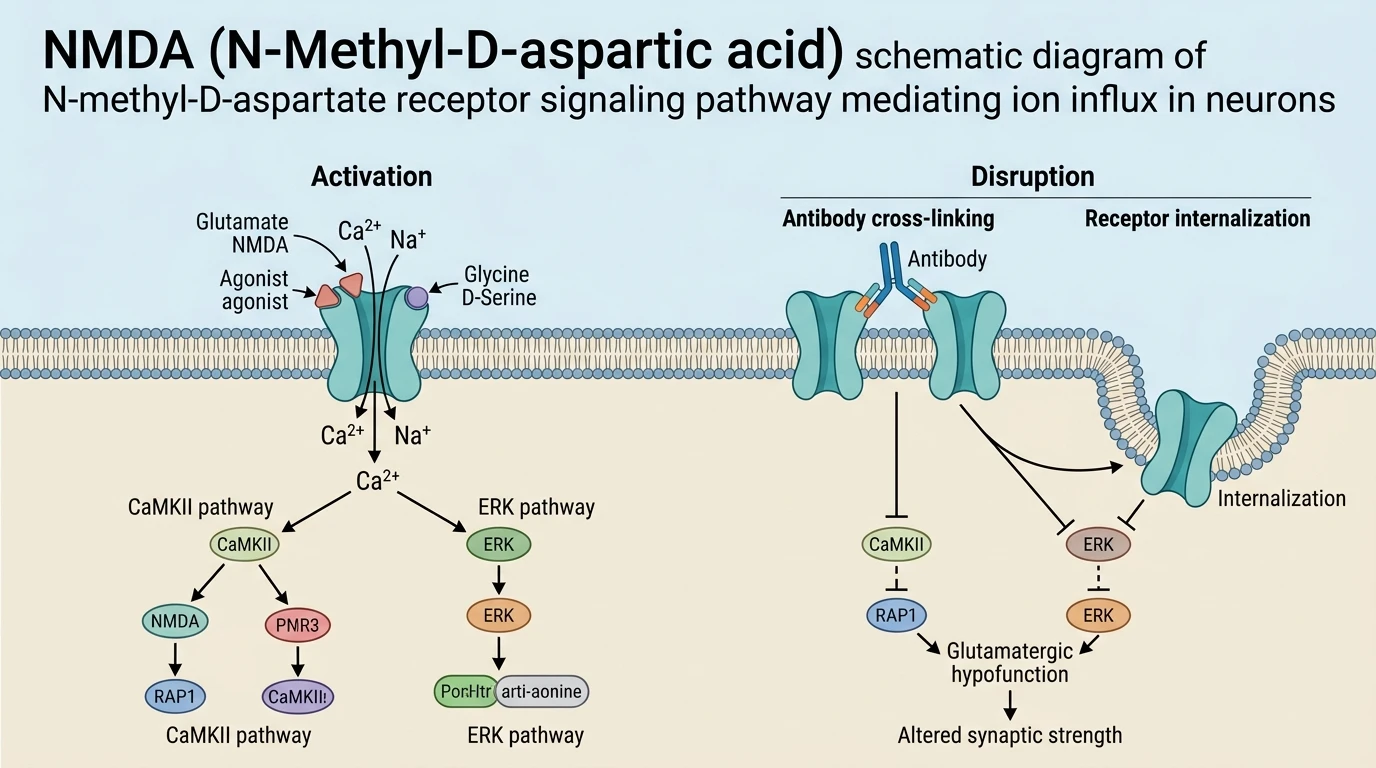
Glutamate-mediated neurotransmission relies heavily on the ionotropic N-methyl-D-aspartate receptor (NMDAR), a heterotetrameric complex comprising GluN1, GluN2, and GluN3 subunits. Under physiological resting conditions, extracellular magnesium ions (Mg2+) block the central pore of the receptor in a voltage-dependent manner. Postsynaptic depolarization relieves this Mg2+ block, allowing the channel to conduct calcium (Ca2+) and sodium (Na+) ions upon concurrent agonist binding. The selective synthetic agent NMDA (N-Methyl-D-aspartic acid) serves as a key tool to isolate and characterize NMDAR-specific activation, distinguishing it from AMPA and kainate ionotropic receptors. Ligand engagement by an NMDA (N-Methyl-D-aspartic acid) NMDAR agonist initiates channel opening, driving intracellular calcium influx that activates calmodulin-dependent protein kinase II (CaMKII), calcineurin, and downstream extracellular signal-regulated kinase (ERK) pathways essential for long-term potentiation (LTP) and long-term depression (LTD).
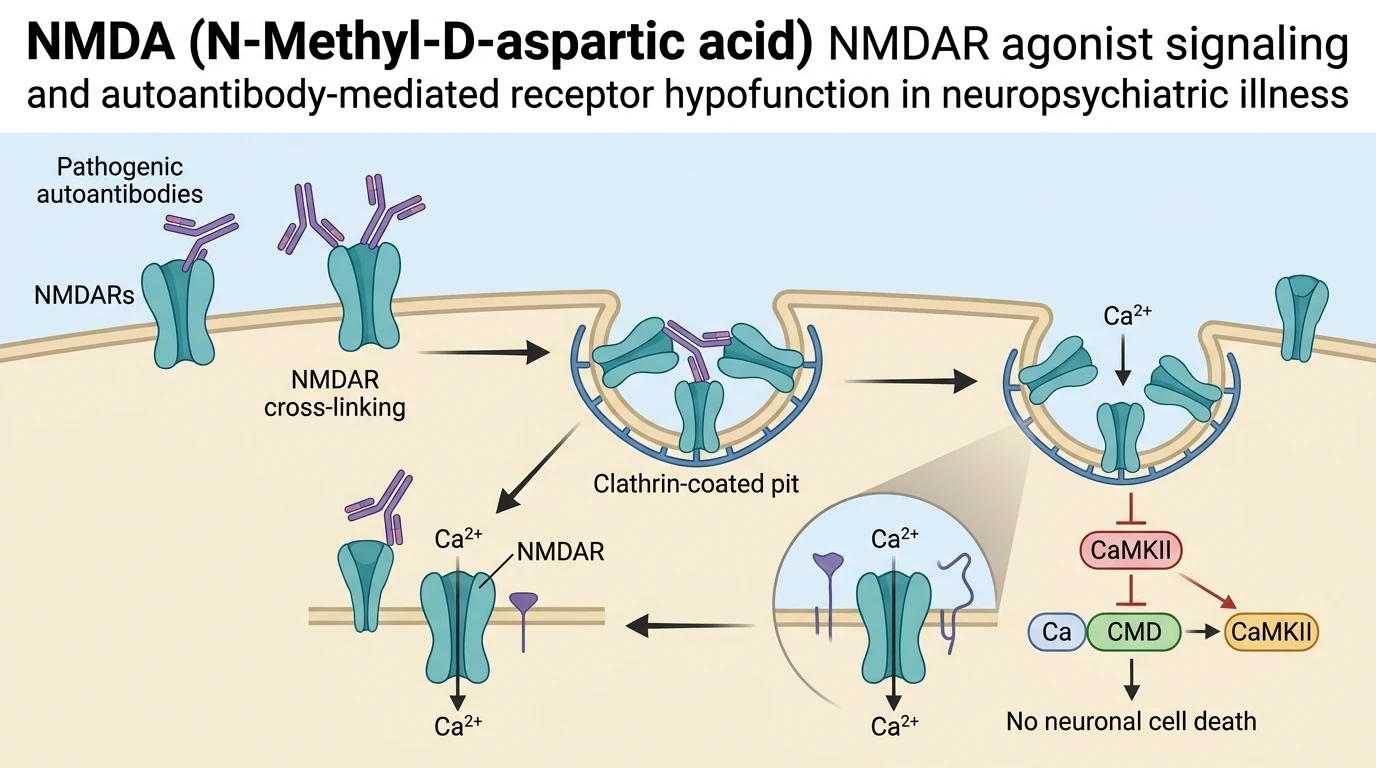
In recent clinical observations, autoimmune targeted disruption of the N-methyl-D-aspartate receptor (NMDAR) has emerged as a driver of severe neuropsychiatric syndromes. Pathogenic autoantibodies targeting the extracellular GluN1 subunit induce cross-linking and selective endocytosis of surface NMDARs. This mechanism decreases functional postsynaptic NMDAR density without causing irreversible structural neurodegeneration or complement-mediated cell lysis. The resulting loss of cell-surface channels impairs NMDAR-mediated currents, generating localized glutamatergic hypofunction across cortical and subcortical networks. This autoantibody-mediated receptor hypofunction leads to neuro-psychiatric manifestations including atypical psychosis, schizophrenia, and severe sleep disorders.
To map the spectrum of anti-NMDAR autoantibody seropositivity, a clinical study evaluated 61 patients stratified into three discrete diagnostic categories: Group A (typical anti-NMDAR encephalitis, n=5), Group B (narcolepsy accompanied by severe psychosis, n=5), and Group C (schizophrenia or schizoaffective disorders, n=51). Laboratory assaying confirmed anti-NMDAR autoantibodies in ten total patients across the cohorts. In Group A, three of five patients (60%) exhibited seropositivity. Within Group B, three of five patients (60%) similarly tested positive for anti-NMDAR antibodies. In Group C, four of fifty-one patients (7.8%) harbored detectable autoantibodies against the receptor.
Crucially, seven of the ten antibody-positive cases across these groups presented with predominant psychotic or sleep disturbances in the complete absence of classical encephalitic manifestations—such as autonomic instability, central hypoventilation, hyperkinesia, or intractable seizures—throughout their documented disease course. This clinical presentation demonstrates that anti-NMDAR autoantibody seropositivity is not restricted to classic, life-threatening anti-NMDAR encephalitis. Instead, autoantibody-induced glutamatergic hypofunction can manifest as isolated psychiatric phenotypes or narcoleptic syndromes.
Therapeutic management in this patient cohort provided further mechanistic insights. Modified electroconvulsive therapy (mECT) was administered to several antibody-positive patients presenting with severe, treatment-resistant psychotic symptoms. Following mECT intervention, these individuals showed marked clinical improvements in psychotic subscores and overall behavioral stability. Electroconvulsive stimulation is postulated to alter synaptic receptor turnover or enhance network-level synchronization, transiently counteracting autoantibody-mediated NMDAR internalization. Taken together within the constraints of these clinical observations, anti-NMDAR autoantibodies appear to execute a functional role across a broader spectrum of atypical psychosis, schizophrenia spectrum disorders, and sleep pathologies than previously recognized.
Autoantibody Prevalence and Clinical Response Profiles
Copy code to add this image to your page
Autoimmune anti-NMDAR autoantibodies bind extracellular epitopes of the N-methyl-D-aspartate receptor, cross-linking subunit complexes and inducing receptor endocytosis. This internalization leads to postsynaptic glutamatergic hypofunction without triggering overt autonomic failure or seizures. Downstream signaling cascades—including CaMKII phosphorylation and long-term potentiation—are disrupted, producing isolated neuropsychiatric phenotypes such as atypical psychosis, schizophrenia-like symptoms, and severe sleep dysregulation.
Anti-NMDAR Autoantibodies Occur in Non-Encephalitic Psychotic Disorders
Serum and cerebrospinal fluid screening revealed anti-NMDAR autoantibodies across distinct clinical cohorts. Seropositivity occurred in three of five patients with classic anti-NMDAR encephalitis. Surprisingly, three of five patients diagnosed with narcolepsy accompanied by severe psychosis also tested positive. Among fifty-one patients with schizophrenia or schizoaffective disorder, four individuals harbored anti-NMDAR autoantibodies. Seven antibody-positive patients presented with isolated psychiatric or sleep disturbances without classic neurological signs. These individuals exhibited no autonomic instability or seizure activity throughout observation. Glutamatergic hypofunction was induced without overt neuroinflammation. Utilizing NMDA (N-Methyl-D-aspartic acid) NMDAR agonist paradigms helped elucidate how antibody binding disrupts normal receptor trafficking. These data demonstrate that autoantibody-mediated NMDAR internalization extends beyond classic encephalitis.
Therapeutic Efficacy of Electroconvulsive Therapy in Seropositive Psychosis
Modified electroconvulsive therapy (mECT) achieved clinical stabilization in several antibody-positive patients presenting with severe psychiatric symptoms. Patient responses varied depending on baseline illness duration and symptom profile. Psychotic manifestations attenuated following serial mECT sessions in seropositive subjects lacking traditional encephalitic markers. Remission occurred rapidly. Pharmacological challenge with an NMDA (N-Methyl-D-aspartic acid) NMDAR agonist model highlights how modulating glutamatergic signaling might lower seizure thresholds during mECT intervention. Mechanistically, electrical stimulation may restore synaptic plasticity by promoting NMDAR cell-surface expression or recalibrating downstream signaling cascades. Post-treatment clinical scores improved significantly in these patients. Systematic evaluation in randomized clinical cohorts remains necessary to validate mECT efficacy in antibody-positive schizophrenia spectrum phenotypes.