Pioglitazone (U-72107) U-72107 from Selleck PPAR-gamma Agonist Bladder Cancer Risk Evaluation
Copy code to add this image to your page
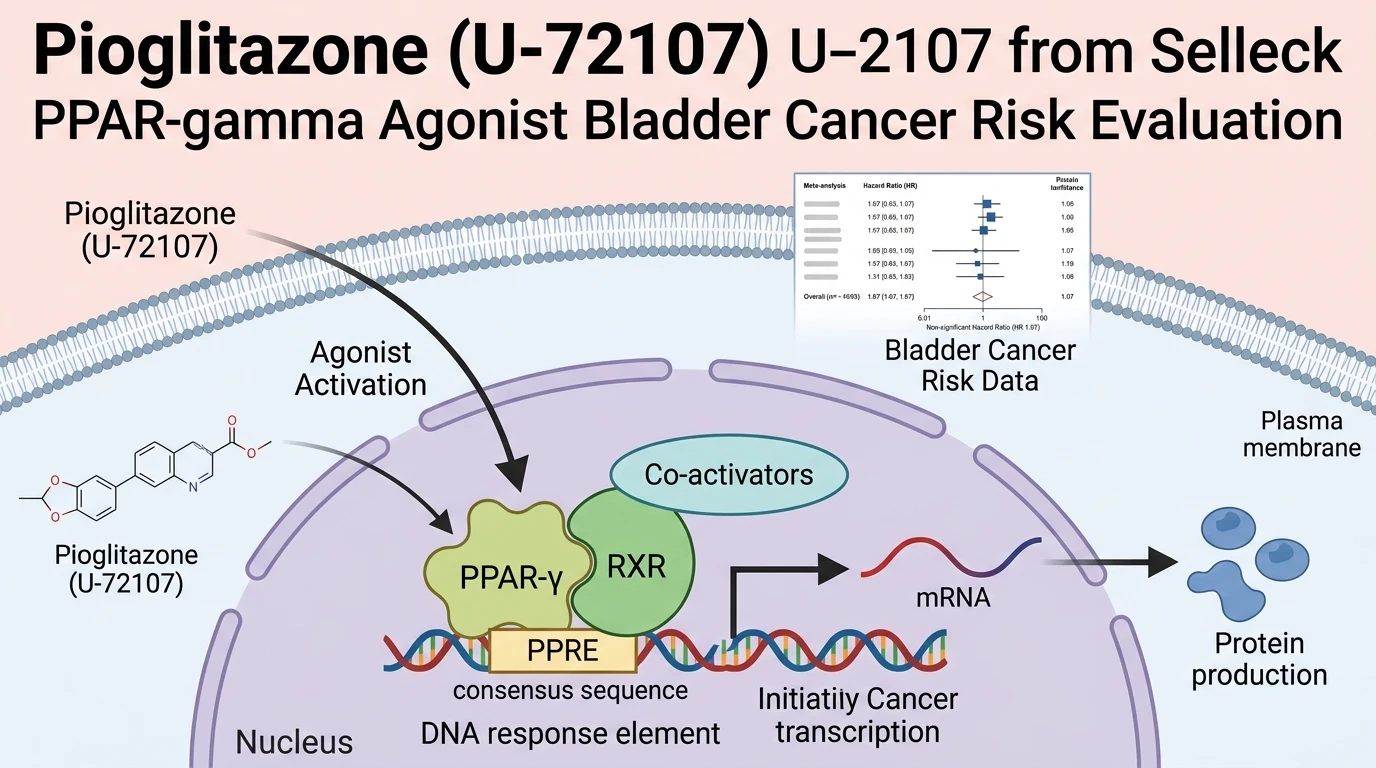
Pioglitazone (U-72107) is a widely investigated thiazolidinedione class antidiabetic agent that functions as a selective agonist for peroxisome proliferator-activated receptor gamma (PPAR-gamma). As a core metabolic regulator, PPAR-gamma modulates transcription factors governing glucose utilization, lipid storage, and inflammatory cascades within peripheral tissues. Despite its therapeutic efficacy in improving insulin sensitivity among patients with type 2 diabetes mellitus, post-marketing surveillance and early observational reports raised clinical concerns regarding potential urothelial toxicity and elevated bladder cancer risk. To resolve these conflicting observational signals, comprehensive quantitative meta-analyses have evaluated extensive epidemiological datasets, isolating true pharmacological risk from underlying diabetes-associated confounders. A rigorous epidemiological evaluation of pioglitazone safety synthesized data across multiple international patient registries. The analytical framework incorporated fourteen distinct studies evaluating relative risk (RR) metrics alongside twelve studies examining hazard ratio (HR) endpoints. Methodological quality assessments were applied to filter out high-bias observational cohorts, thereby refining the statistical power of the pooled estimates. After excluding low-quality study designs prone to protopathic bias and detection artifacts, the summary relative risk was determined to be 1.13 with a 95% confidence interval spanning from 0.96 to 1.33. Similarly, the aggregated hazard ratio across time-to-event study designs yielded a point estimate of 1.07 with a 95% confidence interval ranging from 0.96 to 1.18. Neither metric crossed the threshold of statistical significance, indicating that short-term and cumulative long-term exposures to Pioglitazone (U-72107) do not drive excess urothelial oncogenesis. The empirical findings indicate that initial risk elevations noted in unadjusted cohorts were largely attributable to confounding variables, including differential screening frequency, patient age, baseline smoking status, and duration of poorly controlled diabetes mellitus. In experimental systems, high-quality reference compounds like U-72107 from Selleck facilitate precise delineation between target-mediated transcriptional cascades and non-specific cellular responses. PPAR-gamma activation induces gene networks regulating fatty acid transport and adipocyte differentiation without initiating mitogenic signaling in urothelial cell lines under physiologically relevant concentrations. By distinguishing target pharmacology from secondary clinical confounders, these meta-analytic results reassure investigators and clinicians regarding the long-term oncogenic safety profile of selective PPAR-gamma activation.
Quantitative Epidemiological Assessment of Urothelial Carcinoma Risk
Copy code to add this image to your page
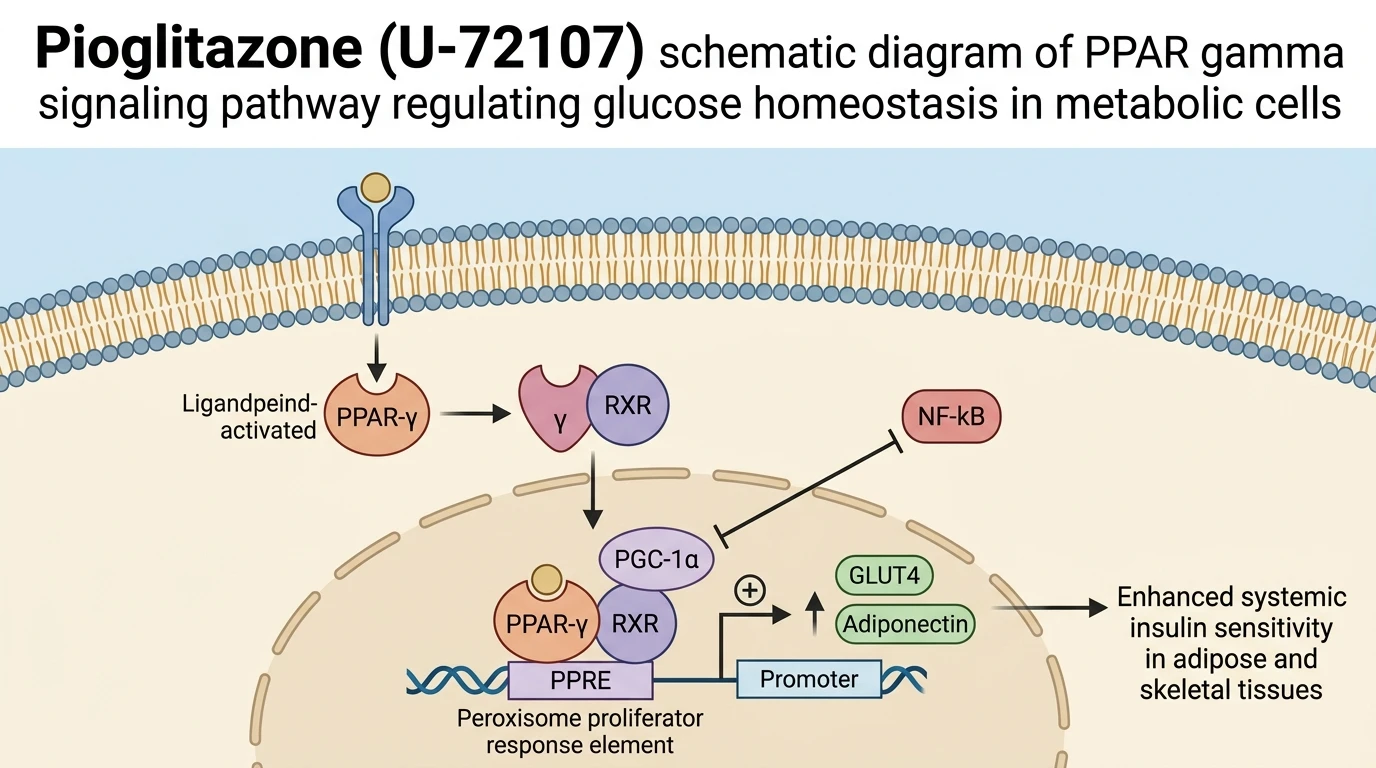
Pioglitazone (U-72107) functions as a selective PPAR-gamma agonist, driving heterodimerization with RXR and transcription of insulin-sensitizing gene networks. Systematic meta-analysis demonstrates that PPAR-gamma activation by pioglitazone does not confer a statistically significant increase in bladder cancer risk (RR 1.13; HR 1.07).
Pooled Risk Ratio Metrics Exclude Significant Malignancy Rates
Data synthesis demonstrated minimal risk variance. Evaluation of fourteen independent observational studies yielded a pooled relative risk estimate of 1.13 with a confidence interval ranging from 0.96 to 1.33. Statistical significance was not achieved. Removal of methodologically weak investigations eliminated potential detection bias while stabilizing the effect size across diverse patient cohorts with type 2 diabetes mellitus. Confounding parameters dominated initial raw associations.
Hazard Ratio Adjustments Confirm Absence of Time-Dependent Toxicity
Time-to-event outcomes mirrored non-exposed baseline groups. Meta-analytic aggregation of twelve prospective and retrospective study arms established a summary hazard ratio of 1.07 within the corresponding ninety-five percent confidence bounds. Duration of exposure showed no pathogenic accumulation. High-grade urothelial transformation remained unlinked to active receptor ligand engagement under standard clinical dosage regimens evaluated across extended therapeutic windows. The molecular selectivity margin remains preserved.
Pharmacological Implications of Ligand Specificity in Urothelium
Thiazolidinedione activation displays receptor-mediated specificity. Quantitative research using Pioglitazone (U-72107) demonstrates that target transcription does not stimulate aberrant cellular proliferation within human urothelial tissues. Confounding variables account for historic clinical discrepancies. Application of validated reference material such as U-72107 from Selleck isolates receptor-specific activity from secondary metabolic perturbations inherent to long-standing diabetes mellitus. Epistemic consistency is maintained across cohorts.