ATGL Inhibitors
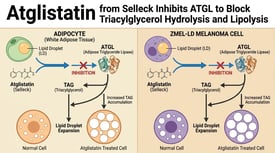
Adipose Triglyceride Lipase (ATGL), also known as PNPLA2, is the rate-limiting enzyme in the mobilization of fatty acids from stored triacylglycerols (TAGs) in lipid droplets. It specifically catalyzes the initial step of lipolysis, converting TAGs into diacylglycerols (DAGs) and releasing one free fatty acid. ATGL activity is tightly regulated by its co-activator, CGI-58 (ABHD5), and its inhibitor, G0S2. The fatty acids released by ATGL serve as essential energy substrates for mitochondrial beta-oxidation and act as signaling molecules that activate nuclear receptors like PPAR-alpha. While lipolysis is a fundamental physiological process, its dysregulation is a hallmark of several metabolic and systemic diseases. ATGL inhibitors are primarily being developed to treat conditions characterized by excessive lipolysis or "lipotoxicity." One major application is in the treatment of cancer cachexia, a wasting syndrome where systemic hyperlipolysis leads to the depletion of adipose tissue and muscle mass. By inhibiting ATGL, researchers aim to preserve energy stores and improve the quality of life in cancer patients.
Furthermore, ATGL inhibition is being explored for non-alcoholic fatty liver disease (NAFLD) and non-alcoholic steatohepatitis (NASH). Although it may seem counterintuitive to inhibit a lipase in fatty liver disease, reducing the flux of fatty acids from adipose tissue to the liver can actually decrease hepatic lipotoxicity and inflammation. Other potential indications include heart failure, where excessive fatty acid uptake can impair cardiac function. The most prominent research tool in this field is Atglistatin, a highly selective small-molecule inhibitor of ATGL. Atglistatin works by binding to the patatin-like domain of the enzyme, preventing its interaction with the lipid droplet. In preclinical studies, Atglistatin has demonstrated the ability to reduce plasma fatty acid levels, improve insulin sensitivity, and prevent the development of fatty liver in high-fat diet models. Despite these promising results, the development of ATGL inhibitors for human use is still in the preclinical or early discovery stages.
Inhibitors of ATGL are generally classified as small-molecule competitive inhibitors or allosteric modulators. Most current efforts focus on compounds that mimic the structure of Atglistatin or target the CGI-58 binding interface. A significant challenge in targeting ATGL is the risk of "neutral lipid storage disease" (NLSD), a rare genetic condition caused by ATGL deficiency, which leads to systemic TAG accumulation in various tissues, including the heart and skeletal muscle. Therefore, any therapeutic inhibitor must be carefully dosed to reduce excessive lipolysis without completely blocking the enzyme's essential functions. Future research is directed toward developing tissue-specific ATGL inhibitors or transiently acting agents to avoid the side effects of chronic, systemic inhibition. There is also interest in the role of ATGL in "lipophagy" and its crosstalk with other metabolic pathways. As the link between lipid metabolism and chronic inflammation becomes clearer, ATGL inhibitors may find broader applications in treating metabolic syndrome and cardiovascular diseases.