Atglistatin from Selleck Inhibits ATGL to Block Triacylglycerol Hydrolysis and Lipolysis
Copy code to add this image to your page
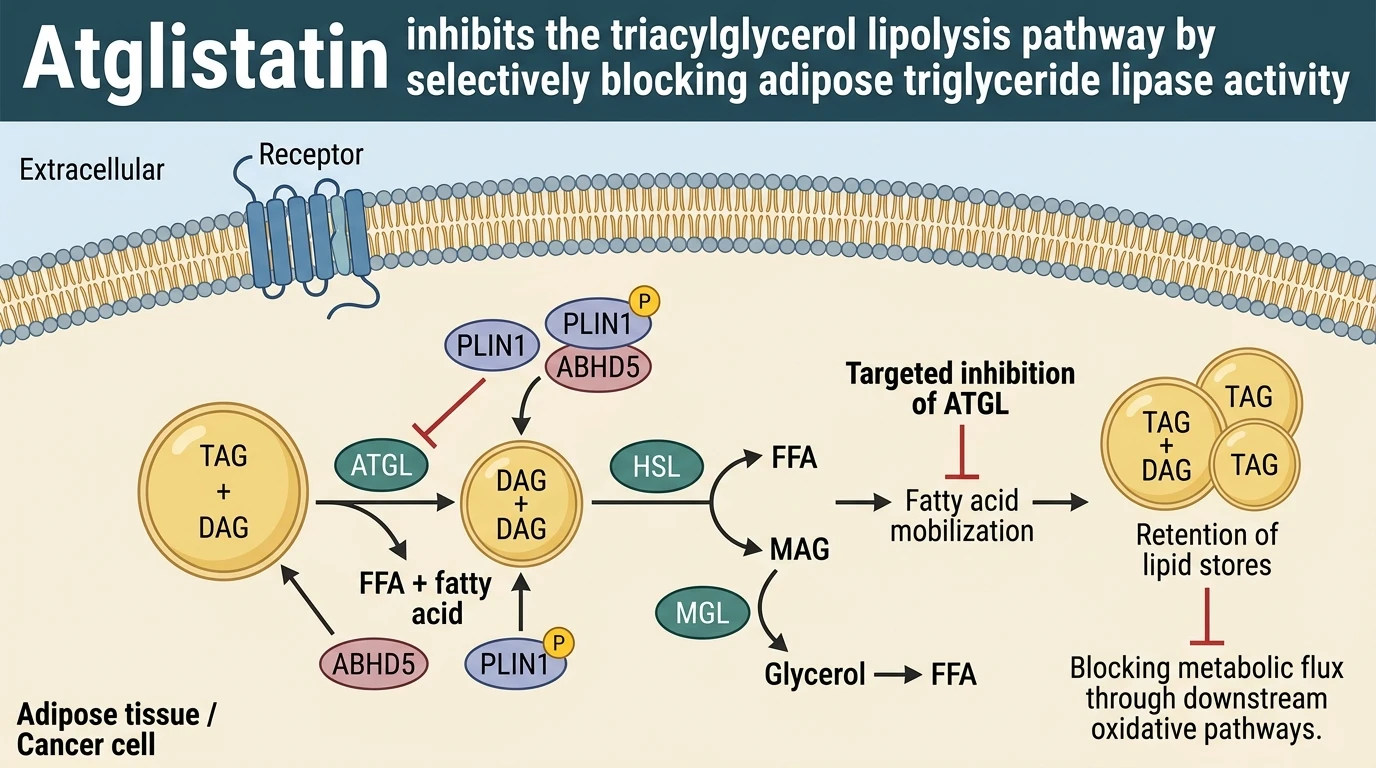
Selective inhibition of adipose triglyceride lipase (ATGL) represents a validated pharmacological strategy to interrogate intracellular lipid catabolism and cellular energy homeostasis. ATGL executes the initial rate-limiting step of lipolysis by catalyzing the cleavage of the ester bond in triacylglycerol molecules stored within intracellular lipid droplets, yielding diacylglycerol and a free fatty acid. In mammalian adipocytes, this hydrolytic cascade requires functional interaction with its co-activator protein, ABHD5 (CGI-58), and is regulated by perilipin family members that coat the phospholipid monolayer of the lipid droplet structure. Small-molecule blockade of ATGL activity provides a direct mechanism to attenuate fatty acid release, shift lipid accumulation dynamics, and alter cellular metabolic reliance on fatty acid oxidation.
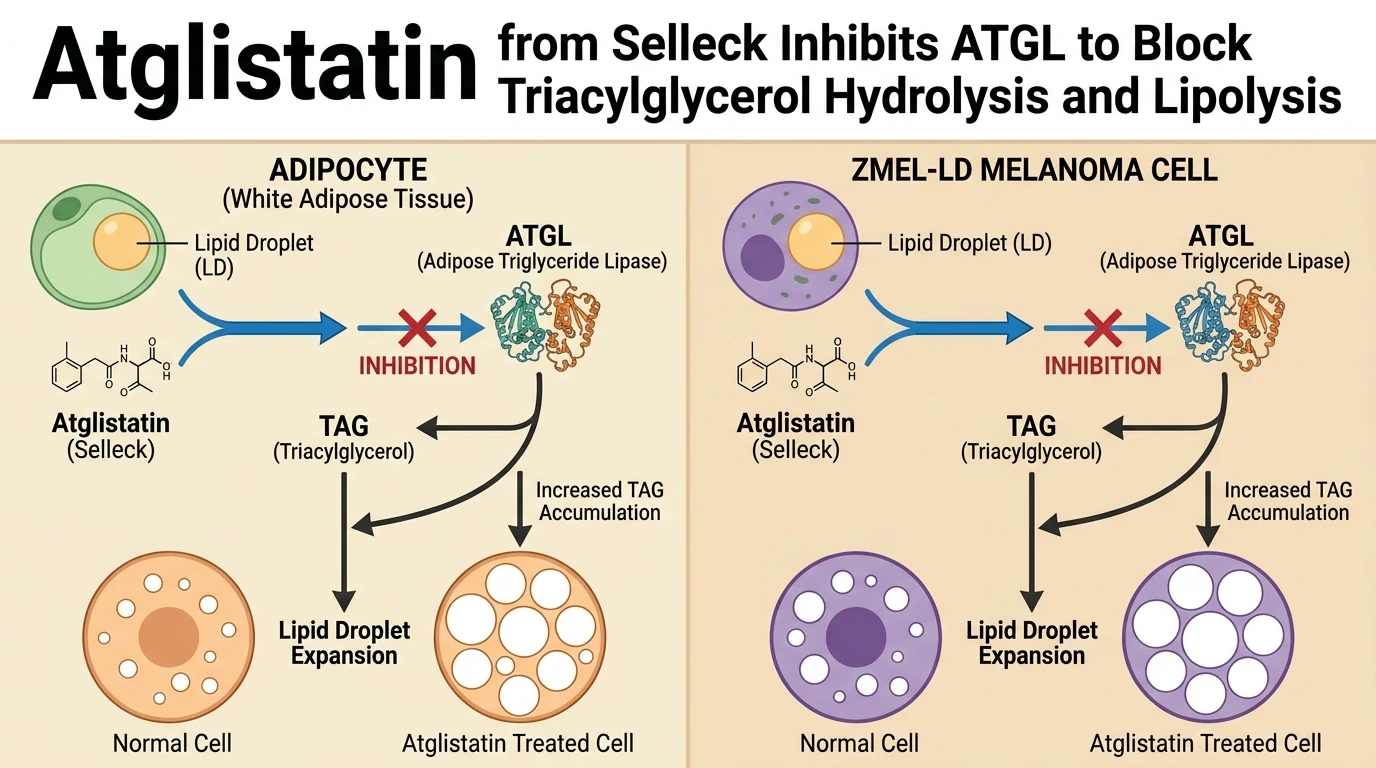
To systematically identify regulators of lipolytic flux, phenotypic chemical screens rely on quantitative biochemical readouts paired with specialized cellular models. In a high-throughput assay utilizing differentiated 3T3-L1 adipocytes, a library of 1,280 bioactive compounds was evaluated to map pathways governing lipid retention and breakdown. Within this screening platform, Atglistatin served as the benchmark positive control for direct lipolysis inhibition. Atglistatin from Selleck demonstrated robust, concentration-dependent suppression of basal and stimulated lipolytic activity in vitro. Biochemical quantification confirmed that direct ATGL target engagement by Atglistatin produced a pronounced reduction in the accumulation of glycerol in culture media supernatants. Because glycerol release serves as an obligatory stoichiometric marker of complete triacylglycerol hydrolysis, this quantitative metric established effective catalytic blockade of the initial enzymatic cascade without disrupting baseline cell survival parameters.
Transitioning from in vitro cellular assays to intact vertebrate models requires real-time reporting of lipid droplet dynamics. The development of the Tg(-3.5ubb:plin2-tdTomato) transgenic zebrafish model established a robust in vivo platform for tracking neutral lipid storage in fluorescently labeled lipid droplets. Utilizing perilipin-2 (plin2) fusion reporters allowed high-resolution fluorescent imaging of visceral and subcutaneous adipose tissue depots in living larvae and adult fish. Pharmacological evaluation of Atglistatin within this transgenic system recapitulated the lipolytic suppression observed in cultured adipocytes. Systematic exposure to Atglistatin produced a significant expansion of visceral adipose tissue area over defined temporal windows. Crucially, this alteration in lipid storage occurred without causing systemic toxicity; treated fish exhibited no significant deviations in standard length or overall organismal viability relative to vehicle controls. These empirical findings demonstrate that pharmacological ATGL inhibition selectively alters lipid deposition parameters without compromising broader developmental or physiological viability under tested conditions.
Beyond classic adipocytes, lipolytic reprograming plays a functionally significant role in malignant cell populations that rely on lipid droplet turnover to sustain membrane biogenesis and energy production under metabolic stress. Evaluation of Atglistatin in the zebrafish melanoma cell line ZMEL-LD yielded critical insights into cancer cell lipid dynamics. Under nutrient-restricted or metabolic stress conditions, ZMEL-LD cells rapidly hydrolyze stored lipid droplets to mobilize fatty acids for beta-oxidation. Continuous treatment with Atglistatin effectively prevented lipid droplet degradation in ZMEL-LD cells. The persistence of perilipin-coated lipid droplets in treated melanoma cells confirms that ATGL-driven lipolysis is an active, conserved mechanism underlying neutral lipid turnover in transformed cells.
Collectively, these empirical observations validate ATGL as an essential molecular node across diverse physiological and pathological states. Using Atglistatin as a tool compound enabled precise differentiation between ATGL-dependent hydrolytic flux and alternative lipid catabolic pathways. Furthermore, the concordant results obtained across 3T3-L1 adipocytes, ZMEL-LD cancer cells, and Tg(-3.5ubb:plin2-tdTomato) transgenic zebrafish confirm the utility of this multi-tiered experimental pipeline for identifying novel metabolic modulators in cellular and organismal contexts.
Pharmacological Evaluation and In Vivo Target Validation
Copy code to add this image to your page
Atglistatin selectively inhibits adipose triglyceride lipase (ATGL), the rate-limiting enzyme in triacylglycerol breakdown. By blocking ATGL catalytic activity, Atglistatin prevents the hydrolysis of stored triacylglycerols into diacylglycerols and free fatty acids. This enzymatic inhibition reduces glycerol release in adipocytes, increases visceral adipose tissue expansion in vivo, and prevents lipid droplet degradation in melanoma cells.
Atglistatin Attenuates Adipocyte Glycerol Release in Vitro
Direct enzymatic inhibition of ATGL interrupts the primary committed step of triacylglycerol breakdown. In primary screening assays using differentiated 3T3-L1 adipocytes, 1,280 small molecules were screened for lipolysis suppression. Glycerol accumulation dropped sharply. Atglistatin established the positive control baseline for competitive ATGL inhibition; glycerol output into culture media decreased markedly upon treatment. This reduction in supernatant glycerol directly correlated with suppressed enzymatic cleavage of triacylglycerol substrates—a prerequisite for downstream monoacylglycerol degradation. Cell viability assays confirmed that catalytic inhibition occurred without non-specific cytotoxicity across tested dose ranges. Consequently, these in vitro measurements isolate ATGL as the primary target mediating the anti-lipolytic phenotype.
Visceral Adipose Expansion in Transgenic Zebrafish Reporters
Translational modeling requires robust phenotypic readouts within intact organismal systems. The transgenic Tg(-3.5ubb:plin2-tdTomato) zebrafish strain allows live visual tracking of perilipin-2-coated lipid droplets across anatomical compartments. Administration of Atglistatin from Selleck significantly increased visceral adipose tissue area relative to vehicle-treated controls. Tissue area expanded. Notably, body axis metrics remained unaffected; standard length and overall larva survival were unchanged across treatment cohorts. Pharmacological ATGL inhibition thus drives localized lipid retention without causing systemic growth impairment or developmental toxicity in vivo.
Retention of Lipid Droplet Storage in Melanoma Models
Lipid storage dynamics also dictate metabolic adaptability in neoplastic tissues. In the zebrafish melanoma line ZMEL-LD, rapid turnover of neutral lipid stores supports membrane synthesis and cellular survival during metabolic stress. Treatment with Atglistatin from Selleck suppressed lipid droplet clearance in ZMEL-LD cells under serum-restricted conditions. Lipid droplets persisted. Fluorescent signal quantification confirmed sustained plin2-associated droplet intensity over extended culture durations. Inhibiting ATGL interrupts essential fatty acid mobilization pathways in cancer cells, highlighting potential vulnerabilities in tumor lipid reliance.