Auranofin (SKF-39162) and Auranofin Derivatives Target Bacterial Thioredoxin Reductase Redox Homeostasis
Copy code to add this image to your page
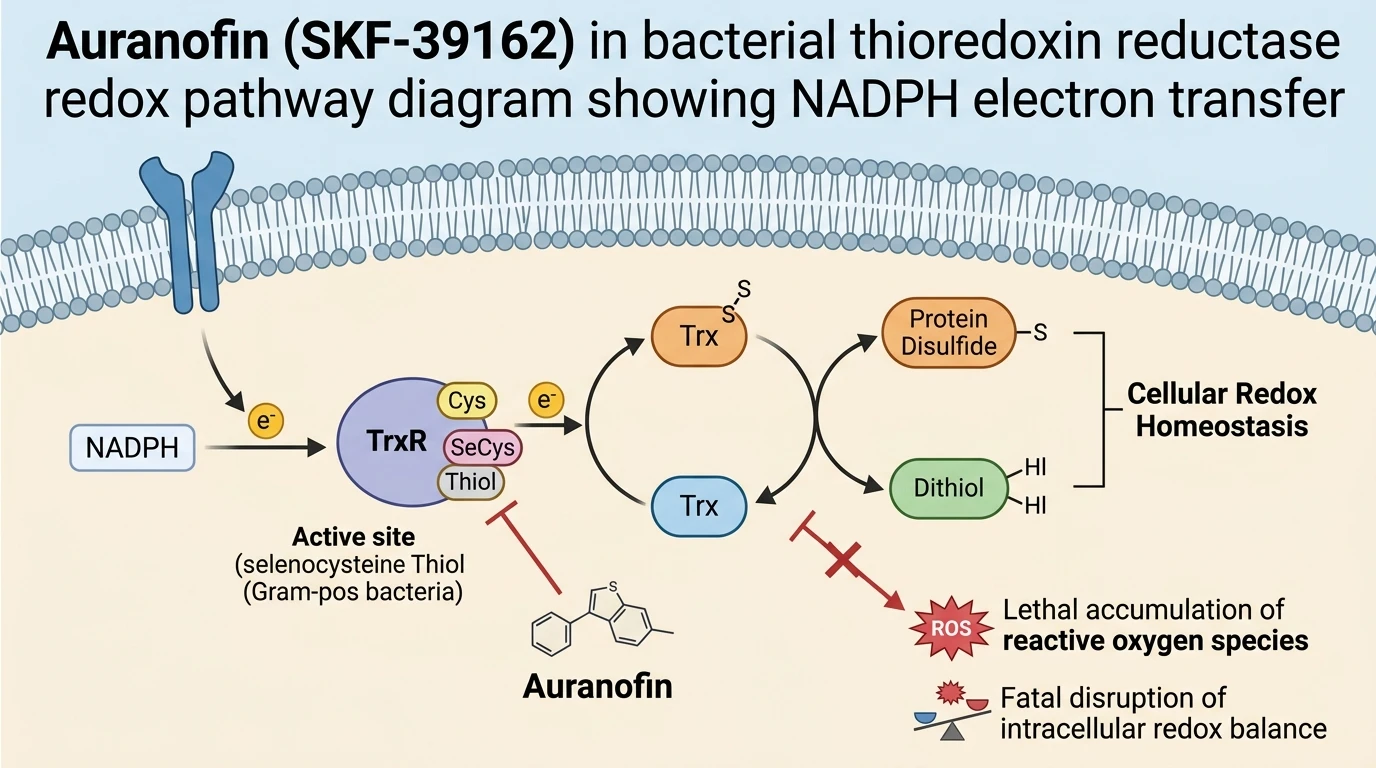
The emergence of multidrug-resistant Gram-positive pathogens requires novel therapeutic strategies targeting essential bacterial pathways distinct from conventional ribosome, cell wall, or DNA replication targets. Bacterial thioredoxin reductase (TrxR) represents a key vulnerability in microbial antioxidant defenses. TrxR relies on NADPH-dependent reduction to transfer electrons to thioredoxin (Trx), maintaining protein thiols in their active reduced state and detoxifying hydroperoxides. Unlike mammalian systems that feature distinct structural architectures, bacterial TrxR enzymes feature specific active-site thiol motifs—frequently containing active-site cysteine and selenocysteine residues—that are highly susceptible to targeted covalent inactivation by thiophilic heavy metal complexes.
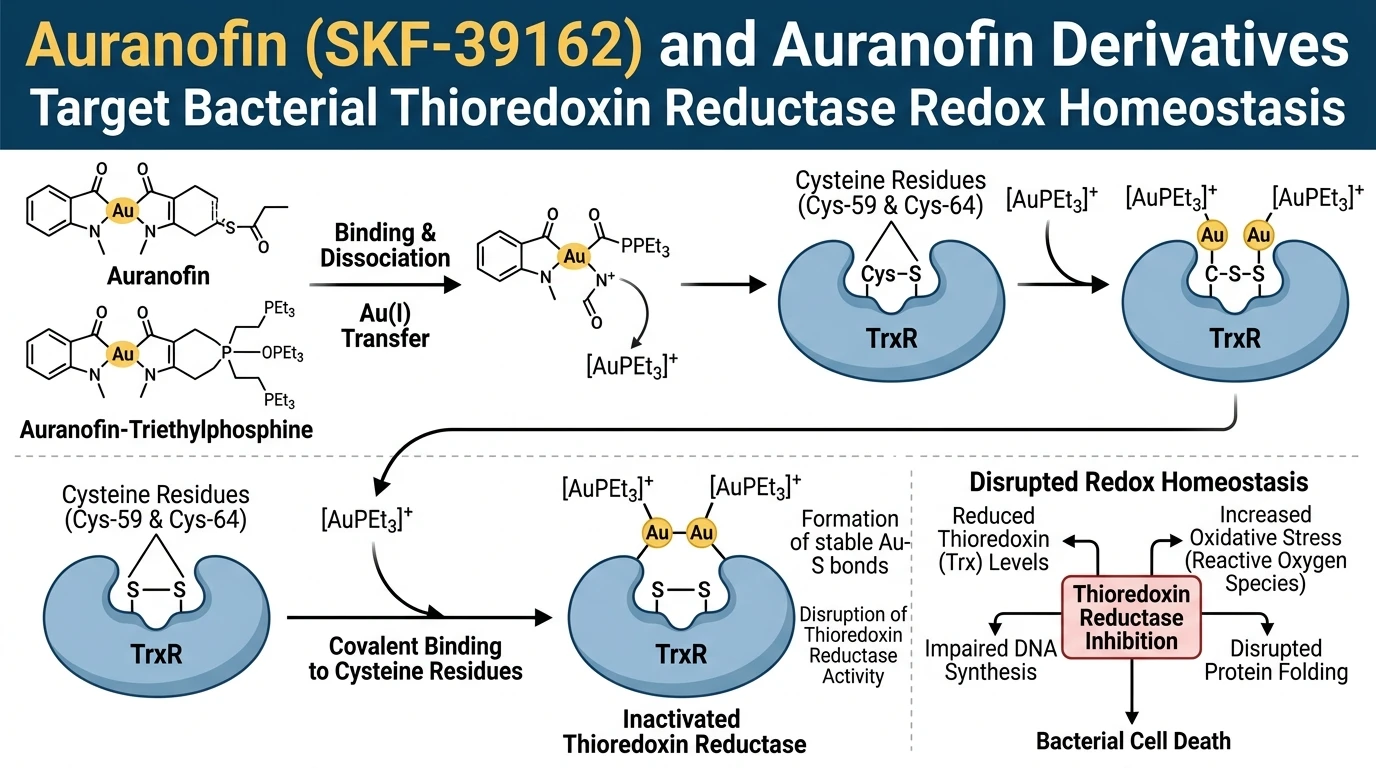
Gold(I) phosphine compounds operate through a mechanistically unique target engagement paradigm. Auranofin (SKF-39162), originally developed for inflammatory conditions, functions as a prodrug that delivers the pharmacophoric [AuPEt3]+ cation directly to cellular nucleophiles. Upon entering the biological environment, the labile thiosugar ligand dissociates, freeing the gold(I) coordination complex to bind soft sulfur and selenium nucleophiles within the TrxR catalytic pocket. Covalent adduction to these active-site residues irreversibly halts electron transfer from NADPH to thioredoxin. Consequently, cells experience overwhelming oxidative distress, collapse of reduced thiol pools, and rapid cell death.
To optimize the pharmacological properties of this compound class, structural modification of the leaving group has emerged as a promising medicinal chemistry approach. A key derivative, designated AF-AcCys, substitutes the native thiosugar ligand of Auranofin with L-acetylcysteine. Biological evaluations demonstrate that AF-AcCys retains high antibacterial activity against Staphylococcus aureus, yielding minimal inhibitory concentrations (MIC) of 0.25–0.5 µM. This potency closely mirrors that of the parent compound. Interestingly, efficacy against Staphylococcus epidermidis is diminished under identical conditions, revealing a clear divergence in antimicrobial spectrum among staphylococcal strains.
High-resolution electrospray ionization mass spectrometry (ESI-MS) characterization provides definitive proof of the underlying chemical mechanisms. In physiological aqueous buffers, AF-AcCys undergoes rapid coordinative ligand exchange, releasing the active [AuPEt3]+ fragment. Mass spectra demonstrate covalent binding of this monovalent gold-phosphine cation to Cys34 of human serum albumin, serving as a primary protein-binding model. Parallel experiments utilizing a peptide model corresponding to the C-terminal active site of TrxR show equivalent covalent adduct formation. These structural observations confirm that replacing the thiosugar with L-acetylcysteine does not compromise the fundamental mechanism of target engagement.
Quantum chemical modeling using density functional theory (DFT) offers further physical insights into molecular stability and binding kinetics. DFT calculations indicate that AF-AcCys possesses a slightly stronger Au–S bond dissociation energy compared to parent Auranofin. This thermodynamic stabilization stems from enhanced electrostatic interactions between the L-acetylcysteine moiety and the central gold atom. Despite this increased intrinsic bond strength, the ligand exchange barrier remains sufficiently low in biological environments to permit kinetic substitution by microbial thiols. The altered biological spectrum of AF-AcCys—specifically its altered efficacy across different staphylococcal species—is primarily driven by altered lipophilicity. With a negative octanol-water partition coefficient (logP = -0.95), AF-AcCys displays higher hydrophilicity than the parent molecule, which significantly alters cellular envelope permeation kinetics while preserving intracellular target engagement.
Pharmacological Characterization and Target Engagement Profiles
Copy code to add this image to your page
Auranofin and its analogues function as molecular delivery systems that release the triethylphosphinegold(I) pharmacophore, [AuPEt3]+, upon ligand exchange. This cation targets bacterial thioredoxin reductase (TrxR) by forming covalent bonds with active-site cysteine and selenocysteine residues. Inactivation of TrxR prevents electron transport from NADPH to thioredoxin, disrupting intracellular thiol homeostasis and accumulating lethal levels of reactive oxygen species. Structural alterations to the leaving ligand, such as replacement with L-acetylcysteine, modulate lipophilicity and cellular entry without impairing target engagement.
Ligand Exchange Dynamics Preserve Covalent Pharmacophore Transfer
High-resolution electrospray ionization mass spectrometry (ESI-MS) confirmed that AF-AcCys readily undergoes coordinative ligand exchange. This reaction unleashes the active triethylphosphinegold(I) cation, [AuPEt3]+. Under tested in vitro assay conditions, the cation bound covalently to Cys34 of human serum albumin; furthermore, rapid adduct formation occurred with the C-terminal active-site peptide model of thioredoxin reductase (TrxR). Target engagement proceeded rapidly. Electrospray spectra revealed stoichiometric coordination without non-specific ligand cleavage. These findings indicate that thiosugar replacement does not impede the primary mechanism of action. The pharmacophoric gold core remains functionally available for enzyme alkylation.
Density Functional Calculations Reveal Enhanced Electrostatic Coordination
Quantum chemical modeling via density functional theory (DFT) elucidated the energetic parameters governing gold-ligand stability. Calculations revealed a slightly stronger Au–S bond dissociation energy in AF-AcCys compared to parent Auranofin. Increased electrostatic attraction between the carboxylate moiety of L-acetylcysteine and the gold center accounts for this elevated bond enthalpy. Consequently, the modified ligand alters the thermodynamic barrier for substitution without abolishing target accessibility. Intracellular thiols compete effectively for coordination. Gold cation release proceeds steadily at physiological pH.
Physicochemical Properties Dictate Distinct Staphylococcal Sensitivity Spectra
Microbial susceptibility profiles demonstrated potent activity against Staphylococcus aureus, exhibiting minimal inhibitory concentration (MIC) values ranging from 0.25 to 0.5 µM. Conversely, efficacy against Staphylococcus epidermidis declined under identical testing parameters. The increased hydrophilicity of the L-acetylcysteine derivative—reflected in its negative lipophilicity coefficient (logP = -0.95)—likely accounts for this species-specific variation. Cellular envelope composition differs between staphylococcal species. Thus, altered passive membrane permeability modulates intracellular gold accumulation without compromising target enzyme binding kinetics.